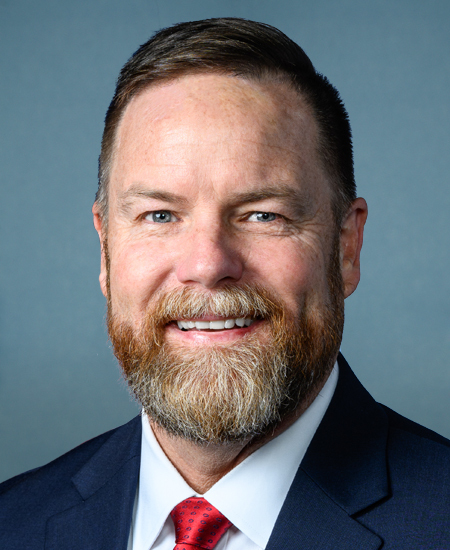
Photo of Aaron Bean
R United States House · District 4 · Florida On the 2026 ballot

Rep. Aaron Bean

Compare
Total votes
1,879
all sessions
Attendance
100%
6 missed
Higher than 96% of chamber peers
With party
92%
of cast votes
Lower than 90% of chamber peers
Bipartisan score
5%
crosses aisle rarely
Higher than 88% of chamber peers
Sponsored
461
bills & resolutions
Near the chamber average
Committees
4
assignments
461 bills and resolutions

Sponsored bills

Total
461
Primary
45
Co-sponsor
416
This page
461
matching current filters
Co-sponsor HR 9869
In committee · North Carolina House · Co-sponsor
FECA Modernization and Cost Containment Act of 2026

Maddy summaryThe FECA Modernization and Cost Containment Act of 2026 updates the Federal Employees' Compensation Act to lower costs and improve care for injured federal workers. It requires federal agencies to contract with managed care networks, which will direct employees to specific providers for medical services except in emergencies. These networks must follow standardized treatment protocols, limit fees to established schedules, and submit annual reports on cost savings and provider performance. The bill also mandates the creation of a review board to monitor compliance and authorizes the use of predictive analytics to detect fraud in claims.

In committee Jul 22, 2026 1 co-sponsor
Co-sponsor HR 9811
In committee · North Carolina House · Co-sponsor
Anti-Fraud Fund Act of 2026

Maddy summaryThe Anti-Fraud Fund Act of 2026 increases funding for the Health Care Fraud and Abuse Control Account by $7 billion annually from fiscal year 2027 through 2030. This additional money is intended to support the government's efforts in detecting and preventing fraud within the healthcare system. The bill modifies existing laws to ensure these funds are available for the specified period without altering other spending limits.

In committee Jul 21, 2026 1 co-sponsor
Co-sponsor HR 9641
In committee · North Carolina House · Co-sponsor
Essential Caregivers Act of 2026

Maddy summaryThe Essential Caregivers Act of 2026 requires nursing homes, long-term care hospitals, rehabilitation facilities, and intermediate care facilities to allow two chosen family members or friends to visit residents during times when regular visitation is suspended. These essential caregivers must agree to follow the facility's existing safety and infection control rules, which are no more restrictive than those applied to staff. While facilities can limit access for the first seven days of a suspension or deny entry if a caregiver shows symptoms of a serious infectious disease, they cannot block visits for end-of-life care. Additionally, the bill mandates that complaints about denied access to essential caregivers be investigated and resolved within three days.

In committee Jul 15, 2026 1 co-sponsor
Co-sponsor HR 7651
In committee · North Carolina House · Co-sponsor
Chloe Cole Act of 2026

Maddy summaryHR 7651, the Chloe Cole Act of 2026, prohibits healthcare providers from performing certain medical interventions on minors under 18 aimed at altering physical development to align with gender identity. These "covered interventions" include puberty blockers, hormone treatments, and specific surgeries, but exclude medically necessary care for conditions like disorders of sexual development or traumatic injuries. The bill creates a federal civil lawsuit right for affected minors or their parents against providers who perform such interventions, allowing claims for damages including emotional distress and punitive awards, with strict liability for providers after the law's enactment. It explicitly allows exceptions for legitimate medical treatments and requires providers to prove such exceptions apply if challenged.

In committee Jul 15, 2026 1 co-sponsor
Co-sponsor HR 3514
In committee · North Carolina House · Co-sponsor
Improving Seniors’ Timely Access to Care Act of 2025

Maddy summaryThis bill requires Medicare Advantage plans to implement electronic pre-approval systems for medical services by 2028 and meet transparency reporting standards starting in 2027. Plans must publicly report data on approval/denial rates, appeal outcomes, response times, and technology use for pre-approval requests, including details on how denials relate to clinical criteria. It establishes a 24-hour response timeframe for certain requests and mandates annual reviews of pre-approval requirements based on data and input from seniors and providers. The law directly affects Medicare Advantage plans, seniors enrolled in these plans, and healthcare providers who submit pre-approval requests. These changes aim to make the pre-approval process faster, more transparent, and more accountable for seniors seeking covered medical services.

In committee Jul 15, 2026 1 co-sponsor
Co-sponsor HR 1181
Passed · North Carolina House · Co-sponsor
Protecting Privacy in Purchases Act

Protecting Privacy in Purchases Act This bill prohibits payment card networks from using merchant codes that distinguish firearms retailers from general-merchandise retailers or sporting-goods retailers. The Department of Justice must enforce this bill and report annually on the resulting investigations and cases.

Passed Jul 15, 2026 1 co-sponsor
Co-sponsor HR 139
Passed · North Carolina House · Co-sponsor
Sunshine Protection Act of 2025

Maddy summaryThe Sunshine Protection Act of 2025 would make daylight saving time permanent across the United States, ending the current practice of changing clocks twice yearly. It repeals the 1966 law requiring seasonal time changes and adjusts time zone offsets to reflect permanent daylight saving time (e.g., shifting from "4 hours" to "3 hours" in historical references). States that currently opt out of daylight saving time (like Arizona and Hawaii) would retain their existing arrangements, while all other states would adopt permanent daylight saving time unless they choose to stay on standard time. This change would directly affect all U.S. residents by eliminating the need to reset clocks in spring and fall.

Passed Jul 15, 2026 1 co-sponsor
Co-sponsor HRES 1427
In committee · North Carolina House · Co-sponsor
Expressing support for the designation of July 10th as Journeyman Lineworkers Recognition Day.

Maddy summaryThis resolution expresses support for designating July 10th as Journeyman Lineworkers Recognition Day to honor the workers who maintain the nation's electrical grid. The bill specifically recognizes the dangerous conditions these employees face, such as working at heights near live power lines and responding to disasters like hurricanes and wildfires. It also commemorates Henry Miller, the first president of the International Brotherhood of Electrical Workers, who died on July 10, 1896, while performing his duties. Ultimately, the measure encourages the public to observe this day with reflection on the contributions of lineworkers.

In committee Jul 13, 2026 1 co-sponsor
Primary HR 9455
In committee · North Carolina House · Lead sponsor
SMOOTH Payments Act

Maddy summaryThe SMOOTH Payments Act modifies federal tax rules to allow health insurance plans that offer a specific payment option to qualify for subsidies, whereas currently only catastrophic plans are excluded. Under this proposal, eligible plans would let enrollees choose between paying zero cost-sharing at the time of service or paying monthly, capped amounts instead. This change directly affects individuals enrolled in qualified health plans by expanding the range of plans that can receive financial assistance starting in 2027. The bill aims to simplify out-of-pocket expenses by enabling a new payment structure similar to existing capitated models.

In committee Jun 25, 2026 0 co-sponsors
Co-sponsor HR 9422
In committee · North Carolina House · Co-sponsor
Medicaid RAC Improvement Act of 2026

Maddy summaryThe Medicaid RAC Improvement Act of 2026 strengthens oversight of the Medicaid Recovery Audit Contractor program to better detect and recover incorrect payments. It requires the Centers for Medicare and Medicaid Services to establish clear communication rules for when state program exceptions expire and mandates detailed annual reports on audit results, including amounts recovered and underpayments. The bill also expands the program to include Medicaid managed care plans, requiring these organizations to allow audits of their claims and cooperate with recovery efforts. Additionally, the legislation directs the government to study barriers preventing states from participating in the program and to run a five-year demonstration project to increase state involvement. Finally, it clarifies that audits can review payments made up to four years prior to the current fiscal year.

In committee Jun 24, 2026 1 co-sponsor
Showing 11 to 20 of 461 bills