Maddy summaryHB 821, titled "Drivers License Expiration Moratorium," establishes a temporary pause on the expiration of certain Class C driver's licenses. The bill allows these licenses to remain valid for up to two years after their expiration date, aiming to address a backlog of drivers unable to renew in person. This provision does not apply to licenses that are currently canceled, revoked, or suspended, nor to Real ID compliant licenses valid for eight years or more. The act is effective upon becoming law for licenses expiring on or after that date, and it will expire on December 31, 2027.
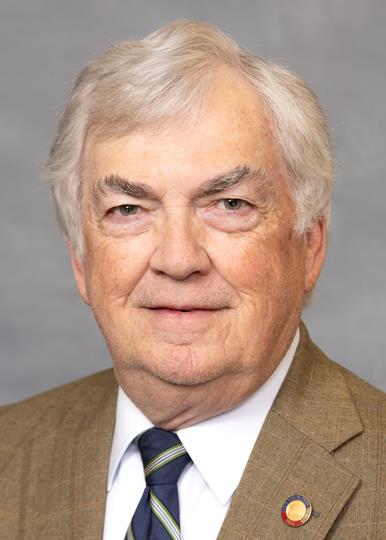
Rep. Jay Adams
Sponsored bills
Maddy summaryHB 271 alters how municipal elections are conducted in several towns and cities in Cabarrus County. The bill changes regular municipal elections in the City of Concord, Town of Harrisburg, City of Kannapolis, Town of Midland, and Town of Mount Pleasant from a nonpartisan to a partisan basis. For the City of Concord, it also specifies that only voters residing in a particular district can vote for that district's City Council member, rather than the entire city voting for all members. These changes will apply to elections held in 2025 and thereafter.
Maddy summaryHB 674, "The Firearms Liberty Act," proposes several changes to firearms regulations. It would allow for the issuance of lifetime concealed handgun permits, in addition to the current five-year permits, affecting individuals seeking to carry concealed handguns. The bill also specifies that permittees whose concealed carry permits lapse would not need to retake a firearms safety course for renewal under certain conditions. Furthermore, it aims to protect the property rights of individuals subject to domestic violence protective orders by enabling them to store or sell their firearms through qualified licensed dealers. Finally, the bill authorizes the storage and use of defensive devices in biometric safes for schools.
Maddy summaryHouse Joint Resolution 379 is an application from the State of North Carolina to the U.S. Congress. It requests that Congress call a "convention of the states" as outlined in Article V of the U.S. Constitution. The purpose of this convention would be to propose new amendments to the Constitution. These amendments would focus on imposing fiscal restraints on the federal government, limiting its power, and setting term limits for federal officials and members of Congress. This application is considered ongoing until two-thirds of the states submit similar requests.
Maddy summaryHB 870 modifies the administration of environmental programs in North Carolina, primarily focusing on agreements between state environmental agencies and the U.S. Environmental Protection Agency (USEPA). It requires the General Assembly to approve all memorandums of agreement between the Department of Environmental Quality (DEQ) and USEPA before they can be executed. The bill also directs DEQ to initiate discussions with the USEPA to revise sedimentation control agreements, aiming to streamline regulations and reduce costs for those involved in land-disturbing activities. Additionally, DEQ must request pre-publication consultation from the USEPA on proposed federal regulation changes and report on funding for federal environmental programs.
Maddy summaryHB 894 modifies the North Carolina State Building Code to allow certain licensed federal firearms dealers to be exempt from standard door lock requirements during nonbusiness hours. This exemption applies to businesses primarily selling firearms or ammunition with up to 15,000 square feet of retail space, allowing doors to remain locked from the inside when closed to the public. To qualify, businesses must pay a $500 permit fee, have an approved alarm system, provide a locking plan to employees, and post warning signs. The State Building Code Council is directed to adopt permanent rules for this exemption, with temporary provisions in effect until then.
Maddy summaryHB 765, titled "Save the American Dream Act," introduces new requirements for fiscal notes concerning housing affordability at both state and local levels. The bill mandates that the state's Fiscal Research Division prepare a five-year fiscal note for any proposed state legislation that could impact the cost of constructing, purchasing, owning, or selling a single-family residence. Similarly, it requires county and city governments to prepare a fiscal note for local ordinances that could affect these same costs. These local notes must be made public at least five days before the ordinance is introduced.
Maddy summaryHB 24, titled "Restore Down-Zoning Authority," aims to reinstate the power of local governments to initiate "down-zoning." This means local governments would regain the ability to change zoning classifications for properties to allow for less intensive development or use. The bill achieves this by repealing Section 3K.1 of S.L. 2024-57, which had previously restricted this authority. If enacted, it would apply retroactively to December 11, 2024, ensuring that any local ordinances impacted by the repealed section are restored to their status prior to that date.
Maddy summaryHB 254 designates the fourth Thursday of March each year as Tuskegee Airmen Commemoration Day in North Carolina. This officially recognizes and honors the legacy of the African-American pilots, navigators, bombardiers, instructors, and support staff who trained at Tuskegee Institute from 1941 to 1949.
Maddy summaryHB 822 modifies North Carolina laws governing moped operation, directly affecting moped operators. The bill presumes a moped is designed for one person unless manufacturer documentation indicates otherwise. It restricts mopeds to the right-hand side of the right-hand lane on highways with speed limits over 35 mph, except when preparing for a left turn. Furthermore, it prohibits operating a moped on any highway where the posted speed limit is greater than 35 miles per hour. Violations of these provisions would constitute an infraction, with the changes becoming effective on December 1, 2025.