Issue · Environment

Environment (Drinking Water)

Every environment bill, vote, and legislator stance in New York, automatically classified by Maddy, our AI policy reader.

Total bills
68
2025 Regular Session
Top supporter
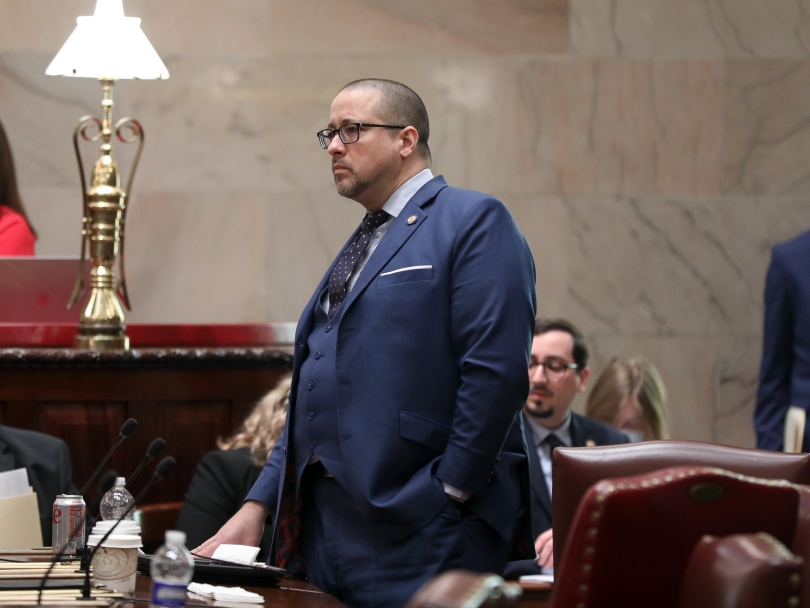
Gustavo Rivera
100% support rate
Top opponent
Dan Stec
0% support rate
Ranked legislators
10
5 support · 5 oppose
Key legislators

Who's moving drinking water in New York

Legislators moving drinking water in New York
Legislator Party Stance Support rate Votes
Gustavo Rivera
Gustavo Rivera Senate · District 33
D
Strong +
100% 7
Kristen Gonzalez
Kristen Gonzalez Senate · District 59
D
Strong +
100% 7
Michelle Hinchey
Michelle Hinchey Senate · District 41
D
Strong +
100% 7
Andrew Gounardes
Andrew Gounardes Senate · District 26
D
Strong +
100% 6
Brian Kavanagh
Brian Kavanagh Senate · District 27
D
Strong +
100% 6
Dan Stec
Dan Stec Senate · District 45
R
Strong −
0% 6
Mark Walczyk
Mark Walczyk Senate · District 49
R
Strong −
0% 6
Peter Oberacker
Peter Oberacker Senate · District 51
R
Strong −
0% 6
Steve Chan
Steve Chan Senate · District 17
R
Strong −
0% 5
Joe Griffo
Joe Griffo Senate · District 53
R
Strong −
17% 6
Showing 61–68 of 68 bills

All environment bills

in committee · New York · Senate Dec 1, 2025

S 4533: Relates to the water resources planning council

This bill expands New York's Water Resources Planning Council from 15 to 17 voting members, requiring the governor to appoint two members with water science expertise, two with environmental science/engineering expertise, and one with environmental justice expertise (selected from public interest groups). The council must now make recommendations on statewide water management, ensure environmental justice considerations in water decisions, review relevant state/federal laws, and develop a comprehensive water strategy by 2028. It directly affects state agencies (like environmental conservation and health departments), local water systems, and communities managing water resources, with new reporting requirements for deficiencies and financing constraints. The changes aim to improve coordination, equity, and sustainability in water planning across the state.
in committee · New York · Assembly Jan 7, 2026

A 4373: Relates to regulation of PFAS as a toxic air pollutant

Relates to regulation of PFAS as a toxic air pollutant; requires the department to ensure certain process operations use appropriate control technology for PFAS emissions; establishes a fence line monitoring program to monitor PFAS emissions in disadvantaged communities, to provide public reports, and related duties.
Sub-Topics Drinking Water
in committee · New York · Assembly Feb 3, 2026

A 3091: Relates to environmental restoration projects; repealer

This bill modifies New York's environmental conservation law to clarify funding and definitions for cleanup projects. It requires that environmental restoration projects (starting in 2025-2026) be funded within available state appropriations and adds detailed definitions for terms like "contaminant" (including PFAS substances) and "municipality." Key provisions allow municipalities to use settlements from responsible parties to cover their share of project costs without triggering state fund recalculations, and prioritize projects in disadvantaged communities or brownfield areas. It also mandates that remediation standards meet existing public health and environmental protections, while providing state indemnification for municipalities that follow cleanup agreements.
in committee · New York · Senate Jan 7, 2026

S 3205: Prohibits the sale or offer for sale of any cosmetic product or personal care product containing PFAS substances

This bill bans the sale or offer for sale of cosmetic and personal care products containing intentionally added PFAS substances, effective June 1, 2026. It directly affects manufacturers, retailers, and sellers of these products within the state. The law defines PFAS as fluorinated chemicals with at least one fully fluorinated carbon atom and specifically targets ingredients intentionally added to products. The prohibition covers all such products, including items like makeup, lotions, and hair care products. This is a direct regulatory change to product safety standards, not a procedural measure.
Sub-Topics Drinking Water
passed · New York · Senate Feb 10, 2026

S 672: Relates to environmental restoration projects; repealer

Bill S 672 updates the environmental conservation law regarding environmental restoration projects, primarily affecting municipalities and entities involved in remediating contaminated sites. It allows for project funding starting in fiscal year 2025-2026 and expands the definition of "contaminant" to include emerging contaminants and PFAS substances. The bill modifies how responsible party settlement payments are applied to project costs and adds new criteria for prioritizing projects, such as those in disadvantaged communities or addressing drinking water contamination. Additionally, it broadens state indemnification for municipalities, successors, lessees, and lenders involved in these remediation efforts.
in committee · New York · Senate Jan 7, 2026

S 3253: Relates to certain mined land-plans

S 3253 requires mining operations on Long Island to maintain a minimum 10-foot buffer of undisturbed ground between active mining areas and the existing water table in counties with populations over one million that rely on aquifers for drinking water. The bill amends New York's environmental conservation law to mandate this buffer as part of all new or renewed mining plans in designated areas. This directly affects mining companies seeking permits in Long Island counties like Nassau and Suffolk, which depend on aquifers for public water supplies. The key provision ensures mining plans explicitly include this buffer to minimize potential groundwater contamination from mining activities.
passed · New York · Senate Mar 25, 2026

S 7677: Permits the town of Warwick to use preservation funds for water quality improvement

This bill allows the town of Warwick to use up to 10% of its existing community preservation fund for water quality improvement projects, such as cleaning rivers or protecting drinking water sources. Previously, these funds could only be used for preserving community character (e.g., land conservation). The change explicitly adds water quality projects to the fund's permitted uses while maintaining the 10% spending limit. It does not create new funding but reallocates existing resources for environmental protection.
in committee · New York · Senate Jan 7, 2026

S 1493: Relates to regulation of PFAS as a toxic air pollutant

Relates to regulation of PFAS as a toxic air pollutant; requires the department to ensure certain process operations use appropriate control technology for PFAS emissions; establishes a fence line monitoring program to monitor PFAS emissions in disadvantaged communities, to provide public reports, and related duties.
Sub-Topics Drinking Water
Showing 61 to 68 of 68 bills
Previous 1 5 6 7