This resolution designates the week of February 22-February 26, 2021, as Public Schools Week.
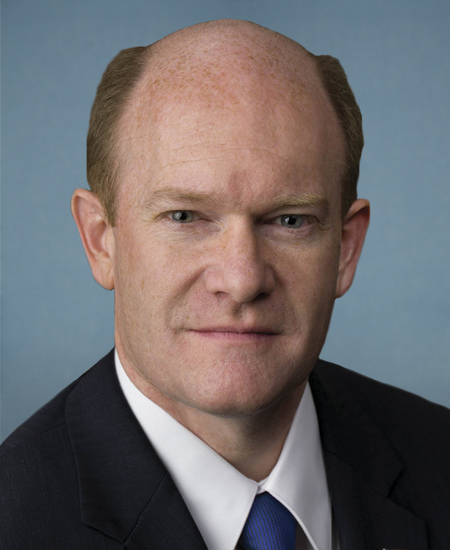
Sen. Christopher A. Coons
Sponsored bills
Stop Tip-overs of Unstable, Risky Dressers on Youth Act or the STURDY Act This bill requires the Consumer Product Safety Commission to revise the safety standards for freestanding clothing storage units such as dressers, bureaus, or chests of drawers. Such standards must include specified testing related to tip overs and new warning requirements for all such products entering the U.S. market.
Partnering Aspiring Teachers with High-need Schools to Tutor Act of 2021 or the PATHS to Tutor Act of 2021 This bill expands access to tutoring in hard-to-staff and high-need schools by establishing a grant program and providing certain incentives to teachers. Specifically, the bill directs the Department of Education (ED) to award competitive grants to local consortia to carry out tutoring programs. Local consortia refers to partnerships between teacher preparation programs, local educational agencies or individual schools, and community-based organizations. Grant recipients may use these funds for certain activities, including matching and placing tutors, purchasing instructional materials and connectivity resources, and providing transportation and meals to students who attend the tutoring program. Further, ED must enter into an interagency agreement with the Corporation for National and Community Service to include tutor positions as approved national service positions. Finally, the bill allows tutoring to count toward service requirements for the Teacher Education Assistance for College and Higher Education grant program.
Democracy Restoration Act of 2021 This bill addresses the voting rights of individuals convicted of a criminal offense and the restoration of their voting rights. First, the bill declares that the right of a U.S. citizen to vote in any election for federal office shall not be denied or abridged because that individual has been convicted of a criminal offense unless, at the time of the election, such individual is serving a felony sentence. Further, the bill provides for enforcement of, and remedies for violations of, the bill. In addition, it sets forth requirements for state and federal notification of individuals of the restoration of their voting rights. Finally, the bill prohibits federal funding of construction or improvement of a place of incarceration unless U.S. citizens incarcerated in that jurisdiction are notified, upon release, of their voting rights.
Hospitality and Commerce Job Recovery Act of 2021 This bill extends existing and establishes new tax credits that assist the hospitality and restaurant industry. Specifically, it allows a conventionand trade show restart tax credit; extends the employee retention tax credit through 2021; suspends for taxable years 2021 through 2022, the limitation on entertainment expenses related to a trade or business, allows a restaurant and dining restart credit for businesses closed or forced to reduce services due to COVID-19 (i.e., coronavirus disease 2019); allows a 50% tax credit for travel expenditures; and allows a tax credit for unmerchantable inventory for the period between December 31, 2019, and before April 1, 2021.
This resolution recognizes Black History Month as an opportunity to reflect on U.S. history and to commemorate the contributions of African Americans. It calls for the United States to (1) honor the contribution of pioneers who helped to ensure its legacy; and (2) move forward as a nation "indivisible, with liberty and justice for all."
International Human Rights Defense Act of 2021 This bill establishes in the Department of State a permanent Special Envoy for the Human Rights of LGBTQI (lesbian, gay, bisexual, transgender, queer, or intersex) Peoples who shall serve as the principal State Department advisor regarding human rights for LGBTQI people and represent the United States in diplomatic matters relevant to the human rights of LGBTQI people. The special envoy shall periodically provide Congress with a U.S. global strategy to prevent and respond to criminalization, discrimination, and violence against LGBTQI people. The State Department and the U.S. Agency for International Development may provide assistance to prevent and respond to such activities against LGBTQI people. The bill also requires that annual country reports on human rights practices include information on criminalization, discrimination, and violence based on sexual orientation and gender identity.
Libya Stabilization Act This bill provides for sanctions and aid related to the conflict in Libya. The bill provides statutory authority for an April 19, 2016, executive order imposing property- and visa-blocking sanctions on persons contributing to the violence in Libya. The President must impose property- and visa-blocking sanctions on any foreign person that (1) knowingly supports or engages in a significant transaction with a foreign person knowingly operating in Libya on behalf of Russia in a military capacity, (2) engages in significant actions threatening peace or stability in Libya, (3) misappropriates Libyan state assets or natural resources, or (4) is knowingly responsible for or complicit in serious human rights abuses in Libya. These sanctions shall expire on December 31, 2026. The bill authorizes the U.S. Agency for International Development to provide humanitarian assistance to individuals and communities in Libya, including health assistance, food, shelter, and support for an effective COVID-19 (i.e., coronavirus disease 2019) response. The Department of State must work to strengthen Libya's democratic governance, including by providing assistance to (1) unify Libya's financial and governing institutions, and (2) ensure free and credible future elections in Libya. The Department of the Treasury must vote and argue for international financial institutions to support an economic recovery in Libya that complements the establishment of democratic institutions and rule of law.
Apprenticeship Hubs Across America Act of 2021 This bill requires the Department of Labor to implement a program to award grants to workforce intermediaries (certain national, regional, state, or local entities that facilitate the establishment of registered apprenticeship programs) to enable them to engage a variety of stakeholders to support, develop, and implement registered apprenticeship programs.
Next Generation Entrepreneurship Corps Act This bill establishes the Next Generation Entrepreneurship Corps Program to promote entrepreneurship in the most distressed regions of the United States, including those regions affected by COVID-19 (i.e., coronavirus disease 2019), by awarding participating fellows a two-year stipend to start and grow a new small business. Fellows will receive (1) a $120,000, two-year stipend for living and basic startup expenses; (2) health care; and (3) interest-free federal student loan deferral for two years. Further, fellows shall receive mentorship from the Service Corps of Retired Executives and be matched with a full range of lenders, investors, and insurers. The bill also establishes a fund in the Department of the Treasury from which the SBA may provide loans for qualified investors to support a small business owned and operated under the program by a fellow.