This resolution honors the life and legacy of Henry Louis Aaron for his accomplishments on and off the baseball field and for defying racism and breaking down racial barriers in the fight for equality.
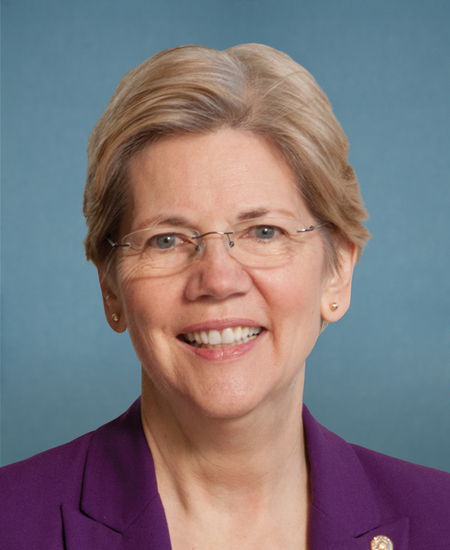
Sen. Elizabeth Warren
Sponsored bills
Medical Bankruptcy Fairness Act of 2021 This bill allows medically distressed debtors to exempt certain property from their estates in bankruptcy, which allows them to retain ownership of such property. Specifically, a medically distressed debtor may exempt up to $250,000 of the debtor's interest in (1) specified real or personal property that the debtor or debtor's dependent uses as a residence, or (2) a burial plot for the debtor or debtor's dependent. The bill also waives certain administrative and procedural requirements for a medically distressed debtor. Additionally, the bill allows a medically distressed debtor to discharge in bankruptcy debts for certain education loans. A debtor who seeks relief as a medically distressed debtor must attest in writing that the debtor's medical expenses are genuine and were not incurred to bring the debtor within the meaning of a medically distressed debtor under this bill.
CARES Windfall for the Wealthiest Repeal Act This bill restores and makes permanent the limitation on excess businesses losses of noncorporate taxpayers. It also allows taxpayers a carryback of their net operating losses arising in 2019 and 2020.
Inaugural Committee Transparency Act of 2021 This bill requires the presidential inaugural committee to disclose to the Federal Election Commission, by 90 days after the presidential inaugural ceremony, any disbursement made in an amount equal to or greater than $200 and the purpose of each disbursement. The committee must also disclose the name and address of the person to whom the disbursement was made, the date of the disbursement, and the total amount and purpose of the disbursement. The bill prohibits (1) an inaugural committee from soliciting or receiving a donation from a foreign national, in addition to the current ban on a committee accepting such a donation; (2) a person from making a donation to an inaugural committee in the name of another; (3) a foreign national from making a donation or making a promise to make a donation to such a committee; or (4) converting a donation to an inaugural committee to personal use. The committee must disburse any remaining donated funds not later than 90 days after the inaugural ceremony to tax-exempt charitable organizations, but may request an extension of such 90-day period.
Coronavirus Unemployment Benefits Tax Relief Act This bill excludes from gross income, for income tax purposes, up to $10,200 of unemployment compensation received by an individual in a taxable year beginning in 2020.
COVID HCBS Relief Act of 2021 This bill temporarily increases the applicable Federal Medical Assistance Percentage (i.e., federal matching rate) under Medicaid for certain approved home- and community-based services that are provided between October 1, 2020, and September 30, 2022. As a condition for receiving the increased rate, a state must agree to undertake activities to improve the delivery of such services during and after the public health emergency relating to COVID-19 (i.e., coronavirus disease 2019), such as by providing additional benefits to home health workers and by helping individuals who were relocated to nursing facilities during the emergency move back to their homes.
Anti-Racism in Public Health Act of 2021 This bill establishes within the Centers for Disease Control and Prevention (CDC) a National Center on Antiracism and Health and a law enforcement violence prevention program. Among other activities, the new center must declare racism a public health crisis, collect and analyze data, and administer research and grant programs to address racism and its impact on health and well-being. Additionally, the bill specifically directs the CDC's National Center for Injury Prevention and Control, in coordination with the Department of Justice and other relevant stakeholders, to carry out the law enforcement violence prevention program by conducting research and supporting other activities pertaining to law enforcement violence and public health.
Stop Subsidizing Multimillion Dollar Corporate Bonuses Act This bill extends the $1 million limit on the deductibility of executive compensation to all employees of publicly traded corporations.
End Taxpayer Subsidies for Drug Ads Act This bill prohibits a tax deduction for expenses relating to direct-to-consumer advertising of prescription drugs. Direct-to-consumer advertising is any dissemination, by or on behalf of a sponsor of a prescription drug product, of an advertisement that is in regard to the drug product and primarily targeted to the general public.
Public Health Emergency Privacy Act This bill imposes privacy, confidentiality, and security requirements on the use and disclosure of COVID-19 (i.e., coronavirus disease 2019) emergency health data. This is data that is linked to an individual or device, such as test results. The requirements apply to organizations that collect, use, or disclose emergency health data electronically or that manage websites or applications for contact tracing and other COVID-19 response activities. These organizations must provide notice of privacy and other policies. They must also ensure the accuracy of, prevent discrimination based on, and limit disclosure of the data. If an organization collects data from at least 100,000 individuals, it must publicly report additional information about how it uses and discloses the data. Furthermore, the bill prohibits the use of emergency health data for commercial advertising or in ways that restrict access to opportunities, services, and other accommodations. It also prohibits government entities and organizations from using this data to infringe on the right to vote. The Department of Health and Human Services must report on the civil rights impact of the collection, use, and disclosure of health data. The bill provides for enforcement by the Federal Trade Commission, states, and a private right of action. It further specifies that certain dispute resolution mechanisms, such as arbitration, are unenforceable with respect to disputes arising under the bill.