Federal Adjustment of Income Rates Act or the FAIR Act This bill modifies pay rates for federal employees in 2022. Specifically, the bill increases rates under the statutory pay systems and for prevailing rate employees by 2.2%, and increases locality pay by 1%.
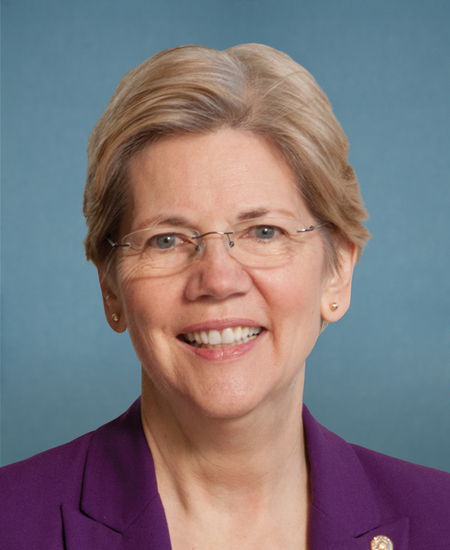
Sen. Elizabeth Warren
Sponsored bills
Protecting Domestic Violence and Stalking Victims Act of 2021 This bill establishes new federal firearms restrictions for individuals who are convicted of misdemeanor stalking offenses. The bill expands the categories of persons who are prohibited from receiving, possessing, shipping, or transporting a firearm or ammunition. Specifically, it adds a new category of prohibited persons: persons convicted of a misdemeanor crime of stalking. The term misdemeanor crime of stalking means a misdemeanor stalking offense under federal, state, tribal, or municipal law and a course of harassment, intimidation, or surveillance of another person that (1) places such person in reasonable fear of harm to themselves, an immediate family member, a household member, or a spouse or intimate partner (including a current or former dating partner); or (2) causes emotional distress to such person. The bill also specifically prohibits dating partners who are convicted of a misdemeanor crime of domestic violence or who are subject to certain restraining orders from receiving, possessing, shipping, or transporting a firearm or ammunition. Currently, such restrictions generally only apply to spouses, co-parents, and cohabitants.
Shareholder Protection Act of 2021 This bill requires shareholder authorization of certain political expenditures by a publicly traded company. A violation of this requirement is considered a breach of fiduciary duty, and the officers and directors who authorized the expenditure are subject to joint and several liability. A publicly traded company must require a board vote with respect to political expenditures in excess of $50,000 and, within 48 hours, make publicly available the individual votes of each board member.
Butch Lewis Emergency Pension Plan Relief Act of 2021 This bill modifies the funding rules and provides financial assistance for certain pension plans that are underfunded or insolvent. First, the bill expands the authority of, and provides funding for, the Pension Benefit Guaranty Corporation (PBGC) to provide special partition assistance to a multiemployer pension plan that is insolvent or at risk of insolvency. The bill expands eligibility for partition assistance, provides funding for a plan to reach a projected funded ratio of 80% over a 30-year period, and does not require a plan to repay such assistance. The bill further permits a multiemployer pension plan to elect to retain its funding zone status from the previous year for either (1) the first plan year beginning during the period from March 1, 2020, through February 28, 2021; or (2) the next succeeding plan year, as designated by the plan sponsor. A plan may also extend by five years the funding improvement or rehabilitation period if the plan is designated as in endangered or critical status for a plan year beginning in 2020 or 2021. A plan in critical and declining status may not suspend payment of plan benefits. Additionally, the bill adjusts the minimum funding standards for a multiemployer pension plan to account for investment losses and other losses related to the COVID-19 pandemic and modifies the PBGC guarantee formula to increase the maximum potential benefits under a multiemployer pension plan.
Background Check Expansion Act This bill establishes new background check requirements for firearm transfers between private parties (i.e., unlicensed individuals). Specifically, it prohibits a firearm transfer between private parties unless a licensed gun dealer, manufacturer, or importer first takes possession of the firearm to conduct a background check. The prohibition does not apply to certain firearm transfers, such as a gift between spouses in good faith.
This resolution expresses the sense of the Senate that it is the duty of the federal government to expand and strengthen the care economy. The care economy consists of child care, home health, and similar sectors where caregiving is a predominant feature of the work.
This bill requires the Joint Committee on the Library to obtain, and the Architect of the Capitol to permanently install in the U.S. Capitol or on the U.S. Capitol Grounds, a monument honoring Associate Justice of the Supreme Court Ruth Bader Ginsburg.
Ultra-Millionaire Tax Act of 2021 This bill imposes a tax on the net value of all taxable assets of the taxpayer on the last day of any calendar year (wealth tax). The amount of such tax shall be equal to the sum of 2% of the amount of taxpayer assets exceeding $50 million but not in excess of $1 billion, plus the applicable percentage (3% or 6% if certain legislation is in effect) of the net value of such taxable assets exceeding $1 billion. There is no tax on the net value of taxable assets not in excess of $50 million. The bill defines net value of all taxable assets as the value of all property of the taxpayer, real or personal, tangible or intangible, wherever situated reduced by any debts (including secured debts) owed by the taxpayer. The definition excludes property with a value of $50,000 or less, tangible personal property, certain property used in a trade or business, and collectibles. The Internal Revenue Service (IRS) must audit annually not less than 30% of taxpayers required to pay the tax imposed by this bill. The bill provides funding to the IRS for FY2022-FY2032 for enforcement of the requirements of this bill, taxpayer services, and for business system modernization.
Student Loan Tax Relief Act This bill modifies tax provisions allowing an exclusion from gross income for income arising from discharges of student loan debt after January 31, 2020. This includes loans for postsecondary educational expenses, private education loans, and loans made by tax-exempt educational organizations. The bill eliminates the temporary expiration date for the exclusion and the death or total and permanent disability requirement for a discharge.
Mental Health Justice Act of 2021 This bill creates a grant program for states and local governments to train and dispatch mental health professionals to respond, instead of law enforcement officers, to emergencies that involve people with behavioral health needs. The Substance Abuse and Mental Health Services Administration (SAMHSA) must manage the program in consultation with the Department of Justice (DOJ). SAMHSA may cancel grants that increase incarceration or institutionalization. Grantees must use funds for purposes including de-escalation and anti-racism training. The Department of Health and Human Services and the DOJ must evaluate this program.