

Improving Minority Participation And Careers in Telecommunications Act or the IMPACT Act This bill establishes a grant program to assist certain institutions of higher education with setting up a program that prepares minority students to participate in the telecommunications workforce. Specifically, the bill requires the National Telecommunications and Information Administration, acting through the Office of Minority Broadband Initiatives, to establish the Telecommunications Workforce Training Grant Program. This grant program shall provide funds to historically Black colleges or universities, tribal colleges or universities, or minority-serving institutions to facilitate the creation of programs that (1) educate and train students to participate in the telecommunications workforce, and (2) include both a curriculum and apprenticeship or internship opportunities.
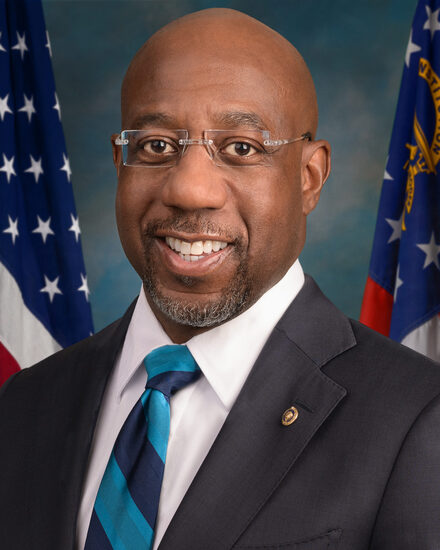
Sen. Raphael G. Warnock
Sponsored bills
Kira Johnson Act This bill establishes grants to improve maternal health outcomes for racial and ethnic minority groups and other underserved populations. Specifically, the Department of Health and Human Services must award grants for community-based programs to improve maternal health outcomes for Black pregnant and postpartum individuals, as well as individuals in other underserved groups; training for health care providers and others who work in maternity care settings on reducing and preventing racism, bias, and discrimination; and respectful maternity care compliance programs in specified health care facilities. The National Academies of Sciences, Engineering, and Medicine must study issues related to the training programs, and the Government Accountability Office must study issues related to the compliance programs.
This resolution condemns and denounces all forms of anti-Asian sentiment, including those related to COVID-19 (i.e., coronavirus disease 2019), and calls on federal law enforcement officials, working with state and local agencies, to take specified steps. The resolution calls on federal officials to expeditiously investigate and document all credible reports of hate crimes, harassment, bullying, and threats against the Asian American and Pacific Islander communities; the Attorney General to work with state and local agencies and Asian American and Pacific Islander community-based organizations to prevent discrimination and to expand culturally competent and linguistically appropriate education campaigns on public reporting of hate crimes; and the Department of Health and Human Services to issue guidance describing best practices to mitigate racially discriminatory language in describing the pandemic. The resolution recommits the United States to serving as a model for the world in building a more inclusive, diverse, and tolerant society by (1) prioritizing language access and inclusivity in communication practices, and (2) combating misinformation and discrimination that puts Asian Americans and Pacific Islanders at risk.
Voter Empowerment Act of 2021 This bill expands voter registration and voting access. Specifically, the bill expands voter registration by requiring states to (1) make available online voter registration, (2) establish automatic voter registration systems, (3) permit same-day voter registration, and (4) accept voter registration applications from individuals under age 18. Further, the bill limits removing voters from voter rolls and prohibits interference with voter registration or voting. Next, the bill requires states to allow individuals with disabilities to use absentee registration procedures and to vote by absentee ballot in federal elections. The bill also prohibits voter caging (the practice of sending mail to addresses on voter rolls, compiling a list of the undeliverable mail, and using the list to remove registered voters from voter rolls). Next, the bill expands voting access by requiring states to allow early voting and voting by mail without additional conditions. It also requires states to provide secured drop boxes at which individuals may drop off their completed absentee ballots. In addition, the bill declares that the right of a U.S. citizen to vote in any federal election shall not be denied or abridged because that individual has been convicted of a criminal offense unless, at the time of the election, such individual is serving a felony sentence. Finally, the bill permanently reauthorizes the Election Assistance Commission (EAC). It also directs the EAC to make grants to states for specified activities, including to implement automatic voter registration systems.
Integrity, Notification, and Fairness in Online Retail Marketplaces for Consumers Act or the INFORM Consumers Act This bill requires online marketplaces to collect, verify, and disclose certain information from high-volume, third-party sellers. High-volume, third-party sellers include online marketplace participants that conduct 200 or more transactions resulting in total revenues of $5,000 or more during a continuous 12-month period. Online marketplaces must acquire these sellers' (1) bank account numbers, (2) government-issued identification, (3) tax identification numbers, and (4) contact information. Online marketplaces must verify this information and annually certify any changes to it. Further, online marketplaces must make certain information (e.g., sellers' names and contact information) available to consumers through the sellers' product listings and provide consumers with methods to report electronically and by telephone any suspicious activity on the marketplace. The bill provides the Federal Trade Commission with the authority to enforce these requirements.
Recycling Enhancements to Collection and Yield through Consumer Learning and Education Act of 2021 or the RECYCLE Act This bill provides support for recycling programs. Specifically, the bill requires the Environmental Protection Agency (EPA) to establish a program to award grants to improve the effectiveness of residential and community recycling programs through public education and outreach. In addition, the EPA must develop a model recycling program toolkit for states, Native American tribes, and local governments. Finally, the bill specifies that the EPA's review of its federal procurement guidelines for purchasing certain recycled materials and items made with such materials must occur at least once every five years.
Creating a Respectful and Open World for Natural Hair Act of 2021 or the CROWN Act of 2021 This bill prohibits discrimination based on a person's hair texture or hairstyle if that style or texture is commonly associated with a particular race or national origin. Specifically, the bill prohibits this type of discrimination against those participating in federally assisted programs, housing programs, public accommodations, and employment. Persons shall not be deprived of equal rights under the law and shall not be subjected to prohibited practices based on their hair texture or style. The bill provides for enforcement procedures under the applicable laws.
Mental Health Access Improvement Act of 2021 This bill provides for coverage of marriage and family therapist services and mental health counselor services under Medicare. It also excludes such services from the skilled nursing facility prospective payment system, and authorizes marriage and family therapists and mental health counselors to develop discharge plans for post-hospital services.
Student Loan Tax Elimination Act This bill eliminates the origination fee on federal student loans. Origination fees are the fees lenders charge for processing new loan applications.
Personal Health Investment Today Act of 2021 or the PHIT Act of 2021 This bill allows a medical care tax deduction for up to $1,000 ($2,000 for a joint return or a head of household) of qualified sports and fitness expenses per year. The bill defines qualified sports and fitness expenses as amounts paid exclusively for participating in a physical activity, including (1) fitness facility memberships, (2) physical exercise or activity programs, or (3) equipment for a physical exercise or activity program.