

Veterans' Assuring Critical Care Expansions to Support Servicemembers (ACCESS) Act of 2025 This bill addresses the administration of the Veterans Community Care Program (VCCP) and other Department of Veterans Affairs (VA) health care matters. Among other provisions regarding the VCCP, the bill establishes in statute access standards that determine when a veteran is eligible to receive non-VA care through the VCCP, requires the VA to notify veterans regarding their eligibility for care within two business days after the VA is aware the veteran is seeking care, and extends the deadline for the submittal of claims under the VCCP by health care entities and providers. The VA must address its mental health treatment programs by establishing a standardized screening process to determine whether a veteran satisfies criteria for priority or routine admission to a mental health residential rehabilitation treatment program or a program for residential care for mental health and substance abuse disorders, tracking the performance of medical facilities and Veterans Integrated Service Networks in meeting the requirements for mental health treatment screenings and timely admission to treatment programs under such screenings, and establishing an appeal process for when a veteran is denied admission to a covered treatment program or is accepted into a program but not offered bed placement in a timely manner. Additionally, the VA must establish an online self-service module for veterans to request and manage appointments, track referrals, and appeal and track decisions related to requests for care.
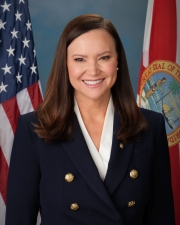
Sen. Ashley Moody
Sponsored bills
Maddy summaryThis resolution commends the Florida Panthers for winning the 2025 Stanley Cup Final and congratulates their fans. It directs the Senate to send a copy of the resolution to the team's ownership (including Vincent Viola), management (Matthew Caldwell), and hockey operations leadership (Bill Zito). The resolution is purely ceremonial and does not create any legal obligations or policy changes. It specifically recognizes the team's playoff victories and individual player awards from the 2024-2025 NHL season.
Maddy summaryThis bill amends federal law to include rioting as a form of "racketeering activity" under the Racketeer Influenced and Corrupt Organizations (RICO) Act. It does so by adding a reference to section 2101 (which defines rioting as a federal crime) into the existing list of racketeering activities. This change would allow federal prosecutors to pursue RICO charges against individuals or groups who engage in rioting as part of a larger pattern of organized criminal conduct. The bill directly affects those whose rioting activities are linked to organized criminal enterprises, potentially subjecting them to enhanced penalties under RICO.
Maddy summaryThis bill mandates the FDA to study how microplastics in food and water affect human health, specifically examining exposure pathways and impacts on children’s health, the endocrine system, cancer, chronic illness, and reproductive health. The study must identify major exposure routes and assess health effects across these areas. Within one year of the bill’s enactment, the FDA must submit a report to Congress detailing its findings and recommending potential legislative or administrative actions. The bill focuses solely on gathering scientific data to inform future decisions, without imposing new regulations or directly affecting specific groups.
Maddy summaryThis bill creates a new federal tax deduction for qualified flood insurance premiums paid by homeowners. It directly affects individuals who own property in flood-prone areas and pay for flood insurance through either the National Flood Insurance Program (NFIP) or private policies meeting specific criteria. The deduction is limited to taxpayers with adjusted gross income under $200,000 ($400,000 for joint filers), and covers premiums for NFIP policies, private flood insurance, Federal Policy Fees, and certain surcharges. The change applies to taxable years beginning after the bill's enactment date.
Halt All Lethal Trafficking of Fentanyl Act or the HALT Fentanyl Act This act permanently places fentanyl-related substances as a class into schedule I of the Controlled Substances Act. A schedule I controlled substance is a drug, substance, or chemical that has a high potential for abuse; has no currently accepted medical value; and is subject to regulatory controls and administrative, civil, and criminal penalties under the Controlled Substances Act. Under the act, offenses involving fentanyl-related substances are triggered by the same quantity thresholds and subject to the same penalties as offenses involving fentanyl analogues (e.g., offenses involving 100 grams or more trigger a 10-year mandatory minimum prison term). Additionally, the act establishes a new, alternative registration process for certain schedule I research. The act also makes several other changes to registration requirements for conducting research with controlled substances, including permitting a single registration for related research sites in certain circumstances, waiving the requirement for a new inspection in certain situations, and allowing a registered researcher to perform certain manufacturing activities with small quantities of a substance without obtaining a manufacturing registration. Finally, the act expresses the sense that Congress agrees with the interpretation of the Controlled Substances Act in United States v. McCray , a 2018 case decided by the U.S. District Court for the Western District of New York. In that case, the court held that butyryl fentanyl, a controlled substance, can be considered an analogue of fentanyl even though, under the Controlled Substances Act, the term controlled substance analogue specifically excludes a controlled substance.
Maddy summaryThis bill creates a new federal crime for assaulting first responders (like police, firefighters, and paramedics) causing serious injury or death, with enhanced penalties. It specifically applies when the assault involves interstate travel, weapons that crossed state lines, or interference with the responder's work affecting commerce. Penalties include up to 10 years in prison for serious injury, or life imprisonment if death occurs, kidnapping, or an attempt to kill happens. Federal prosecution requires Attorney General certification unless states decline jurisdiction or fail to adequately address the crime.
Maddy summaryThis bill amends the Anti-Terrorism Act of 1987 to prohibit U.S. operations by the Muslim Brotherhood and its branches, defining it as a terrorist organization. It imposes mandatory visa ineligibility and visa revocation for foreign individuals identified as Muslim Brotherhood members, including those affiliated with groups like Hamas. The bill requires the Secretary of State to annually report to Congress identifying global Muslim Brotherhood branches and determine if they meet criteria for foreign terrorist organization designation under existing law. If designated, the President must impose sanctions, including foreign terrorist organization status and asset-blocking under Executive Order 13224, with sanctions remaining in place for at least four years for any identified branch.
Maddy summaryThe PRICE Act (S 2269) increases penalties for assaulting, resisting, or impeding U.S. Immigration and Customs Enforcement (ICE) officers or employees. It would double the maximum prison sentence and adjust the fine for such offenses when committed against ICE personnel, as specified in amended federal law (18 U.S.C. § 111). This bill directly affects individuals convicted of violent or obstructive acts against ICE officers, making their penalties more severe than for similar crimes against other federal officers. The key provision modifies existing penalties without changing the definition of the offense or creating new requirements for ICE operations.
Maddy summaryThis bill authorizes the minting of commemorative coins for the 2028 Los Angeles Olympic and Paralympic Games and the 2034 Salt Lake City Olympic and Paralympic Winter Games. It specifies four coin types ($5 gold, $1 silver, half-dollar, and proof silver $1) with defined quantities and designs reflecting U.S. athletic participation. A surcharge on each coin sale (e.g., $35 for $5 coins) funds the respective Olympic committees' legacy programs, including youth sports initiatives. The coins are legal tender but intended solely for commemoration, with surcharges directed to the organizing committees after covering minting costs.