Maddy summaryThe Problem Solvers MAPS Act requires states to draw congressional districts that are contiguous, compact in shape, and nearly equal in population. It prohibits mapmakers from creating boundaries intended to advantage or disadvantage specific candidates, incumbents, or political parties. Additionally, the law mandates that state officials consider preserving existing political subdivisions like counties, cities, and tribal land boundaries when establishing new districts. These rules apply to any congressional district created on or after the date the act is signed into law.
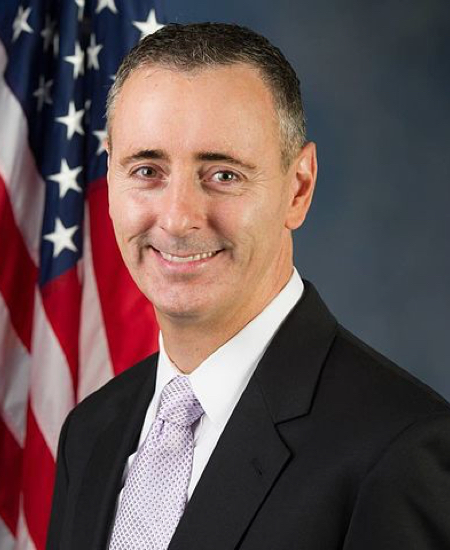
Rep. Brian K. Fitzpatrick
Sponsored bills
Maddy summaryThe Problem Solvers TRUST Act would prohibit states from changing their U.S. House of Representatives district maps during the ten-year period following a census, unless a court orders new lines to comply with federal or state constitutional requirements. If such a court order is issued, the state must make changes that result in the smallest possible alteration to the existing map. The bill also sets a one-year deadline for filing legal challenges against a redistricting plan after it becomes law. These rules would apply to congressional redistricting occurring after the November 2032 federal elections and would not affect how states draw districts for local or state offices.
Maddy summaryThe Quiet Skies Act directs the Secretary of Transportation to create new regulations banning voice calls on cell phones in the United States. This rule must be finalized within 180 days of the law's enactment and will apply to all air travelers. The bill aims to reduce noise on airplanes by prohibiting passengers from making or receiving phone calls while in flight.
Maddy summaryThis bill, titled the Renewing the African American Civil Rights Network Act, extends federal funding for the African American Civil Rights Network by three years. The legislation directly affects the network's operations by amending the United States Code to change the authorization period from seven years to ten years. By updating this timeline, the bill ensures continued financial support for the organization's mission to promote civil rights and historical preservation. No new programs or policy changes are introduced; the measure solely focuses on renewing the existing funding authorization.
Maddy summaryThe Pray Safe Act of 2025 establishes a federal Clearinghouse within the Department of Homeland Security to provide houses of worship, faith-based organizations, and nonprofit groups at risk of threats with evidence-based safety resources. The Clearinghouse will publish online best practices for security planning, facility safety, and incident response, while listing existing federal and state grant programs to help these organizations implement these measures. It requires annual updates based on user feedback and includes a centralized resource section for contacts like Protective Security Advisors and Fusion Centers. The program expires four years after enactment and does not create new funding but coordinates existing federal and state safety resources.
Maddy summaryThe Local Communities & Bird Habitat Stewardship Act of 2025 establishes the Urban Bird Treaty Program, which provides grants and technical assistance to local groups - including cities, nonprofits, community organizations, and academic institutions - to protect and restore urban bird habitats. Key provisions include funding for habitat restoration (e.g., removing invasive species and planting native plants), reducing urban bird hazards, and engaging communities in monitoring and education. The program, administered by the National Fish and Wildlife Foundation, authorizes $1 million annually from 2026 to 2032 for projects focused on conserving urban bird populations through collaborative local efforts. It directly affects communities seeking to enhance green spaces and support bird conservation in populated areas.
Maddy summaryThis bill amends NOAA's policies to improve prevention and response to sexual harassment and assault for NOAA personnel and "covered personnel," including fisheries observers, protected species observers, and endangered species observers working with NOAA. Key provisions require annual reports on harassment and assault cases, establish new restricted reporting options that maintain victim anonymity, and mandate vessel operators to report incidents to the Coast Guard with specific details. The bill updates definitions to clarify who is covered, creates mechanisms for confidential reporting without automatically triggering investigations, and includes protections for victim privacy. It also requires summaries of cases reported to the Coast Guard and updates policies for handling restricted reports.
Maddy summaryThe Stronger Engagement for Indian Health Needs Act of 2025 redesignates the head of the Indian Health Service from "Director" to "Assistant Secretary for Indian Health" within the Department of Health and Human Services. It updates all federal laws, regulations, and documents that previously referenced the "Director" to now refer to the "Assistant Secretary." The bill also authorizes the Assistant Secretary to appoint a Deputy Assistant Secretary and adjusts the position's pay grade in the federal pay system. This is an administrative reorganization that does not change funding, program responsibilities, or healthcare services for Native American communities.
National Law Enforcement Officers Remembrance, Support and Community Outreach Act. [ sic ] This bill temporarily directs the Department of the Interior to award a grant to the National Law Enforcement Officers Memorial Fund for the expenses associated with operating and enhancing the community outreach, public education, and officer safety and wellness programs of the National Law Enforcement Museum.
Maddy summaryThis House resolution formally recognizes suicide as a serious public health problem in the United States and expresses support for designating September 2026 as National Suicide Prevention Month and September 10, 2026, as World Suicide Prevention Day. The bill cites data from the CDC, SAMHSA, and the VA to highlight that suicide is a leading cause of death among young people, veterans, and during the postpartum period, while also noting the significant economic costs associated with it. It declares suicide prevention a national priority and emphasizes that mental health is as important as physical health. The resolution supports the development of strategies to improve access to quality mental health, substance abuse, and suicide prevention services for all communities.