Issue · Labor & Employment

Labor & Employment

Every labor & employment bill, vote, and legislator stance in Montana, automatically classified by Maddy, our AI policy reader.

Total bills
173
2025 Regular Session
Top supporter
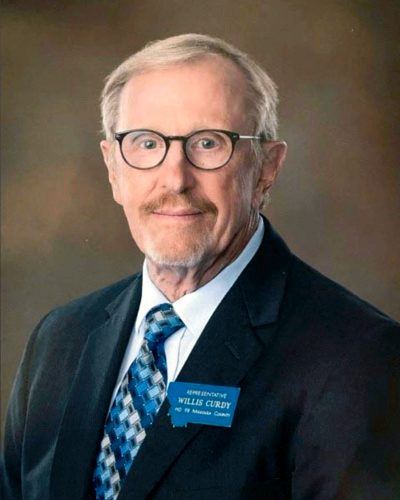
Willis Curdy
92% support rate
Top opponent
Caleb Hinkle
13% support rate
Ranked legislators
10
5 support · 5 oppose
Key legislators

Who's moving labor & employment in Montana

Legislators moving labor & employment in Montana
Legislator Party Stance Support rate Votes
Willis Curdy
Willis Curdy Senate · District 49
D
Strong +
92% 290
Pat Flowers
Pat Flowers Senate · District 31
D
Strong +
92% 288
Sara Novak
Sara Novak Senate · District 36
D
Strong +
92% 291
Dave Fern
Dave Fern Senate · District 2
D
Strong +
92% 285
Gayle Lammers
Gayle Lammers Senate · District 21
R
Strong +
91% 291
Caleb Hinkle
Caleb Hinkle House · District 68
R
Strong −
13% 261
Tom Millett
Tom Millett House · District 2
R
Strong −
17% 258
Kathy Love
Kathy Love House · District 85
R
Strong −
19% 251
Carl Glimm
Carl Glimm Senate · District 3
R
Oppose
21% 307
Jedediah Hinkle
Jedediah Hinkle House · District 67
R
Oppose
22% 255
Showing 161–170 of 173 bills

All labor & employment bills

signed · Montana · House May 5, 2025

HB 656: Revising the fund structure and use of employment security account

HB 656 revises the use of the state's Employment Security Account and transfers the Office of Community Service. The bill amends state law to allow funds from the Employment Security Account to be used for administering the Office of Community Service and for enforcing state and federal anti-discrimination laws. Additionally, it moves the Office of Community Service from the Governor's office to the Department of Labor and Industry.
died · Montana · House May 20, 2025

HB 297: Establish requirement for paid sick days

HB 297, known as the "Healthy Families and Workplaces Act," aimed to establish a requirement for paid sick leave for employees. It would have required employers with 10 or more employees to provide at least one hour of paid sick leave for every 40 hours worked, with an annual usage cap of 80 hours. Employees could carry over up to 40 unused hours to the following year. The bill also defined authorized uses for paid sick leave, protected employees from retaliation, and authorized the Department of Labor and Industry to enforce its provisions. Employers with existing paid leave policies that met or exceeded these requirements would have been exempt.
signed · Montana · House May 13, 2025

HB 823: Revise laws relating to the state plan committee

HB 823 revises the State Plan Committee, which oversees career and technical education in Montana. It expands the committee by adding three new members appointed by the Commissioner of Labor and Industry, representing the state workforce innovation board, business, and labor communities. The bill also coordinates the committee's meetings with the Montana State Workforce Innovation Board and requires its state plan to align with the federal Workforce Innovation and Opportunity Act combined state plan.
Sub-Topics Public Employees
died · Montana · Senate May 23, 2025

SB 291: Revising laws related to workers' compensation definition of wages

SB 291 amends Montana's workers' compensation law to require the Department of Labor and Industry to annually update its rules defining the value of lodging provided to employees as part of their compensation. The bill specifically changes Section 39-71-123 to mandate that lodging values must be adjusted yearly based on geographic housing costs and other reasonable factors. This affects workers in occupations where housing is part of their wages, such as agricultural or hospitality roles, ensuring the value used for calculating workers' compensation benefits reflects current local housing markets. The change focuses on the administrative process for valuing lodging, not on altering who qualifies for workers' compensation coverage.
signed · Montana · House May 5, 2025

HB 428: Revising provisions related to workers compensation

HB 428 revises workers' compensation laws, primarily by clarifying the definition of "employer" for various entities and their workers. The bill specifies who is considered an employer for temporary workers, motor carriers, certain religious organizations, and fiscal agents making payments on behalf of workers. It also requires employers and insurers to annually submit reports detailing paid losses to help fund workers' compensation administration. Additionally, the legislation modifies the frequency of summary reports submitted by insurers and revises provisions related to medical status forms.
died · Montana · Senate May 23, 2025

SB 94: Generally revise public sector unions law

SB 94 prohibits Montana public employers from using public funds or resources for labor organization activities, directly affecting public sector workers like teachers and school staff. It bans contributions of public money to unions or paid leave for union work, but allows unpaid time off for such activities and permits using accrued personal leave under specific conditions. The bill requires unions to cover costs for paid leave used in union activities through annual invoices to public employers and mandates reporting on time spent on union-related work. These changes aim to limit public funding for union operations while establishing clear administrative procedures.
signed · Montana · House May 19, 2025

HB 667: Revise labor laws relating to employers and public service

HB 667 revises labor laws regarding employees who seek or hold public office. It prohibits employers from restricting employees from seeking election or appointment to city, county, or state public office, or from retaliating against them for doing so. During an employee's mandatory leave of absence for public service, employers cannot require the employee to use personal leave or benefits without their consent, nor can they require them to perform work. If an employer generally permits personal use of company devices, they cannot prohibit an employee on public service leave from using those devices for personal reasons.
signed · Montana · House Apr 17, 2025

HB 128: Protect volunteer emergency service providers from termination

HB 128 protects volunteer emergency service providers, such as firefighters and EMTs, from being terminated by their public or private employers. It prohibits employers from firing an employee solely for serving as a volunteer emergency provider, provided the employee notifies their employer of their volunteer status. If an employee is absent or late to work due to volunteer emergency service, they must notify their employer as soon as possible, and employers may request documentation of the emergency response. The bill clarifies that employees cannot claim regular pay for time spent on volunteer duties, and employers retain the right to determine if an employee can leave work to respond to an emergency. Employees whose employment is terminated in violation of these provisions may bring a civil action for remedies like reinstatement and back wages.
died · Montana · House May 20, 2025

HB 319: Prohibiting employer requirements for employees to attend controversial social vision training

HB 319 aimed to prohibit employers from requiring employees to attend training sessions related to "controversial social vision." The bill defined "controversial social vision" as any agenda, concept, or theory not broadly accepted in society or that generates strong opposition from mainstream political, religious, or social groups. Additionally, it sought to amend election law to prevent an elector's employer, an agent of the employer, or a union officer from being designated as an agent for a disabled elector.
died · Montana · House May 20, 2025

HB 484: Revise minimum wage laws to provide increases

HB 484 proposed to increase the state's minimum hourly wage from $6.15 to $12.06, affecting many hourly workers and their employers. The bill maintained the existing mechanism for annual cost-of-living adjustments to the minimum wage. It also retained a lower minimum wage of $4 per hour for businesses with annual gross sales of $110,000 or less. If enacted, these provisions would have become effective on July 1, 2025.
Showing 161 to 170 of 173 bills