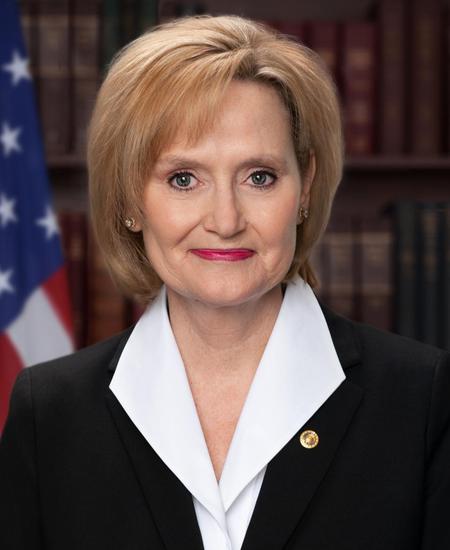
This resolution supports the designation of 2026 as the International Year of the Woman Farmer and recognizes the critical role of women in agriculture. The resolution also encourages citizens to celebrate the impact these women have on the food systems and agricultural workforce of the United States by encouraging and empowering women to pursue careers in agriculture and cultivate leadership opportunities.
Sen. Cindy Hyde-Smith
Sponsored bills
Safeguard American Voter Eligibility Act or the SAVE America Act This bill requires individuals to provide documentary proof of U.S. citizenship when registering to vote, and requires photo identification to vote, in federal elections. Specifically, the bill prohibits states from accepting and processing an application to register to vote in a federal election unless the applicant presents documentary proof of U.S. citizenship. The bill specifies what documents are considered acceptable proof of U.S. citizenship, such as identification that complies with the REAL ID Act of 2005 that indicates U.S. citizenship. Further, the bill (1) prohibits states from registering an individual to vote in a federal election unless, at the time the individual applies to register to vote, the individual provides documentary proof of U.S. citizenship; and (2) requires states to establish an alternative process to demonstrate U.S. citizenship. Each state must take affirmative steps on an ongoing basis to ensure that only U.S. citizens are registered to vote, which shall include establishing a program to identify individuals who are not U.S. citizens using information supplied by certain sources. Additionally, states must remove noncitizens from their official lists of eligible voters. The bill (1) provides for a private right of action for certain violations, and (2) establishes criminal penalties for certain offenses. Individuals voting in federal elections must present an eligible photo identification document. An individual who votes by absentee ballot must submit a copy of their identification document with both the request for, and the submission of, the absentee ballot.
Maddy summaryS 3712, the "BO's Act," requires the U.S. Department of Health and Human Services to study home cardiorespiratory monitors used for infants, particularly high-risk babies, to assess their effectiveness in preventing sudden unexpected infant death. The bill mandates a report to Congress within one year of enactment, detailing monitor accuracy, new home sleep care models, insurance coverage criteria, and recommendations on whether these devices should be covered by public or private health plans. This legislation directly affects infants (especially high-risk cases), healthcare providers, and insurance companies by initiating a federal review of current practices. The bill does not create new laws or funding but establishes a data-gathering process to inform future policy decisions about infant monitoring devices.
Maddy summaryThis resolution designates the week of January 25-31, 2026, as "National School Choice Week" to recognize educational options for K-12 students. It encourages parents to learn about school choices and urges the public to host events raising awareness about diverse education environments, including public schools, charter schools, private schools, and homeschooling. The resolution has no policy or funding impact - it is a ceremonial designation acknowledging existing annual events celebrating educational choice.
Maddy summaryThe SAVE Moms and Babies Act of 2026 prohibits the FDA from approving new abortion drugs or granting investigational exemptions for them. It requires existing approved abortion drugs to be dispensed only in-person by certified healthcare providers in clinics or hospitals (not pharmacies), mandates providers to verify pregnancy duration and handle complications, and enforces strict adverse event reporting to the FDA. The bill directly affects healthcare providers prescribing abortion drugs, patients seeking these medications, and the FDA’s regulatory authority over such drugs. Key provisions include banning use after 70 days gestation, requiring provider certification for specific medical capabilities, and mandating documentation of risks to patients.
Maddy summaryS 3627, the Pregnant Students’ Rights Act, requires colleges and universities participating in federal student aid programs to provide clear information about pregnancy-related resources and accommodations to all enrolled students. The bill mandates annual email notifications, inclusion in student handbooks and orientations, and availability at health centers and websites, detailing campus/community resources, available accommodations, and how to file Title IX complaints. It specifically covers students planning to or currently pregnant who wish to carry a baby to term. The law focuses solely on disseminating existing information and does not create new rights or accommodations. (Bill text amended under Section 485 of the Higher Education Act.)
Maddy summarySRES 585 is a commemorative resolution honoring Ben Nighthorse Campbell, a former U.S. Senator from Colorado and the first Native American to chair the Senate Committee on Indian Affairs. It recognizes his military service, Olympic judo career, legislative work (including authoring the National Museum of the American Indian Act), and advocacy for tribal communities. The resolution has no policy impact - it formally expresses the Senate’s respect for his legacy, requests transmission to his family, and directs a moment of silence. It directly affects Campbell’s legacy and family, not any current policy or population. (Note: This is a procedural resolution, not a bill with legislative provisions.)
Maddy summaryThis bill extends the timeframe for funding middle-mile broadband infrastructure projects in rural areas under the Rural Electrification Act. It amends Section 602(g) by changing the period from 2018-2023 to 2026-2031, allowing rural communities more time to access and deploy this critical internet backbone infrastructure. Middle-mile infrastructure connects local networks to the broader internet, directly benefiting rural residents and businesses lacking reliable high-speed internet access. The change is a simple extension of an existing program's timeline without creating new funding or requirements.
Maddy summaryThis bill modifies tax rules for bonds used to fund agricultural and manufacturing facilities. It expands what counts as a "manufacturing facility" to include production of intangible property (like software) and related on-site facilities, while raising the dollar limit for qualified small issue bonds from $10 million to $30 million (with annual inflation adjustments). It also increases the annual bond limit for first-time farmers from $450,000 to $1 million and changes how farmland size is measured for eligibility. The changes apply to bonds issued after the bill's enactment date for manufacturing and after December 31, 2025, for farm-related bonds. These adjustments primarily affect agricultural businesses and manufacturers seeking tax-exempt financing for facility projects.
Maddy summaryThis bill amends the National School Lunch Program to allow schools participating in the program to serve whole milk as an option to students, in addition to reduced-fat and fat-free milk. It permits schools to offer whole milk (organic or non-organic), reduced-fat, low-fat, and fat-free milk, as well as lactose-free milk and nutritionally equivalent nondairy beverages that meet specific nutritional standards. The bill clarifies that milk fat in whole milk should not be counted as saturated fat for compliance with meal nutrition standards. Additionally, it requires schools to include food allergy information in training for food service personnel. These changes directly affect schools participating in the National School Lunch Program and the students who eat school meals.