Issue · Labor & Employment

Labor & Employment (Unemployment)

Every labor & employment bill, vote, and legislator stance in Minnesota, automatically classified by Maddy, our AI policy reader.

Total bills
29
2025-2026 Regular Session
Top supporter
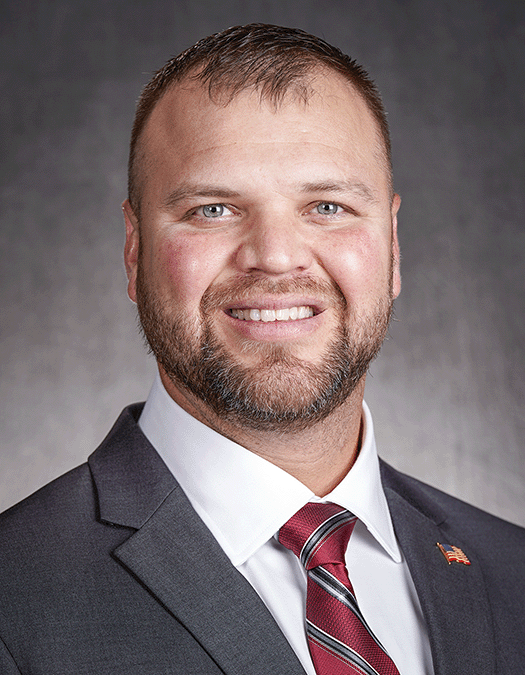
Andrew Myers
100% support rate
Top opponent
Aisha Gomez
0% support rate
Ranked legislators
10
5 support · 5 oppose
Key legislators

Who's moving unemployment in Minnesota

Legislators moving unemployment in Minnesota
Legislator Party Stance Support rate Decisive votes
Andrew Myers
Andrew Myers House · District 45A
R
Strong +
100% 4
Ben Bakeberg
Ben Bakeberg House · District 54B
R
Strong +
100% 4
Ben Davis
Ben Davis House · District 6A
R
Strong +
100% 4
Bernie Perryman
Bernie Perryman House · District 14A
R
Strong +
100% 4
Bidal Duran
Bidal Duran House · District 2A
R
Strong +
100% 4
Aisha Gomez
Aisha Gomez House · District 62A
D
Strong −
0% 4
Amanda Hemmingsen-Jaeger
Amanda Hemmingsen-Jaeger Senate · District 47
D
Strong −
0% 4
Andy Smith
Andy Smith House · District 25B
D
Strong −
0% 4
Anquam Mahamoud
Anquam Mahamoud House · District 62B
D
Strong −
0% 4
Athena Hollins
Athena Hollins House · District 66B
D
Strong −
0% 4
Showing 1–10 of 29 bills

All labor & employment bills

in committee · Minnesota · House Apr 9, 2026

HF 4889: Higher education; wage credit use clarification provided.

This bill clarifies how wage credits from jobs at colleges and universities can be used for unemployment benefits during breaks between academic terms. It primarily affects employees of educational institutions by specifying when they are eligible to receive unemployment support while waiting for the next school year. The law establishes that workers in instructional, research, or administrative roles must have a written job offer or a contract guaranteeing 50% pay if rehiring fails to qualify for benefits, whereas those in other roles may still receive credits if they have a reasonable assurance of returning work. Additionally, the measure defines what counts as a valid job offer and ensures that employment across multiple schools is counted together when determining eligibility. These rules take effect on July 1, 2026, and apply to unemployment claims made on or after that date.
Sub-Topics Unemployment
in committee · Minnesota · Senate Mar 4, 2026

SF 4134: Additional benefits adoption for certain iron ore mining employees

This bill creates a new unemployment benefits program for iron ore mining workers in Minnesota who lose their jobs between January 15, 2026, and March 15, 2026, due to layoffs. It also extends these benefits to employees of explosive manufacturing companies that supply iron ore mining firms if those mining companies experience significant layoffs. To qualify, workers must have worked for an iron ore mining employer that laid off at least half its workforce during the specified period, have already used up their regular unemployment benefits, and meet standard eligibility requirements. The program provides the same weekly benefit amount as regular unemployment insurance for up to 26 weeks, with special rules for workers who qualify for new benefit accounts during the payment period.
Sub-Topics Unemployment
in committee · Minnesota · House May 17, 2026

HF 3393: Additional benefits for certain iron ore mining employees adopted.

HF 3393 creates supplemental unemployment benefits for workers in the iron ore mining industry and related explosive manufacturing firms that supply them. It provides additional benefits to employees laid off between January 15 and March 15, 2026, due to a 50%+ workforce reduction at their employer. Eligible workers must have exhausted regular unemployment benefits and meet standard eligibility requirements, receiving up to 26 weeks of supplemental payments matching their regular weekly benefit amount. The bill applies retroactively to January 15, 2026, and excludes those receiving federal Trade Readjustment Allowance benefits.
Sub-Topics Unemployment
in committee · Minnesota · Senate Feb 13, 2025

SF 1357: Compensatory Revenue Task Force establishment, Read Act implementation professional development requirements modifications, teacher training funding provision, unemployment aid account increase provision, and appropriations

This bill modifies Minnesota's education finance system and teacher training requirements. It mandates that school districts provide evidence-based professional development to teachers by specific deadlines: K-3 educators and reading intervention staff by July 2026, and grades 4-12 reading teachers by July 2027. The bill also updates how schools calculate compensatory revenue eligibility using direct certification and education benefits, requires at least 80% of compensatory funds to be spent at the school building where students generating the revenue are served, and increases funding for teacher training and school unemployment aid accounts. These changes directly affect school districts, teachers, and students in Minnesota's public education system.
in committee · Minnesota · Senate Mar 6, 2025

SF 2188: Additional school unemployment aid appropriation

SF 2188 appropriates $105 million from the general fund to the Minnesota Department of Education for school unemployment aid under Minnesota Statutes §124D.995, specifically for the 2026 fiscal year. This is a one-time funding allocation, not a new program, and must comply with existing requirements in §124D.995. The bill directly affects school districts and employees eligible for unemployment aid through the state's established program. It does not create new eligibility criteria or alter current benefit structures.
in committee · Minnesota · Senate Apr 2, 2025

SF 3216: Sulfate water quality standards site-specific modifications approval during pendency of related rulemaking provision, reactive mine waste storage provision, and additional unemployment insurance benefits provision

This bill creates targeted unemployment benefits for workers laid off from the iron ore mining industry or related explosive manufacturing during March 15-June 15, 2025, due to significant workforce reductions (50%+ layoffs). Eligible workers must have exhausted regular unemployment benefits and meet standard eligibility requirements, receiving up to 26 weeks of additional benefits at their prior weekly rate. The bill also establishes standards for storing reactive mine waste to prevent water quality impacts, defining "reactive mine waste" as material causing sustained pH decreases in contact water. It is effective retroactively from March 15, 2025.
in committee · Minnesota · House Feb 24, 2025

HF 1415: Funding increased for the school unemployment aid account in the special revenue fund, and money appropriated.

HF 1415 increases funding for Minnesota's school unemployment aid program, which provides financial support to hourly school employees who face unemployment between academic terms. The bill appropriates specific additional funds from the general fund to the Department of Education for fiscal years 2026 and 2027. This directly affects hourly school workers, such as those in maintenance or summer programs, who qualify for unemployment aid under existing rules. The change simply adds more money to an existing account without altering eligibility or program structure.
Sub-Topics Unemployment
in committee · Minnesota · Senate Mar 13, 2025

SF 2557: Funding increase for the school unemployment aid account in the special revenue fund

SF 2557 increases funding for the school unemployment aid account, which provides financial support to hourly school staff who lose summer employment. The bill appropriates specific funds from the general fund to the Department of Education for fiscal years 2026 and 2027, directly affecting school employees who work seasonal summer terms. This is a funding mechanism, not a new policy, and it aligns with existing provisions under Minnesota Statutes, section 124D.995. The bill does not change eligibility or benefit amounts but ensures dedicated funding for this existing program.
Sub-Topics Unemployment
in committee · Minnesota · House Mar 20, 2025

HF 2210: Additional school unemployment aid funding provided, and money appropriated.

HF 2210 allocates $105 million from the general fund to the Minnesota Department of Education for school unemployment aid under existing law (Minnesota Statutes § 124D.995). This one-time funding directly supports school districts and employees eligible for unemployment benefits during school-related layoffs. The bill provides no new policy changes but ensures existing unemployment aid programs receive additional financial resources for the 2026 fiscal year.
Sub-Topics Unemployment
in committee · Minnesota · House Apr 7, 2025

HF 2728: Child care great start compensation support payments modified.

HF 2728 modifies Minnesota's Great Start Compensation Support Payments for child care programs. It changes how payments are calculated by basing them on full-time equivalent staff caring for children, with one full-time equivalent defined as 32 hours weekly. The bill adds a 10% payment increase for programs receiving child care assistance under specific statutes or located in designated "child care access equity areas" (defined as regions with low child care access, high poverty, unemployment, low homeownership, and low median income). These changes apply directly to licensed child care programs serving young children.
Sub-Topics Unemployment
Showing 1 to 10 of 29 bills
1 2 3 Next