Issue · Labor & Employment

Labor & Employment (Unemployment)

Every labor & employment bill, vote, and legislator stance in Minnesota, automatically classified by Maddy, our AI policy reader.

Total bills
29
2025-2026 Regular Session
Top supporter
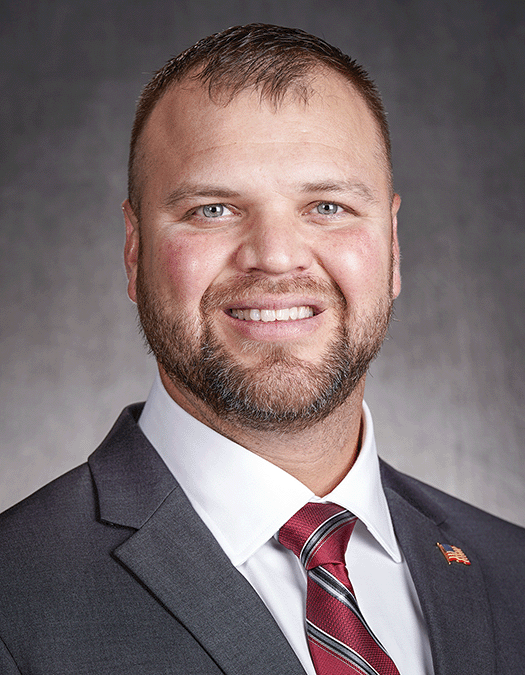
Andrew Myers
100% support rate
Top opponent
Aisha Gomez
0% support rate
Ranked legislators
10
5 support · 5 oppose
Key legislators

Who's moving unemployment in Minnesota

Legislators moving unemployment in Minnesota
Legislator Party Stance Support rate Decisive votes
Andrew Myers
Andrew Myers House · District 45A
R
Strong +
100% 4
Ben Bakeberg
Ben Bakeberg House · District 54B
R
Strong +
100% 4
Ben Davis
Ben Davis House · District 6A
R
Strong +
100% 4
Bernie Perryman
Bernie Perryman House · District 14A
R
Strong +
100% 4
Bidal Duran
Bidal Duran House · District 2A
R
Strong +
100% 4
Aisha Gomez
Aisha Gomez House · District 62A
D
Strong −
0% 4
Amanda Hemmingsen-Jaeger
Amanda Hemmingsen-Jaeger Senate · District 47
D
Strong −
0% 4
Andy Smith
Andy Smith House · District 25B
D
Strong −
0% 4
Anquam Mahamoud
Anquam Mahamoud House · District 62B
D
Strong −
0% 4
Athena Hollins
Athena Hollins House · District 66B
D
Strong −
0% 4
Showing 21–29 of 29 bills

All labor & employment bills

in committee · Minnesota · Senate Feb 10, 2025

SF 1148: Labor dispute applicants eligibility under certain conditions provisions modifications

This bill modifies Minnesota's unemployment insurance rules for workers involved in labor disputes. It changes the eligibility timeline: workers participating in a dispute lose benefits until the dispute ends, while non-participants lose benefits until the dispute begins. Exceptions include cases where workers quit due to safety violations, lockouts, or being discharged before a dispute starts. The bill directly affects Minnesota workers who stop working because of workplace labor conflicts. It does not change the core definition of "labor dispute" but clarifies eligibility periods and adds specific exemptions.
Sub-Topics Unemployment
in committee · Minnesota · Senate Apr 2, 2025

SF 3231: Additional benefits adoption for certain iron ore mining employees

This bill creates a temporary program providing additional unemployment benefits to workers laid off from iron ore mining jobs or related explosive manufacturing due to significant layoffs (50%+ workforce reduction) between March 15 and June 16, 2025. Eligible workers receive benefits equal to their regular unemployment amount for up to 26 weeks, retroactive to March 15, 2025, through June 19, 2026. To qualify, workers must have exhausted regular benefits from a previous job in the affected industry and meet standard unemployment requirements. The program excludes those already receiving federal Trade Readjustment Allowance benefits.
Sub-Topics Unemployment
in committee · Minnesota · Senate Mar 10, 2025

SF 2361: Employer misrepresentation and misconduct penalties increasement provision

This bill increases penalties for Minnesota employers who misrepresent information to the unemployment system. It amends statutes to set penalties at the greater of $500 or 100% of the financial harm caused - such as overpaid benefits, unpaid benefits, or unpaid employer contributions - instead of fixed amounts. Employers who collude with applicants to fraudulently obtain benefits face similar scaled penalties. Additional penalties of up to $10,000 may apply per employee misclassified as an independent contractor instead of an employee. The bill directly affects employers who commit fraud or fail to properly classify workers under Minnesota's unemployment and labor rules.
in committee · Minnesota · Senate Mar 3, 2025

SF 2053: Direct support services rate calculations report requirement provision

Minnesota Senate File 2053 (SF 2053) requires the state Commissioner of Human Services to submit a report by March 15, 2027, detailing cost calculations for proposed wage and benefit increases in collective bargaining agreements between the state and direct support service providers. The report must estimate reimbursement rates, including costs for wage floor increases, paid time off adjustments, holiday pay, benefits, and related tax impacts (like FICA and unemployment taxes) for all providers. It mandates that the commissioner assume all providers would receive full rate increases equal to proposed changes, without assuming any cost absorption by employers. This bill directly affects human services providers in covered programs and the state’s budgeting process for implementing future agreements.
in committee · Minnesota · House Mar 24, 2025

HF 107: Unemployment insurance eligibility modified under certain conditions for applicants involved in a labor dispute.

HF 107 modifies Minnesota's unemployment insurance rules for workers involved in labor disputes. It specifies that workers participating in or directly affected by a labor dispute can receive benefits until the end of the week the dispute was active, while those not involved are eligible until the dispute began. The bill clarifies that certain situations - like employer safety violations, lockouts, or being fired before a dispute starts - do not make applicants ineligible. This directly affects workers who stop working due to labor conflicts, ensuring they maintain eligibility under defined conditions. The changes amend Minnesota Statutes section 268.085, subdivision 13b.
Sub-Topics Unemployment
in committee · Minnesota · Senate Apr 2, 2025

SF 3212: Additional unemployment insurance benefits provision

This bill creates temporary additional unemployment benefits for workers laid off after May 19, 2025, due to job losses in the iron ore mining industry or from companies supplying goods/services to that industry. Eligible workers must have exhausted their regular unemployment benefits from a mining-related job and meet standard eligibility requirements. The program provides up to 26 weeks of additional payments at the same weekly rate as their regular unemployment benefits. These benefits are funded from Minnesota's unemployment trust fund and do not affect employer tax rates for most employers (except mining employers). The program ends May 30, 2026.
Sub-Topics Unemployment
in committee · Minnesota · House Mar 10, 2025

HF 2146: Annual reports from partnership entities of the Intergovernmental Misclassification Enforcement and Education Partnership required, and money appropriated.

HF 2146 requires partnership entities in Minnesota's Intergovernmental Misclassification Enforcement and Education Partnership to submit annual reports starting March 1, 2026, detailing estimates of misclassified workers, costs to workers, impacts on fair competitors, and industry-specific misclassification rates. These reports must also include analyses from state departments on how misclassification affects unemployment insurance, family medical benefits, income tax collection, and workers' compensation programs. The bill appropriates general fund money for fiscal years 2026-2027 to the Departments of Labor, Revenue, Employment, Commerce, and the Attorney General specifically for analyzing misclassification fraud impacts. It directly affects partnership entities and state agencies responsible for labor enforcement and program oversight.
in committee · Minnesota · House Mar 11, 2025

HF 2145: Employer misrepresentation and misconduct penalties increased.

HF 2145 increases penalties for Minnesota employers who commit specific misconduct related to unemployment benefits. It amends statutes to set penalties at the greater of $500 or 100% of the financial harm caused - such as overpaid benefits, unpaid benefits, or unpaid employer taxes - when employers make false statements, fail to disclose material facts, or collude with applicants to fraudulently obtain benefits. Employers who misclassify employees as independent contractors (instead of employees) face an additional $10,000 penalty per misclassified worker. The bill directly affects employers who engage in these violations, making penalties stricter and more directly tied to the financial impact of their actions.
in committee · Minnesota · Senate Apr 1, 2025

SF 2360: Biennial misclassification fraud impact report requirement and appropriation

SF 2360 requires partnership businesses in Minnesota to annually report on worker misclassification (where employees are incorrectly classified as independent contractors) starting March 1, 2026. The reports must include estimates of affected workers, financial costs to those workers, impacts on fair competition, and industry-specific misclassification rates. The bill also appropriates general fund money for fiscal years 2026-2027 to fund analysis by state agencies (Labor, Revenue, Employment & Economic Development, Commerce, and the Attorney General) on how misclassification affects programs like unemployment insurance, workers' compensation, and tax collections. This data will help guide enforcement priorities and assess fiscal impacts without changing existing labor laws.
Showing 21 to 29 of 29 bills