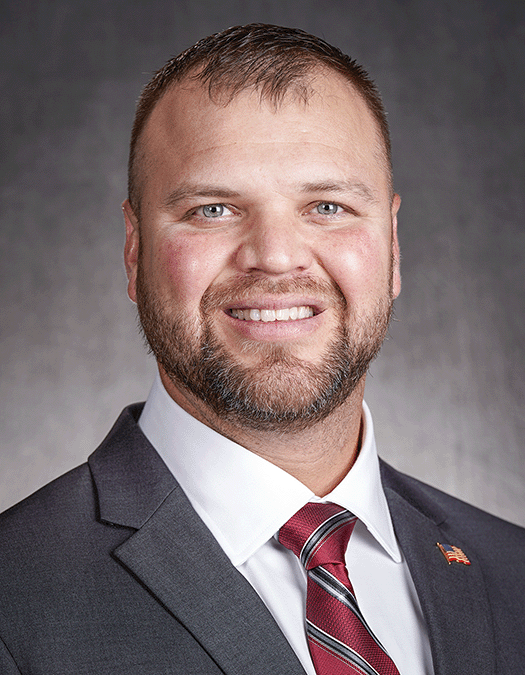
SF 2557 increases funding for the school unemployment aid account, which provides financial support to hourly school staff who lose summer employment. The bill appropriates specific funds from the general fund to the Department of Education for fiscal years 2026 and 2027, directly affecting school employees who work seasonal summer terms. This is a funding mechanism, not a new policy, and it aligns with existing provisions under Minnesota Statutes, section 124D.995. The bill does not change eligibility or benefit amounts but ensures dedicated funding for this existing program.
HF 2210 allocates $105 million from the general fund to the Minnesota Department of Education for school unemployment aid under existing law (Minnesota Statutes § 124D.995). This one-time funding directly supports school districts and employees eligible for unemployment benefits during school-related layoffs. The bill provides no new policy changes but ensures existing unemployment aid programs receive additional financial resources for the 2026 fiscal year.
HF 2728 modifies Minnesota's Great Start Compensation Support Payments for child care programs. It changes how payments are calculated by basing them on full-time equivalent staff caring for children, with one full-time equivalent defined as 32 hours weekly. The bill adds a 10% payment increase for programs receiving child care assistance under specific statutes or located in designated "child care access equity areas" (defined as regions with low child care access, high poverty, unemployment, low homeownership, and low median income). These changes apply directly to licensed child care programs serving young children.
This bill amends Minnesota Statutes section 268.085, subdivision 13b, to clarify unemployment insurance eligibility for workers involved in labor disputes. It specifies that workers participating in a labor dispute remain eligible for benefits until the end of the calendar week the dispute was active, while non-participating workers remain eligible until the dispute began. The bill also adds exceptions where eligibility is maintained, such as when workers stop working due to employer safety violations, lockouts, or being discharged before a dispute started. These changes directly affect Minnesota workers who stop working due to labor disputes, ensuring clearer eligibility rules during such events.
HF 3108 provides additional unemployment benefits to workers laid off from the iron ore mining industry or supporting businesses (like suppliers) due to lack of work after May 19, 2025. To qualify, workers must have exhausted regular unemployment benefits, have 50%+ wage credits from qualifying employers, and meet standard eligibility requirements. The bill offers up to 26 weeks of benefits at the same weekly rate as regular unemployment benefits, ending May 30, 2026. These benefits are funded from Minnesota’s unemployment trust fund and do not affect future employer tax rates, except for mining employers themselves.
HF 3023 creates additional unemployment benefits for iron ore mining workers laid off due to reduced operations between March 15 and June 16, 2025. It provides up to 26 weeks of benefits at the same weekly rate as their regular unemployment benefits, available only after workers exhaust their standard unemployment benefits. Eligibility requires being laid off by an employer in the iron ore mining industry that cut 50%+ of its workforce during the specified period, or by an explosive manufacturer serving that industry. The benefits are retroactive to March 15, 2025, and do not apply to those receiving federal Trade Readjustment Allowance.
HF 3030 provides additional unemployment benefits for workers laid off in the iron ore mining industry (or supporting industries) due to a 50% or greater workforce reduction between March 15 and June 15, 2025, with benefits capped at 26 weeks. Eligibility requires exhausting regular unemployment benefits from qualifying employers and meeting standard eligibility rules. The bill also establishes new requirements for the safe storage of reactive mine waste (defined as waste causing a sustained pH drop of 0.5+ in water) to prevent environmental harm. A procedural provision allows temporary sulfate water quality standard modifications during pending rulemaking, but does not detail implementation.
This bill (SF 3053) modifies Minnesota's definition of "available for suitable employment" for unemployment benefit eligibility under Minnesota Statutes 2024, section 268.085, subdivision 15. It requires applicants to be genuinely ready, willing, and able to accept suitable work without self-imposed restrictions (e.g., refusing night shifts if daytime work is available) or circumstances preventing job acceptance. Specifically, students must show they cannot adjust class schedules to take a job, and applicants absent from their local labor market for personal reasons (not job searching) lose eligibility. The change directly affects individuals applying for unemployment benefits who may face scheduling conflicts or work-hour limitations.
SF 229 amends Minnesota's workforce development law to require the state workforce board to include "county labor force participation rates" as a standard economic indicator when deciding how to allocate workforce development funds. This means the board must examine whether people in each county are working or seeking work (alongside other data like layoffs, job vacancies, and unemployment claims) before approving training programs for current workers. The change directly affects the state workforce board and local workforce planning, ensuring county-level economic health is factored into funding decisions for programs like incumbent worker training. The bill does not create new funding but adjusts the criteria used to distribute existing workforce development resources.
This bill requires partnership entities (like business partnerships) to provide specific information to businesses when the business needs to determine if a worker should be classified as an employee or independent contractor. The required information includes details about unemployment insurance, workers' compensation insurance, and tax identification numbers. This applies directly to businesses using partnership entities and aims to streamline the worker classification process by mandating the provision of these key details. The bill amends Minnesota Statutes section 181.725 to add this requirement.