Issue · Labor & Employment

Labor & Employment (Unemployment)

Every labor & employment bill, vote, and legislator stance in Minnesota, automatically classified by Maddy, our AI policy reader.

Total bills
29
2025-2026 Regular Session
Top supporter
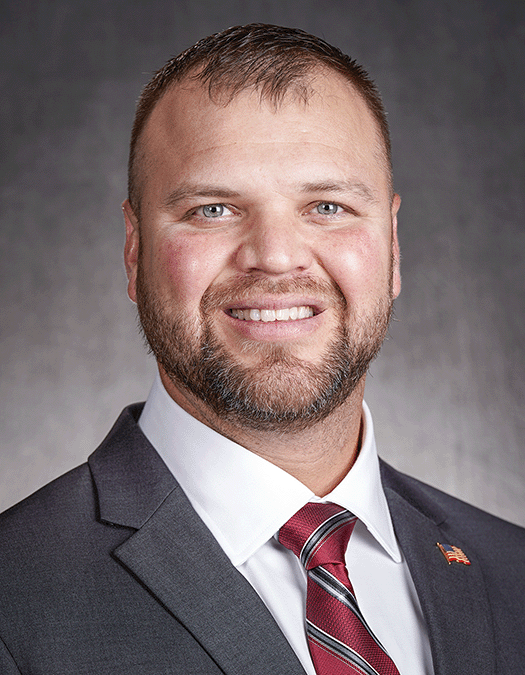
Andrew Myers
100% support rate
Top opponent
Aisha Gomez
0% support rate
Ranked legislators
10
5 support · 5 oppose
Key legislators

Who's moving unemployment in Minnesota

Legislators moving unemployment in Minnesota
Legislator Party Stance Support rate Decisive votes
Andrew Myers
Andrew Myers House · District 45A
R
Strong +
100% 4
Ben Bakeberg
Ben Bakeberg House · District 54B
R
Strong +
100% 4
Ben Davis
Ben Davis House · District 6A
R
Strong +
100% 4
Bernie Perryman
Bernie Perryman House · District 14A
R
Strong +
100% 4
Bidal Duran
Bidal Duran House · District 2A
R
Strong +
100% 4
Aisha Gomez
Aisha Gomez House · District 62A
D
Strong −
0% 4
Amanda Hemmingsen-Jaeger
Amanda Hemmingsen-Jaeger Senate · District 47
D
Strong −
0% 4
Andy Smith
Andy Smith House · District 25B
D
Strong −
0% 4
Anquam Mahamoud
Anquam Mahamoud House · District 62B
D
Strong −
0% 4
Athena Hollins
Athena Hollins House · District 66B
D
Strong −
0% 4
Showing 11–20 of 29 bills

All labor & employment bills

in committee · Minnesota · Senate Feb 17, 2025

SF 1532: Applicants for unemployment insurance involved in a labor dispute eligibility under certain conditions modification

This bill amends Minnesota Statutes section 268.085, subdivision 13b, to clarify unemployment insurance eligibility for workers involved in labor disputes. It specifies that workers participating in a labor dispute remain eligible for benefits until the end of the calendar week the dispute was active, while non-participating workers remain eligible until the dispute began. The bill also adds exceptions where eligibility is maintained, such as when workers stop working due to employer safety violations, lockouts, or being discharged before a dispute started. These changes directly affect Minnesota workers who stop working due to labor disputes, ensuring clearer eligibility rules during such events.
Sub-Topics Unemployment
in committee · Minnesota · House Apr 3, 2025

HF 3108: Additional unemployment insurance benefits for iron ore mining industry workers provided.

HF 3108 provides additional unemployment benefits to workers laid off from the iron ore mining industry or supporting businesses (like suppliers) due to lack of work after May 19, 2025. To qualify, workers must have exhausted regular unemployment benefits, have 50%+ wage credits from qualifying employers, and meet standard eligibility requirements. The bill offers up to 26 weeks of benefits at the same weekly rate as regular unemployment benefits, ending May 30, 2026. These benefits are funded from Minnesota’s unemployment trust fund and do not affect future employer tax rates, except for mining employers themselves.
Sub-Topics Unemployment
passed · Minnesota · House May 19, 2025

HF 3023: Iron ore mining employees additional benefits adopted.

HF 3023 creates additional unemployment benefits for iron ore mining workers laid off due to reduced operations between March 15 and June 16, 2025. It provides up to 26 weeks of benefits at the same weekly rate as their regular unemployment benefits, available only after workers exhaust their standard unemployment benefits. Eligibility requires being laid off by an employer in the iron ore mining industry that cut 50%+ of its workforce during the specified period, or by an explosive manufacturer serving that industry. The benefits are retroactive to March 15, 2025, and do not apply to those receiving federal Trade Readjustment Allowance.
Sub-Topics Unemployment
in committee · Minnesota · House Apr 2, 2025

HF 3030: Approval of site-specific modifications to sulfate water quality standards during pendency of related rulemaking facilitated, reactive mine waste storage provided, and additional unemployment insurance benefits provided.

HF 3030 provides additional unemployment benefits for workers laid off in the iron ore mining industry (or supporting industries) due to a 50% or greater workforce reduction between March 15 and June 15, 2025, with benefits capped at 26 weeks. Eligibility requires exhausting regular unemployment benefits from qualifying employers and meeting standard eligibility rules. The bill also establishes new requirements for the safe storage of reactive mine waste (defined as waste causing a sustained pH drop of 0.5+ in water) to prevent environmental harm. A procedural provision allows temporary sulfate water quality standard modifications during pending rulemaking, but does not detail implementation.
Sub-Topics Unemployment
in committee · Minnesota · Senate Jan 16, 2025

SF 229: Labor force participation rates included as an economic indictor provision

SF 229 amends Minnesota's workforce development law to require the state workforce board to include "county labor force participation rates" as a standard economic indicator when deciding how to allocate workforce development funds. This means the board must examine whether people in each county are working or seeking work (alongside other data like layoffs, job vacancies, and unemployment claims) before approving training programs for current workers. The change directly affects the state workforce board and local workforce planning, ensuring county-level economic health is factored into funding decisions for programs like incumbent worker training. The bill does not create new funding but adjusts the criteria used to distribute existing workforce development resources.
in committee · Minnesota · Senate Mar 13, 2025

SF 2419: Certain information provided by businesses when determining worker classification requirement provision

This bill requires partnership entities (like business partnerships) to provide specific information to businesses when the business needs to determine if a worker should be classified as an employee or independent contractor. The required information includes details about unemployment insurance, workers' compensation insurance, and tax identification numbers. This applies directly to businesses using partnership entities and aims to streamline the worker classification process by mandating the provision of these key details. The bill amends Minnesota Statutes section 181.725 to add this requirement.
in committee · Minnesota · Senate Apr 2, 2025

SF 3230: Provision that acceptance of certain offers of deferred resignation do not constitute a quit from employment

This bill clarifies that workers who accepted a deferred resignation offer from their employer between January 27 and February 13, 2025, will not be considered to have quit their job for unemployment benefits purposes. It directly affects those workers by ensuring they remain eligible for unemployment benefits under Minnesota's existing rules. The key provision retroactively changes the eligibility standard for this specific group, treating their acceptance of deferred resignation as not a voluntary quit. The rule applies to all such cases within that two-week window, effective from January 27, 2025.
Sub-Topics Unemployment
in committee · Minnesota · Senate Apr 7, 2025

SF 3314: Emergency medical services work exception provision in certain circumstances

This bill (SF 3314) provides a temporary exception for unemployment insurance benefits to workers laid off from the iron ore mining industry between April 1 and July 2, 2025. If these workers take a short-term job in emergency medical services (EMS) within their local area during that period, it will not count against their eligibility for unemployment benefits. Specifically, their temporary EMS work will not be considered "failing to seek or accept suitable employment," and earnings from that work will not reduce their weekly unemployment benefit amount. The exception applies retroactively from April 1, 2025.
Sub-Topics Unemployment
in committee · Minnesota · Senate Apr 1, 2025

SF 3202: Rebuttable presumption that in individual is an employee establishment

SF 3202 establishes a rebuttable presumption that workers in Minnesota's trucking and messenger/courier industries are employees, not independent contractors. This means drivers operating licensed vehicles are presumed to be employees unless employers can prove seven specific conditions are met (e.g., the worker owns equipment, covers maintenance costs, has a written independent contractor agreement, and controls work methods). The bill amends Minnesota Statutes 181.722 and 268.035 to implement this change, shifting the burden to employers to demonstrate independent contractor status. It directly affects drivers in these industries and impacts how their employment status is determined for workers' compensation and unemployment benefits.
in committee · Minnesota · House Apr 2, 2025

HF 3078: Acceptance of certain offers of deferred resignation made to not constitute a quit from employment.

This bill clarifies that workers who accepted a deferred resignation offer from their employer between January 27 and February 13, 2025, will not be considered to have quit their job for unemployment benefits purposes. It amends Minnesota Statutes section 268.095 to ensure these individuals remain eligible for unemployment benefits under the standard rules. The change applies retroactively from January 27, 2025, covering all affected workers during that specific two-week period. This directly impacts employees who took such offers during that window and were previously potentially disqualified from benefits.
Sub-Topics Unemployment
Showing 11 to 20 of 29 bills