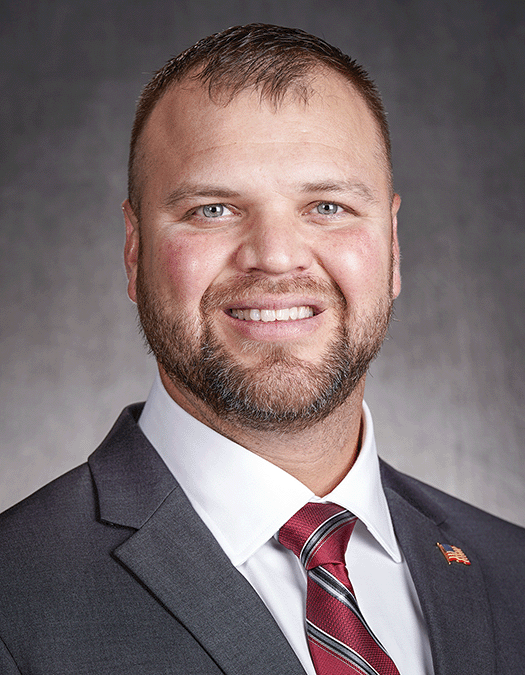
This bill protects crime victims whose vehicles were stolen, used as evidence in crimes, or involved in specific traffic violations. It prohibits charging victims for towing or impounding their vehicles, bans selling their vehicles for 180 days, and requires government reimbursement if a vehicle is sold. It also mandates law enforcement to investigate stolen vehicle reports and provide regular case updates to victims. These changes directly affect crime victims by preventing financial penalties and ensuring their vehicles remain accessible during investigations.
HF 1082 establishes the Minnesota Victims of Crime Account, funded by increased fees/penalties from criminal cases and additional general fund transfers. It appropriates specific funds for fiscal years 2026-2027 to provide grants to organizations that received crime victim service grants in 2024. These grants must support direct services for victims of sexual assault, domestic violence, child abuse, and general crime - including client assistance, housing supports, culturally responsive programming, and prevention efforts like restorative justice. The bill requires services to prioritize underserved communities and reflect Minnesota’s diversity, with up to 10% of funds allowed for grant administration.
SF 852 appropriates funds from the general fund for grants to organizations that received victim services grants in 2024. These grants must support direct services and advocacy for victims of sexual assault, general crime, domestic violence, and child abuse. The funding covers direct client assistance, competitive staff wages, housing supports, culturally responsive programming, and prevention services like restorative justice, with priority for underserved communities. Up to 10% of the funds can cover grant administration. The bill targets organizations serving crime victims across Minnesota’s diverse communities.
This bill requires prosecutors to notify victims when they decline to prosecute violations of orders for protection or harassment restraining orders. It applies directly to victims of domestic abuse, harassment, or stalking who have protection orders violated but face no criminal charges. The key mechanism mandates prosecutors to make "reasonable efforts" to contact victims via phone first, then email or mail, and to explain dismissal reasons (e.g., witness unavailability). The bill updates existing notification rules under Minnesota Statutes to ensure victims receive clear information about their case status without prosecution.
HF 559 requires courts to order convicted individuals who falsely report emergencies to pay restitution. The bill mandates that courts order full restitution to public agencies for their emergency response costs and to direct victims of the false report. This amendment to Minnesota Statutes section 609.78 (2024) applies specifically to those convicted under the statute for making fictitious emergency reports. The restitution requirement does not limit victims' ability to seek additional damages in civil court.
This bill requires correctional authorities to notify crime victims when an offender submits a letter of apology, but only if the victim has previously requested this notification. Victims must submit a written or electronic request to the correctional facility or the Department of Corrections to be included in this notification process. Authorities must make a "good faith effort" to notify these victims within 90 days of the apology being filed. The bill amends Minnesota Statutes to add this requirement to existing victim notification procedures, directly affecting victims who proactively opt-in and correctional facilities handling offender correspondence. It does not change the content of apologies or create new victim rights.
This bill allows courts to sentence offenders below standard guidelines if they were victims of domestic abuse, sexual assault, or sex trafficking. It requires presentence reports to include information about such victimization and permits courts to order reduced sentences when the victimization contributed to the offense and serves the public interest. Offenders placed on probation may also be required to participate in trauma-focused treatment. The law applies to felony sentencing hearings starting August 1, 2025, and affects individuals convicted of crimes who were previously victims of these specific offenses.
HF 467 repeals the expiration date for correctional fees charged by probation agencies and the Department of Corrections. The bill removes the requirement that supervision fees (including community service, restitution, and postprison supervision) must phase out by August 1, 2027. This change ensures these fees can continue to be collected indefinitely without a sunset deadline. The bill directly affects individuals under probation or supervision who pay these fees, as well as probation agencies and the Department of Corrections.
HF 1295 amends Minnesota law to include children's advocacy centers as a program eligible to receive 70% of certain fines collected from offenders convicted of specific crimes, such as those involving child abuse or exploitation. The bill requires courts to collect a minimum fine of 30% of the maximum penalty for these crimes and forward 70% of that amount to a local victim assistance program, now explicitly including children's advocacy centers. If multiple programs serve the county, courts may choose which one receives funds based on the crime type and program needs; if no program is available, funds go to the state general fund. This ensures children's advocacy centers can directly access funding to provide services for child victims.
SF 2907 repeals a sunset provision in Minnesota law that required probation agencies and the Department of Corrections to phase out supervision fees by August 1, 2027. This bill removes the requirement to develop and implement plans for ending these fees, meaning correctional fees for services like probation supervision, electronic monitoring, and restitution collection will no longer have an automatic expiration date. The repeal directly affects probation agencies and the Department of Corrections, which currently collect these fees for court-ordered services. The change preserves the existing fee structure without a mandated end date.