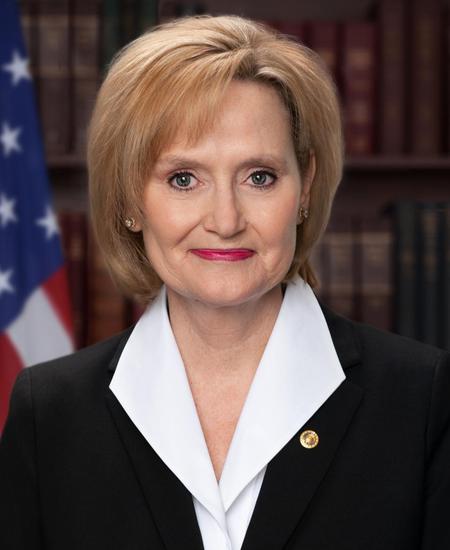
Photo of Cindy Hyde-Smith
R United States Senate · Mississippi On the 2026 ballot

Sen. Cindy Hyde-Smith

Compare
Total votes
1,044
all sessions
Attendance
99%
13 missed
Near the chamber average
With party
95%
of cast votes
Near the chamber average
Bipartisan score
3%
crosses aisle rarely
Near the chamber average
Sponsored
1,206
bills & resolutions
Near the chamber average
Committees
16
assignments
1,206 bills and resolutions

Sponsored bills

Total
1,206
Primary
88
Co-sponsor
1,118
This page
1,206
matching current filters
Co-sponsor S 3145
In committee · Michigan Senate · Co-sponsor
CARE Act of 2025

Maddy summaryS 3145, the CARE Act of 2025, creates a new Medicare payment model for ground ambulance services provided during emergencies without patient transport. It directly affects Medicare beneficiaries who receive emergency medical dispatch services (like on-site care) and ambulance providers who serve them. The bill requires Medicare to pay for these non-transport services at rates aligned with traditional transport payments, while allowing telehealth services provided alongside them to count as originating sites. The model will operate for five years, with a mandatory report after four years evaluating its impact on beneficiary access, outcomes, and regional variations in emergency services.

In committee Nov 6, 2025 1 co-sponsor
Co-sponsor S 3107
In committee · Michigan Senate · Co-sponsor
USPS Act

Maddy summaryThis bill requires the Comptroller General to investigate nationwide mail and USPS property theft patterns annually for five years after enactment. The reports must detail current USPS theft prevention measures and provide recommendations for improving security, submitted to specific congressional committees. It directly affects the USPS by mandating these investigations and reports, while requiring consultation with the Postal Service's Inspector General and Postal Inspection Service. The key mechanism is the mandatory, recurring reporting process to inform Congress about theft trends and security gaps.

In committee Nov 5, 2025 1 co-sponsor
Co-sponsor SRES 482
Passed · Michigan Senate · Co-sponsor
A resolution recognizing the week of November 3 through November 7, 2025, as "National Veterans Small Business Week".

Maddy summarySRES 482 is a ceremonial Senate resolution recognizing November 3-7, 2025, as "National Veterans Small Business Week." It does not create new laws or policies but formally acknowledges veteran-owned small businesses, which employ nearly 3.3 million people and generate over $952 billion in annual sales. The resolution expresses support for these businesses and appreciation for veterans' entrepreneurship, while highlighting the Senate Committee on Small Business and Entrepreneurship’s annual observance of this week. It has no direct impact on regulations, funding, or veteran business operations.

Passed Nov 4, 2025 1 co-sponsor
Co-sponsor S 3099
In committee · Michigan Senate · Co-sponsor
DIRECT Act of 2025

Direct Interstate Retail Exemption for Certain Transactions Act of 2025 or the DIRECT Act of 2025 This bill allows meat and poultry products inspected by State Meat and Poultry Inspection programs to be sold by retail stores, restaurants, or similar retail-type establishments over the internet and shipped by a carrier in commerce (other than for export to a foreign country). The state-inspected meat and poultry products must be shipped directly to household consumers and in normal retail quantities (e.g., do not exceed 300 pounds for beef, 100 pounds for pork, and 27.5 pounds for lamb). As background, under the inspection programs, the Department of Agriculture Food Safety and Inspection Service allows states that meet certain requirements to inspect meat and poultry. The state-inspected products are currently limited to intrastate commerce, unless a state opts into a separate Cooperative Interstate Shipment Program.

In committee Nov 4, 2025 1 co-sponsor
Co-sponsor S 3093
In committee · Michigan Senate · Co-sponsor
DETECT Nitazenes Act of 2025

Maddy summaryThis bill amends the Homeland Security Act of 2002 to require federal agencies to detect and identify nitazenes - synthetic opioids - alongside fentanyl and xylazine in drug detection protocols. It directly affects law enforcement agencies and laboratories using federal detection equipment, updating their technical standards to include nitazenes. The key change is adding "nitazenes" to the list of substances covered under existing detection requirements. This is a procedural update to existing law, not a new regulatory mandate.

In committee Nov 3, 2025 1 co-sponsor
Co-sponsor S 3076
In committee · Michigan Senate · Co-sponsor
Nitazene Control Act

Maddy summaryS 3076, the Nitazene Control Act, permanently classifies nitazenes and related 2-benzylbenzimidazole opioids as Schedule I controlled substances under the federal Controlled Substances Act. This affects anyone possessing, distributing, or researching these substances, as it bans them without specific exemptions. The bill broadly defines the prohibited substances to cover all structural analogs (including modifications to the molecular structure) and those that activate the mu-opioid receptor. It also removes temporary scheduling for these compounds, making their Schedule I status permanent upon enactment. This policy change aims to prevent new illicit analogs from entering the drug supply and reduce overdose risks linked to these potent synthetic opioids.

In committee Oct 30, 2025 1 co-sponsor
Co-sponsor S 3085
In committee · Michigan Senate · Co-sponsor
Firearm Access During Shutdowns Act of 2025

Maddy summaryThis bill ensures that critical firearm-related operations continue during government shutdowns by designating them as "excepted" under federal law. It specifically covers the FBI's background check system (NICS), ATF enforcement programs, Commerce Department firearm export licensing, and State Department defense trade controls. These functions would remain operational even if most government services halt, directly affecting firearm background checks and export licensing processes. The policy change prevents temporary disruptions to gun sales and international firearm transactions during shutdowns.

In committee Oct 30, 2025 1 co-sponsor
Co-sponsor S 3002
In committee · Michigan Senate · Co-sponsor
Pay Our Military Act of 2025

Maddy summaryThis bill ensures military personnel and their support staff continue receiving pay during government funding gaps in fiscal year 2026. It authorizes funds from the Treasury to cover pay and allowances for active-duty service members, reserves, military support civilians (including Coast Guard staff), and qualifying contractors if regular budget appropriations aren't approved. The funding remains available until the earliest of: a new budget passing, a continuing resolution without this funding, or January 1, 2027. It directly affects all active-duty military, reserve components, and civilian/contractor support staff within the Department of Defense and Coast Guard.

In committee Oct 30, 2025 1 co-sponsor
Co-sponsor SRES 475
Passed · Michigan Senate · Co-sponsor
A resolution designating November 1, 2025, as "National Bison Day".

Maddy summarySRES 475 is a symbolic Senate resolution designating November 1, 2025 (the first Saturday of November) as "National Bison Day." It directly affects all Americans by officially recognizing this date for public observance. The resolution acknowledges bison's historical, cultural, and economic significance, particularly to Native American tribes and rural communities, and builds on an existing annual tradition celebrated since 2012. The Senate encourages the public to observe the day with appropriate ceremonies and activities, though the resolution contains no new laws or funding.

Passed Oct 29, 2025 1 co-sponsor
Co-sponsor S 3073
In committee · Michigan Senate · Co-sponsor
Pay Our Capitol Police Act

Maddy summaryThis bill ensures the U.S. Capitol Police continue receiving pay during fiscal year 2026 funding gaps by authorizing temporary funds for salaries, benefits (including hazard pay and retirement), and contractor support. It directly affects Capitol Police officers (classified as "excepted employees" during emergencies), their civilian support staff, and contractors providing essential services. The funding mechanism provides immediate payments for the period starting October 1, 2025, and lasts until Congress passes regular appropriations for the Capitol Police or September 30, 2026, whichever comes first.

In committee Oct 29, 2025 1 co-sponsor
Showing 131 to 140 of 1,206 bills
Previous 1 … 13 14 15 … 121 Next