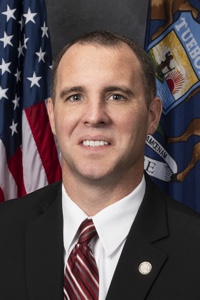
This bill amends the Michigan Amber Alert Act to expand when the state's Amber Alert system can be activated for missing children. It requires the Department of State Police to issue an Amber Alert for any missing child with special needs or for any missing child who law enforcement believes is in danger after a preliminary investigation. The bill defines "child with special needs" as someone under 26 who has a qualifying impairment, requires special education services, and has not yet graduated high school. The legislation also establishes that this act may be known as the "Rowan Act" and was introduced by Senator Sean McCann in March 2026.
SB 463 removes criminal penalties and civil fines for minors (under 18) who purchase, possess, or use tobacco products, vapor products, or alternative nicotine products. The bill eliminates existing legal consequences for these minor offenses, shifting focus away from punishment. It directly affects underage individuals by ending enforcement of penalties under current law (MCL 722.642). The key provision is a "sunset" of these penalties, meaning they would no longer apply once the bill takes effect.
SB 520 amends Michigan's penal code to increase penalties for certain prostitution-related offenses. It raises the maximum penalty for basic violations (under sections 462b-462d) from 10 years to 20 years in prison and from $10,000 to $20,000 in fines. The bill specifically targets individuals who violate these sections, including those operating or facilitating commercial sex, and updates penalties for more severe outcomes like bodily injury or serious harm. These changes apply to anyone convicted under the amended sections of the law. The bill does not alter the scope of prohibited conduct, only the severity of potential punishments.
SB 705 amends Michigan's prostitution laws (MCL 750.448-451, 454, 462) to adjust penalties for repeat offenses, require mandatory reporting of minors involved in prostitution, and establish diversion programs. It increases penalties to misdemeanors (up to 93 days/$500) for first offenses, felonies (up to 5 years/$4,000) for two or more prior convictions, and adds a presumption of coercion for minors (under 18) involved in prostitution - requiring prosecutors to prove otherwise. The bill mandates law enforcement to report minors to health services within 24 hours and requires investigations into potential human trafficking. It directly affects individuals engaging in prostitution, property owners leasing for such purposes, and law enforcement handling cases involving minors.
HB 4048 adds a new sentencing guideline for distributing intimate deepfake sexual images with aggravating circumstances, classifying it as a Class F felony punishable by up to 3 years in prison. This directly affects individuals convicted of disseminating such deepfakes, particularly those with prior offenses under Michigan law. The bill amends sentencing guidelines in Chapter XVII of the Michigan Penal Code to specifically address this crime, establishing a clear penalty framework for courts to apply. It became effective immediately upon the Governor's approval on August 26, 2025.
SB 216 increases criminal penalties for drivers who cause physical injury or death to pedestrians, cyclists, or other vulnerable roadway users through moving traffic violations (like speeding or running a red light). It amends Michigan's traffic laws to enhance penalties under specific sections, adding new provisions (79g and 79h) that strengthen consequences for these offenses. The bill directly affects drivers convicted of moving violations resulting in harm to non-motorized road users, making penalties more severe than current standards. This policy change focuses on improving accountability for dangerous driving that endangers pedestrians and cyclists, without specifying future outcomes.
This bill allocates $2.25 billion in state funding for Michigan's Department of Corrections for fiscal year 2025-2026. It covers administrative costs (including staff salaries and pensions), inmate reentry programs (like education and job training), parole services, and facility operations (including body-worn cameras and housing). The funding directly supports 13,207 correctional staff positions and services for inmates, such as vocational programs and transitional housing. It does not create new programs but provides budgetary support for existing department functions.
SB 170 is a budget bill that allocates $393.39 million in state funds to support Michigan's judiciary for fiscal year 2025-2026. It directly funds court operations, including the Supreme Court ($102.8 million), Court of Appeals ($27.7 million), and judicial salaries for approximately 591 judges across all courts. Key provisions include funding for court administration, problem-solving courts, technology systems, and specialized programs like foster care review and drug treatment courts. The bill specifies exact amounts for each judicial branch and program without changing existing laws or creating new policies. This is a routine funding measure for the state's court system, not a substantive policy change.