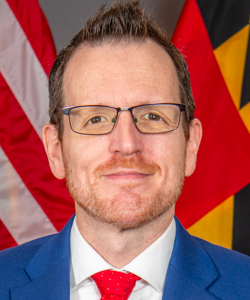
Key legislators
Who's moving criminal justice in Maryland
Showing 71–75 of 75
bills
All criminal justice bills
HB 688 would reclassify violations of Maryland's law against intercepting or disclosing wire, oral, or electronic communications from a felony to a misdemeanor. This affects anyone who unlawfully intercepts, discloses, or uses the contents of such communications in violation of the law. The bill amends Section 10-402(b) of Maryland's Courts and Judicial Proceedings code to change the penalty level, though it maintains the same maximum fine ($10,000) and potential imprisonment (up to 5 years) for the offense.
This constitutional amendment prohibits judges or justices removed or retired for misconduct from holding any future judicial position. It directly affects judges disciplined by the Commission on Judicial Disabilities, adding a new provision that explicitly bars such individuals from future judicial office. The key mechanism requires the Supreme Court to remove or retire judges found guilty of misconduct, with the amendment ensuring these individuals lose eligibility for any subsequent judicial role. This change modifies Article IV of the Maryland Constitution and requires voter approval in the November 2026 election.
HB 477 modifies Maryland's evidence rules to allow certain out-of-court statements in assault in the second degree cases where the defendant caused the witness's unavailability. It permits such statements as evidence if the court finds by a preponderance of evidence that the defendant engaged in wrongdoing to make the witness unavailable. The bill requires statements to have been given under oath, written and signed, or recorded verbatim, and mandates early notice to the defense about the statement's use. This directly affects criminal trials for assault in the second degree by expanding admissible evidence while adding procedural safeguards. The law takes effect October 1, 2026.
HB 432 repeals a provision in Maryland law that allowed municipalities to prohibit "vagrancy" (laws targeting homeless or loitering individuals without clear purpose). The bill directly affects local governments by removing their legal authority to enforce such vagrancy prohibitions under Section 5-207(c)(2) of the Maryland Annotated Code. Key mechanisms include deleting "vagrancy" from the list of activities municipalities could ban, while preserving other related powers like prohibiting gambling or vice. The change takes effect October 1, 2026, and represents a concrete policy shift in local law enforcement authority.
Maryland's SB 245 prohibits state, local governments, county sheriffs, and their agencies from entering new agreements with federal authorities to enforce civil immigration law. It defines such agreements as contracts under federal laws like 8 U.S.C. § 1103 or § 1357. Existing agreements must be terminated by July 1, 2026, or immediately upon the bill's effective date of June 1, 2026. The law directly affects all Maryland local law enforcement entities and state agencies that previously collaborated with federal immigration enforcement.