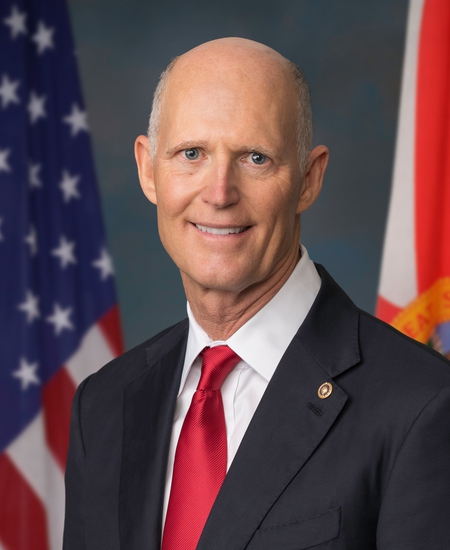
Photo of Rick Scott
R United States Senate · Florida

Sen. Rick Scott

Compare
Total votes
1,044
all sessions
Attendance
98%
23 missed
Higher than 92% of chamber peers
With party
91%
of cast votes
Lower than 86% of chamber peers
Bipartisan score
5%
crosses aisle rarely
Higher than 84% of chamber peers
Sponsored
1,808
bills & resolutions
Higher than 81% of chamber peers
Committees
13
assignments
1,808 bills and resolutions

Sponsored bills

Total
1,808
Primary
424
Co-sponsor
1,384
This page
1,808
matching current filters
Co-sponsor S 501
In committee · Maine Senate · Co-sponsor
Earmark Elimination Act of 2021

Earmark Elimination Act of 2021 This bill establishes a point of order in the Senate against considering legislation that includes an earmark. An earmark is generally any congressionally directed spending, tax benefit, or tariff benefit that benefits a specific entity, state, locality, or congressional district other than through a statutory or administrative formula or competitive award process. The point of order may be waived by an affirmative vote of two-thirds of the Senate. If the point of order is successfully raised and sustained, the earmark must be stricken from the legislation.

In committee Mar 1, 2021 1 co-sponsor
Co-sponsor S 472
In committee · Maine Senate · Co-sponsor
EPIC Act

End Pensions in Congress Act or the EPIC Act This bill excludes future Members of Congress from the Federal Employees Retirement System (FERS) and requires Members currently enrolled in FERS or the Civil Service Retirement System to opt in to continue their enrollment.

In committee Feb 25, 2021 1 co-sponsor
Primary S 459
In committee · Maine Senate · Lead sponsor
Save Democracy Act

Save Democracy Act This bill addresses issues involving voter registration, casting of ballots, and tabulation of ballots in federal elections. Specifically, regarding voter registration for federal elections, the bill prohibits the use of automatic voter registration systems, requires individuals to provide documentary proof of U.S. citizenship to register to vote, requires individuals to provide their full Social Security number on their voter registration application, and requires courts to notify state election officials when an individual is recused from jury duty because the individual is not a U.S. citizen. Next, regarding the casting of ballots in federal elections, the bill requires individuals to provide proof of identification for absentee and in-person voting, prohibits states from mailing unrequested absentee ballots, prohibits the use of a drop box for collecting voted absentee ballots unless it is located inside of a building that serves as an office for the election official, restricts the delivery of ballots by third parties (i.e., prohibits ballot harvesting), requires that absentee ballots be received before the polls close on election day, and requires states to use Social Security numbers to verify the identification of each individual who casts a ballot. Finally, regarding the tabulation of ballots in federal elections, the bill requires states to permit poll watching by at least two campaign representatives per campaign, requires continuous counting of ballots after the closure of polling places on election day, and requires an audit of voting systems.

In committee Feb 25, 2021 0 co-sponsors
Co-sponsor S 488
In committee · Maine Senate · Co-sponsor
Iran Sanctions Relief Review Act of 2021

Iran Sanctions Relief Review Act of 2021 This bill restricts the President's authority to unilaterally undertake certain actions with respect to Iran and increases congressional oversight of those actions. Specifically, the President must report to Congress before terminating or waiving sanctions related to Iran or taking a licensing action that significantly alters U.S. foreign policy with respect to Iran. Each report must (1) describe the proposed action and its rationale, and (2) indicate whether or not the action is intended to significantly alter foreign policy concerning Iran. If the intention is to alter that policy, the report must provide additional information about the policy objectives and anticipated effects of the action. After the President submits a report, the bill provides Congress with a 30-day period to review it; this period is extended to 60 days for reports submitted between July 10 and September 7. During this period, Congress may enact a joint resolution approving or disapproving the action. During the review period, the President may not take the action unless Congress passes a joint resolution of approval; if Congress enacts a joint resolution of disapproval, the bill prohibits the President from taking the action. The bill also outlines procedures for the introduction and consideration of these types of joint resolutions.

In committee Feb 25, 2021 1 co-sponsor
Co-sponsor SRES 72
In committee · Maine Senate · Co-sponsor
A resolution opposing the lifting of sanctions imposed with respect to Iran without addressing the full scope of Iran's malign activities, including its nuclear program, ballistic and cruise missile capabilities, weapons proliferation, support for terrorism, hostage-taking, gross human rights violations, and other destabilizing activities.

This resolution opposes lifting specified sanctions on Iran and resolves that these sanctions may be terminated only after Iran has ceased providing support for acts of international terrorism and has dismantled its nuclear, biological, and chemical weapons and related technologies.

In committee Feb 24, 2021 1 co-sponsor
Co-sponsor SRES 75
Passed · Maine Senate · Co-sponsor
A resolution celebrating Black History Month.

This resolution recognizes Black History Month as an opportunity to reflect on U.S. history and to commemorate the contributions of African Americans. It calls for the United States to (1) honor the contribution of pioneers who helped to ensure its legacy; and (2) move forward as a nation "indivisible, with liberty and justice for all."

Passed Feb 24, 2021 1 co-sponsor
Co-sponsor S 401
In committee · Maine Senate · Co-sponsor
Conscience Protection Act of 2021

Conscience Protection Act of 2021 This bill provides statutory authority for certain protections for health care providers that refuse to participate in abortions based on religious beliefs or other convictions. Health care providers include individual professionals, medical facilities, health insurance organizations, and social services providers that refer clients to health care services. The federal government and entities that receive federal funding for health-related activities, including state and local governments, may not discriminate against a health care provider that refuses to be involved in, or provide coverage for, abortions. Currently, similar requirements apply to various related activities, including certain employment or personnel decisions (the Church Amendments), abortion services training (the Coats-Snowe Amendment), qualified health plans offered through health insurance exchanges, and annual appropriations bills for the Department of Health and Human Services (HHS) and other federal agencies (the Weldon Amendment). The HHS Office for Civil Rights must investigate complaints of this kind of discrimination. Furthermore, HHS may terminate or reduce HHS funding for health-related activities if a person or entity fails to comply with nondiscrimination requirements. Additionally, the Department of Justice or any entity adversely affected by such discrimination may bring a civil action to obtain appropriate relief. A plaintiff does not need to seek or exhaust administrative remedies before bringing the action. A plaintiff may also bring an action, including one for money damages, against a governmental entity. In many cases, principles of sovereign immunity shield states and some localities from these kinds of actions.

In committee Feb 24, 2021 1 co-sponsor
Co-sponsor S 417
In committee · Maine Senate · Co-sponsor
Visa Security Act

Visa Security Act This bill limits the validity period of B-1 (business visitor) and B-2 (tourist) visas issued to Chinese nationals until the Department of State makes certain certifications to Congress regarding the Chinese government. Specifically, the State Department may not issue such a visa with a validity period of more than one year unless it certifies to Congress that the Chinese government has taken certain actions, including (1) stopping its campaign of economic and industrial espionage against the United States; (2) ending its provocative and coercive behavior towards Taiwan; (3) withdrawing its national security law in Hong Kong and upholding its obligations to respect Hong Kong's autonomy; and (4) ending its systematic oppression of minority ethnic groups in China, including the Uyghurs and Tibetans. (Currently, such visas may be valid for up to 10 years.) These restrictions shall not apply to visa applicants from Taiwan or certain applicants from Hong Kong, generally those Hong Kong residents that the State Department has no reason to believe are acting on behalf of the Chinese government. (Taiwan is self-governing but the Chinese government considers it a part of China, while Hong Kong is a part of China but is supposed to have a largely separate legal and economic system.)

In committee Feb 24, 2021 1 co-sponsor
Showing 1,761 to 1,770 of 1,808 bills