American Border Rescue Plan Act This bill establishes that funds made available for certain COVID-19 recovery programs may also be available to eligible law enforcement agencies for border enforcement-related purposes. To be eligible to receive such funds, a law enforcement agency must be (1) located in a state with an international border, and (2) involved in an active and ongoing U.S. Customs and Border Protection operation coordinated through a sector office.
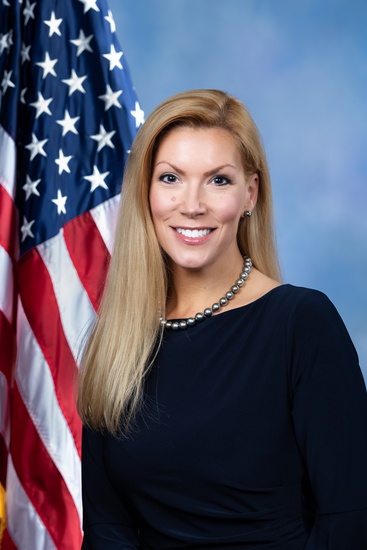
Rep. Beth Van Duyne
Sponsored bills
Accelerate Long-term Investment Growth Now Act or the ALIGN Act This bill makes permanent the expensing of certain new business equipment. Expensing allows the deduction of the full amount of an expense item in the same taxable year.
Report and Educate About Campus Hazing Act or the REACH Act This bill requires institutions of higher education (IHEs) that participate in federal student-aid programs to report hazing incidents and implement hazing education programs. Specifically, the bill requires each IHE to disclose hazing incidents that were reported to campus security authorities or local police agencies in its annual security report. The bill defines the term hazing to mean any intentional, knowing, or reckless act committed by a student, or a former student, of an IHE against another student (regardless of that student's willingness to participate), that (1) is connected with an initiation into, an affiliation with, or the maintenance of membership in an organization that is affiliated with the IHE (e.g., an athletic team); and (2) contributes to a substantial risk of physical injury, mental harm, or degradation or causes physical injury, mental harm, or personal degradation. In addition, each IHE must implement a comprehensive program to prevent hazing, which must include information on hazing awareness, hazing prevention, and the IHE's policies on hazing.
Selective Service Repeal Act This bill repeals the requirement for males between the ages of 18 and 26 to register with the Selective Service. The bill also specifies that an individual shall not be penalized for prior failure to register with the Selective Service.
This resolution condemns Iranian state-sponsored terrorist attacks against U.S. citizens and officials and Iranian dissidents and expresses support for the people of Iran who are engaged in legitimate and peaceful protests against the Iranian regime.
PPP Extension Act of 2021 This bill extends the Paycheck Protection Program, established to support small businesses in response to COVID-19 (i.e., coronavirus disease 2019), through June 30, 2021. Currently, the program is set to expire on March 31, 2021. For the final 30 days of the program (i.e., from June 1 until June 30), the Small Business Administration may only process applications submitted prior to June 1, and it may not accept any new loan applications. The bill excludes the budgetary effects of this bill from PAYGO scorecards under the Statutory Pay-As-You-Go Act of 2010 and from Senate PAYGO scorecards.
Stop the Shutdowns Act This bill requires the Small Business Administration to submit a report analyzing the impact on small businesses of any prospective requirement relating to COVID-19 (i.e., coronavirus disease 2019) that would restrict or prevent those businesses from operating at normal capacity.
Reopening America by Supporting Workers and Businesses Act of 2021 This bill permits states to provide a one-time lump sum payment, through July 1, 2021, to individuals who (1) were eligible for COVID-19 pandemic unemployment compensation during any week after enactment of this bill, and (2) are no longer eligible as a result of becoming thereafter reemployed. Payments of $1,200 shall be paid to individuals who work at least 30 hours and $600 to individuals who work at least 20 hours but less than 30. The payments are available for claimants (1) who are not employed by a government entity, (2) who return to work for at least four consecutive weeks, and (3) whose annual salary does not exceed $75,000. Before receipt of a payment, the individuals' employers must verify their hours and earnings. Additionally, the bill (1) accelerates a scheduled increase in funding for reemployment services and eligibility assessments (RESEA), (2) allows states to use RESEA funds to serve all workers receiving unemployment benefits, and not just those most likely to exhaust their benefits; and (3) allows states to provide reemployment services to individuals receiving pandemic unemployment assistance and pandemic emergency unemployment compensation. Finally, the bill reinstates the requirement that unemployment claimants certify they are able, available, and actively seeking work.
Federal Agency Sunset Commission Act of 2021 This bill provides for the establishment of the Federal Agency Sunset Commission to submit to Congress a schedule for review and abolishment of each agency, including each advisory committee. The schedule for review shall be in the form of a joint resolution. Each agency shall be abolished unless reauthorized by Congress. For each agency, the commission must schedule a date of abolishment to occur at least once every 12 years. The commission must (1) review and evaluate the efficiency and public need for each agency using specified criteria; (2) analyze the authority claimed by the executive branch but not specifically authorized by statute; (3) recommend whether each agency should be abolished, reorganized, or continued; and (4) report to Congress on introduced legislation that would establish a new agency or a new program. The Government Accountability Office and the Congressional Budget Office, in cooperation with the Congressional Research Service, shall prepare an inventory of federal programs to assist Congress and the commission in carrying out this bill. The bill provides for expedited consideration of the schedule for review and abolishment.
Safe Step Act This bill requires a group health plan to establish an exception to medication step-therapy protocol in specified cases. A medication step-therapy protocol establishes a specific sequence in which prescription drugs are covered by a group health plan or a health insurance issuer. A request for such an exception to the protocol must be granted if (1) an otherwise required treatment has been ineffective, (2) such treatment is expected to be ineffective and delaying effective treatment would lead to irreversible consequences, (3) such treatment will cause or is likely to cause an adverse reaction to the individual, (4) such treatment is expected to prevent the individual from performing daily activities or occupational responsibilities, (5) the individual is stable based on the prescription drugs already selected, or (6) there are other circumstances as determined by the Employee Benefits Security Administration. The bill requires a group health plan to implement and make readily available a clear process for an individual to request an exception to the protocol, including required information and criteria for granting an exception. The bill further specifies timelines under which plans must respond to such requests.