Capital Lending and Investment for Marijuana Businesses Act or the CLIMB Act This bill allows national stock exchanges to list state-licensed cannabis-related businesses on their exchanges. It also prohibits a federal agency from bringing certain civil, criminal, regulatory, or administrative actions against a business or person because they provide assistance or services to a state-licensed cannabis-related business.
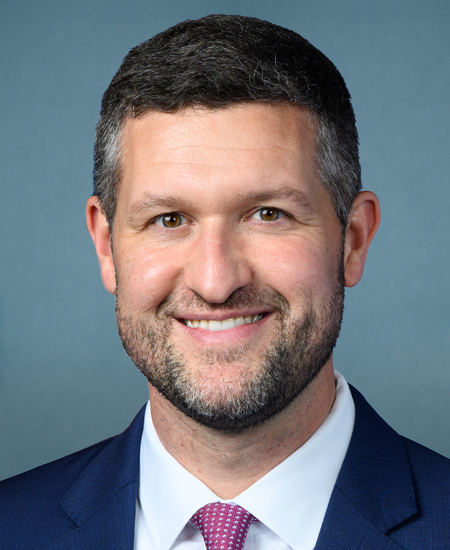
Rep. Patrick Ryan
Sponsored bills
Save America’s Forgotten Equines Act of 2021 or the SAFE Act of 2021 This bill prohibits the transporting, receiving, possessing, purchasing, selling, or donation by a person of an equine (e.g., horse) that the person has reason to believe will be slaughtered for human consumption.
Alzheimer's Accountability and Investment Act This bill requires the National Institutes of Health to annually submit, beginning in FY2024, an estimate of its budget and personnel needs for carrying out initiatives pursuant to the National Alzheimer's Project. This project supports coordination of federal planning, research, and other efforts to address Alzheimer's disease and related dementias.
NAPA Reauthorization Act This bill extends through 2035 and makes other changes to the National Alzheimer's Project. This project supports coordination of federal planning, programs, and other efforts to address Alzheimer's disease and related dementias. In particular, the bill incorporates a focus on promoting healthy aging and reducing risk factors associated with cognitive decline. The bill also expands the membership of the Advisory Council on Alzheimer's Research, Care, and Services to include (1) a researcher with experience recruiting and retaining diverse clinical trial participants, (2) an individual diagnosed with Alzheimer's disease, and (3) representatives from additional federal agencies (e.g., the Department of Justice and the Office of Management and Budget).
Supply Chain Disruptions Relief Act This bill modifies the treatment of liquidations of new motor vehicle inventory as qualified LIFO (last in first out accounting method) inventory. It allows new motor vehicle dealers to elect to wait until the end of 2025 to replace their inventory for purposes of determining income attributable to the sale of such inventory during 2020 and 2021.
Integrating New Technologies to Empower Law Enforcement at Our Borders Act This bill requires the Department of Homeland Security to report to Congress a plan to identify and deploy emerging and advanced technologies (e.g., artificial intelligence, automation, and optical radar) to achieve greater situational awareness along the northern and southern U.S. borders between ports of entry. The report shall contain information including assessments of (1) how Customs and Border Protection is currently using such technologies, (2) how such technologies can address border security capability gaps, and (3) the cost of acquiring such technologies.
Expanding the Families of Veterans Access to Mental Health Services Act The bill expands eligibility for readjustment counseling and related mental health services, including through a Vet Center, to family members of a veteran or member of the Armed Forces who died by suicide.
Equal Access to Abortion Coverage in Health Insurance Act of 2021 or the EACH Act of 2021 This bill requires federal health care programs to provide coverage for abortion services and requires federal facilities to provide access to those services. The bill also permits qualified health plans to use funds attributable to premium tax credits and reduced cost sharing assistance to pay for abortion services.
This bill reauthorizes through FY2026 certain activities under the Impact Aid Program. The program provides funding to local educational agencies that have lost property tax revenue due to the presence of tax-exempt federal property or to those that have experienced increased expenditures due to enrollment of federally connected children (e.g., children living on Indian lands or military bases).
9/11 Responder and Survivor Health Funding Correction Act This bill increases funding for and otherwise modifies a federal program that provides medical monitoring and treatment to responders and survivors who suffer from health conditions related to the September 11, 2001, attacks on the World Trade Center. Among the changes, the bill allows certain health care providers other than physicians to determine whether an individual's health condition is related to the attacks, and it establishes a research program to study the impacts of the attacks on health and educational outcomes of individuals who were 21 years of age or younger when the attacks occurred.