

In committee Sep 23, 2026
1 co-sponsor
Total votes
1,044
all sessions
Attendance
98%
17 missed
Near the chamber average
With party
98%
of cast votes
Near the chamber average
Bipartisan score
2%
crosses aisle rarely
Near the chamber average
Sponsored
1,768
bills & resolutions
Higher than 86% of chamber peers
Committees
13
assignments
1,768 bills and resolutions
Sponsored bills
Total
1,768
Primary
211
Co-sponsor
1,557
This page
1,768
matching current filters
A resolution recognizing Hispanic Heritage Month and celebrating the heritage and culture of Latinos in the United States and the immense contributions of Latinos to the United States.
Maddy summarySRES 870 is a congressional resolution that officially recognizes Hispanic Heritage Month, which runs from September 15 to October 15, 2026. The bill highlights the demographic, economic, and military contributions of Latino Americans, noting their significant role in population growth, workforce participation, and national defense. It urges the public to observe the holiday with programs that celebrate the heritage and culture of Latinos in the United States.
Passed Sep 22, 2026
1 co-sponsor
A resolution recognizing September 20, 2026, as "National LGBTQ+ Servicemembers and Veterans Day".
Maddy summaryThis Senate resolution designates September 20, 2026, as National LGBTQ+ Servicemembers and Veterans Day to honor the service of lesbian, gay, bisexual, transgender, and queer individuals in the U.S. Armed Forces. The text acknowledges historical discrimination, including the "Don't Ask, Don't Tell" policy and bans on transgender service, which resulted in thousands of discharges and denied benefits. It urges the Department of Veterans Affairs and the Department of Defense to end the current ban on transgender military service and restore access to gender-affirming health care for veterans and active duty personnel. Additionally, the resolution calls for these agencies to improve outreach so that individuals discharged based on their sexual orientation or gender identity can receive the benefits they are owed.
In committee Sep 17, 2026
1 co-sponsor
Stop the Wait Act of 2026
Maddy summaryThe Stop the Wait Act of 2026 eliminates the five-month waiting period required before individuals can receive Social Security Disability Insurance benefits, with a phased reduction starting in 2026 and full elimination by 2031. The bill directly affects people who are newly disabled and seeking federal financial support by allowing them to access these payments immediately upon approval rather than after a delay. Additionally, the legislation provides immediate Medicare coverage for eligible individuals under age 65 who lack other health insurance during this transition period. This change ensures that those without minimum essential coverage can enroll in Medicare Part A from the first month of their disability entitlement instead of waiting twenty-four months.
HealthcareSupports HealthcareThe bill eliminates the waiting period for Social Security Disability Insurance benefits and provides immediate Medicare coverage, directly advancing access to healthcare and financial support for disabled individuals.
Labor & EmploymentSupports Labor & EmploymentThe bill eliminates the five-month waiting period for Social Security Disability Insurance benefits, providing immediate financial support to newly disabled individuals, which strengthens worker protections and benefits.
In committee Sep 17, 2026
1 co-sponsor
Route 66 National Historic Trail Designation Act
Maddy summaryThis bill designates the Route 66 National Historic Trail under the National Trails System Act, covering all alignments of U.S. Highway 66 from 1926 to 1985 (approximately 2,400 miles from Chicago, Illinois, to Santa Monica, California). It requires the Secretary of the Interior to administer the trail while respecting its unique character and consulting with affected Native American tribes. Key provisions limit federal land acquisition to no more than 1/4 mile on either side of the trail, prohibit eminent domain, clarify the trail is not part of the National Park System, and ensure existing energy development and transportation activities remain unaffected. The designation does not require new permits or alter current easement authorities for existing infrastructure.
In committee Sep 17, 2026
1 co-sponsor
In committee Sep 16, 2026
0 co-sponsors
ITS Codification Act
Maddy summaryThe Institute for Telecommunication Sciences Codification Act formally establishes the Institute for Telecommunication Sciences (ITS) as a test center within the National Telecommunications and Information Administration. This new entity will serve as a laboratory for the executive branch to study radio frequency emissions, analyze spectrum sharing between federal and non-federal users, and test technologies that enhance electromagnetic spectrum access. Additionally, the bill requires the ITS to launch an initiative focused on developing emergency communication and tracking technologies for locating individuals in confined or shielded environments where standard radio signals fail. To support this goal, the institute will collaborate with private sector partners and other federal agencies to assess needs and create technical standards, with a requirement to submit a progress report to Congress within 18 months of the law's enactment.
In committee Sep 16, 2026
0 co-sponsors
Regional Great Lakes Partnership Act of 2026
Maddy summaryThe Regional Great Lakes Partnership Act of 2026 officially designates the Great Lakes Commission as a formal Regional Great Lakes Partnership. This change recognizes the commission, which is made up of representatives from eight states, as a key entity for coordinating regional efforts. The bill achieves this by adding a specific provision to existing federal law that acknowledges the commission's role. No new funding or operational changes are introduced; the act serves primarily to clarify the commission's official status within the federal framework.
In committee Sep 16, 2026
1 co-sponsor
A joint resolution proposing an amendment to the Constitution of the United States to prohibit the use of slavery and involuntary servitude as a punishment for a crime.
Maddy summaryThis joint resolution proposes an amendment to the U.S. Constitution that would explicitly prohibit using slavery or involuntary servitude as a punishment for a crime. The bill seeks to remove the exception in the 13th Amendment that currently allows such practices within the criminal justice system. If ratified by three-fourths of state legislatures, this change would directly affect incarcerated individuals by banning forced labor as a sentence. The text clarifies that the amendment does not prevent voluntary work programs or community service alternatives for those in correctional institutions.
Criminal JusticeSupports Criminal JusticeProposes constitutional amendment to ban involuntary servitude as punishment, directly advancing criminal justice reform and protecting incarcerated rights.
Labor & EmploymentSupports Labor & EmploymentThe bill prohibits involuntary servitude and forced labor for prisoners, directly strengthening worker protections and banning exploitative employment practices.
In committee Sep 15, 2026
1 co-sponsor
A resolution designating September 2026 as "National Voting Rights Month".
Maddy summaryThis Senate resolution designates September 2026 as National Voting Rights Month to highlight the importance of voting access and the history of voter suppression in the United States. The bill encourages Congress to pass legislation that strengthens protections under the Voting Rights Act of 1965 while opposing measures that could restrict voter eligibility. It also recommends that schools develop curricula on voting rights history and invites the government to fund public service announcements to remind citizens of election dates and registration deadlines.
In committee Sep 15, 2026
1 co-sponsor
Ask Maddy
·
AI policy assistant
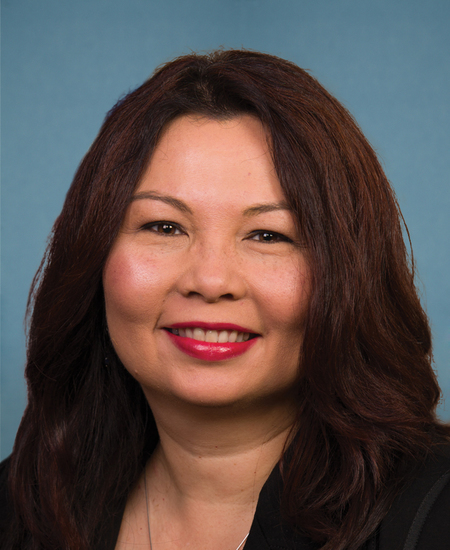
Ask Maddy about Tammy Duckworth
Scope: kansas
Hi! I can help you understand Tammy Duckworth's legislative record. What would you like to know?
Try one of these
i
Maddy answers using official bill text and legislative records. Always verify before sharing.
Sources cited inline