Maddy summarySRES 153 is a ceremonial Senate resolution designating March 27, 2025, as "National Women in Agriculture Day." It recognizes the contributions of women in U.S. agriculture, citing that women operate over 1.2 million farms (36% of total sales, $222 billion in 2022) and work across diverse roles from farming to education and advocacy. The resolution encourages public acknowledgment of women’s impact on the agricultural workforce and food systems, urging support for women entering the field, leadership opportunities, and global food security. As a non-binding resolution, it does not create new laws or funding but formally honors this group during National Women’s History Month and National Ag Week.
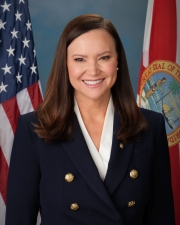
Sen. Ashley Moody
Sponsored bills
Maddy summaryThis bill protects students in single-sex social organizations (like fraternities or sororities) at colleges receiving federal funds. It prohibits institutions from punishing students or these groups solely because they limit membership to one sex - such as denying financial aid, housing, or leadership roles, or forcing students to renounce membership rights. The law clarifies that colleges may still enforce rules for academic misconduct or safety risks unrelated to membership policies and are not required to recognize such organizations. It specifically aims to prevent retaliation while respecting existing Title IX protections and institutional authority.
Maddy summaryThe BOLIVAR Act prohibits U.S. government agencies from entering contracts with businesses that have significant business dealings with Venezuela's Maduro regime (which the U.S. does not recognize as legitimate). Exceptions include contracts for humanitarian aid, disaster relief, national security needs, and operations supporting U.S. embassies in Venezuela. The law applies to contracts signed within three years of enactment and directly affects companies seeking federal contracts involving Venezuela. It does not restrict existing contracts or activities already authorized under U.S. sanctions.
Maddy summarySRES 148 is a ceremonial resolution passed by the U.S. Senate to honor the late Senator Alan K. Simpson of Wyoming, who died in 2022. The resolution expresses the Senate's "profound sorrow and deep regret" over his passing and formally requests the Secretary of the Senate to transmit an enrolled copy to his family. It also directs the Senate to adjourn as a mark of respect during its final session following the resolution's adoption. This resolution has no policy impact or direct effect on constituents - it solely serves as a formal tribute to Simpson's legacy.
Maddy summaryThis bill prevents U.S. federal courts from issuing orders (such as injunctions, stays, or declarations) that stop enforcement of laws against people or entities not directly involved in a lawsuit (non-parties). It requires that such orders only apply if a non-party is represented through a party acting under standard legal rules. The law applies to all federal courts, including those in U.S. territories, and modifies related procedures for temporary restraining orders and declaratory judgments to enforce this restriction. Its core change limits court authority to affect non-parties regarding statutes, regulations, or government actions.
Maddy summaryThis bill (SJRES 44) seeks to block a Department of Energy rule that set new energy efficiency standards for commercial refrigerators, freezers, and refrigerator-freezers. It directly affects businesses that manufacture, sell, or operate these commercial refrigeration units, which would have been required to meet the new standards. The resolution uses a specific legal process (under Chapter 8 of Title 5 U.S. Code) to formally disapprove the rule, meaning it would prevent the rule from taking effect. The rule in question was published in the Federal Register on January 21, 2025 (90 Fed. Reg. 7464). If passed, the rule would have no force or effect.
Maddy summaryThis resolution designates March 15, 2025, as "National Osceola Turkey Day" to recognize the Osceola subspecies of wild turkey, which is native only to peninsular Florida. It highlights Florida's cultural and economic ties to wild turkey hunting, including the state's Wild Turkey Cost Share Program and the role of turkey hunting permits in funding conservation. The resolution is symbolic, not a law, and does not create new regulations or affect specific groups. It aims to promote awareness of the Osceola turkey's ecological significance and Florida's hunting traditions. The designation aligns with Florida's spring turkey hunting season opening dates.
Maddy summaryThis bill (S 1086, "Stop CCP VISAs Act of 2025") would prohibit U.S. visa issuances for Chinese nationals seeking to study or conduct research in the United States under student (F), exchange visitor (J), or vocational (M) visa categories. It directly affects Chinese citizens planning to pursue academic or research programs at U.S. institutions. The key mechanism amends the Immigration and Nationality Act to explicitly ban these visa types for Chinese nationals, preventing them from using these categories for educational or research purposes. If enacted, this would block Chinese nationals from entering the U.S. for academic or research activities via these specific visa pathways.
Maddy summaryS 1013, the CAPE Canaveral Act, mandates the transfer of NASA's headquarters to Brevard County, Florida, within one year of the bill's enactment. This procedural bill directly affects NASA's operational structure by requiring a physical relocation of its central administrative offices. The key provision specifies the move must occur no later than one year after the bill becomes law, without altering NASA's mission or funding. This is a straightforward administrative change focused on location, not policy or program modifications.
Maddy summaryThis bill expands the Work Opportunity Tax Credit to include military spouses. It adds "qualified military spouse" as a new category eligible for the credit, meaning employers who hire spouses of active-duty service members can claim the tax benefit. To qualify, a spouse must be certified by a local agency as married to an Armed Forces member at the time of hire. The change applies to hires occurring after the law's effective date, directly affecting military spouses seeking employment and employers who hire them.