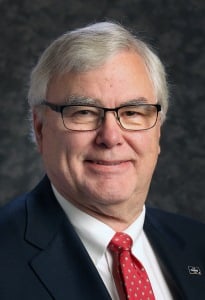
Photo of Jerry Stogsdill
D Kansas House · District 21 On the 2026 ballot

Rep. Jerry Stogsdill

Compare
Total votes
1,621
all sessions
Attendance
99%
14 missed
Near the chamber average
With party
97%
of cast votes
Near the chamber average
Bipartisan score
2%
crosses aisle rarely
Near the chamber average
Sponsored
99
bills & resolutions
Near the chamber average
Committees
3
assignments
99 bills and resolutions

Sponsored bills

Total
99
Primary
99
Co-sponsor
0
This page
99
matching current filters
Primary HB 2707
died · Kansas House · Lead sponsor
Modifying the definition of abuse in the protection from abuse act to include certain acts or threats related to pets and specifying that courts may include orders relating to pets in protection from abuse act orders.

Maddy summaryThis Kansas bill (HB 2707) expands the definition of "abuse" under the Protection from Abuse Act to include intentionally harming, threatening, or causing injury to a pet to control, punish, intimidate, or distress a partner or household member. It also allows courts to include specific orders about pet custody and protection in existing protection orders. The bill directly affects individuals in abusive relationships where pets are used as tools of control, such as when an abuser threatens or harms a pet to coerce a victim. Key mechanisms include adding new provisions to the law defining abuse (Section 1) and creating specific court orders for pet-related safety (Sections 10-11 of K.S.A. 60-3107).

died Apr 10, 2026 0 co-sponsors
Primary HB 2628
died · Kansas House · Lead sponsor
Establishing a refundable income tax credit for tuition payments and fees made to postsecondary educational institutions.

Maddy summaryHB 2628 creates a refundable Kansas income tax credit for residents paying tuition and fees at eligible colleges or universities. It allows qualifying taxpayers to claim up to $300 per year toward these costs for themselves or their child, with any unused portion refunded if the credit exceeds their tax bill. The credit applies to Kansas residents who paid for attendance at institutions meeting state-defined standards under K.S.A. 72-3222. This policy directly supports families and individuals covering higher education expenses, making the credit accessible even if they owe no state income tax.

died Apr 10, 2026 0 co-sponsors
Primary HB 2620
died · Kansas House · Lead sponsor
Increasing the eligible credit amount for the earned income tax credit.

Maddy summaryHB 2620 increases Kansas' earned income tax credit (EITC) by raising the state credit percentage from 17% to 18% of the federal EITC amount for tax years 2010-2012, then maintaining 17% for all subsequent years. It directly affects low-to-moderate-income Kansas residents who qualify for the federal EITC and claim it on their state tax returns. The bill modifies how the state credit is calculated (based on the federal credit amount) and ensures any excess credit beyond state tax liability is refunded to the taxpayer. This change updates Kansas law to align with the federal credit percentage, effective upon publication in the statute book.

died Apr 10, 2026 0 co-sponsors
Primary HB 2629
died · Kansas House · Lead sponsor
Increasing the amount of the standard deduction for Kansas income tax purposes.

Maddy summaryHB 2629 increases Kansas income tax standard deduction amounts for 2024 and beyond. It raises the standard deduction to $3,605 for single filers, $8,240 for married couples filing jointly, and $6,180 for heads of household in 2024, with further increases scheduled for 2026. This bill directly affects Kansas residents who claim the standard deduction instead of itemizing deductions on their state income tax returns. The change reduces taxable income for qualifying filers, lowering their overall tax liability under Kansas law.

died Apr 10, 2026 0 co-sponsors
Primary HB 2598
died · Kansas House · Lead sponsor
Enacting the Kansas paid family leave act.

Maddy summaryHB 2598, the Kansas Paid Family Leave Act, creates a state-run program providing up to 12 weeks of paid leave for eligible workers in Kansas to bond with a new child (birth, adoption, or foster placement), care for a family member with a serious health condition, recover from their own serious health condition, or address military family needs. It covers most full- and part-time employees who worked 26 weeks (20+ hours/week) or 175 days (less than 20 hours/week) in the prior year, plus self-employed individuals who opt into the program. Benefits will equal 67% of an employee's average weekly wage (capped at $1,000/week starting in 2028), funded through payroll deductions of employee premiums beginning January 2027. The program launches for eligible workers on July 1, 2027, with benefits paid from the Family and Medical Leave Insurance Fund.

died Apr 10, 2026 0 co-sponsors
Primary HB 2597
died · Kansas House · Lead sponsor
Establishing a right to paid sick leave for Kansas employees and setting forth minimum requirements and rules for the provision of such sick leave.

Maddy summaryHB 2597 requires all Kansas employers to provide employees with paid sick leave starting January 1, 2027. Employees earn at least two hours of paid sick leave for every 30 hours worked, up to a maximum of 40 hours per year, which can carry forward annually. The bill allows use for personal illness, caring for sick family members, addressing domestic violence, or handling emergencies like school closures due to weather. It applies to most employees but explicitly excludes independent contractors, with rules to be implemented by the Kansas Secretary of Labor.

died Apr 10, 2026 0 co-sponsors
Primary HB 2600
died · Kansas House · Lead sponsor
Establishing the Affordable Healthcare for Kansans program to expand medicaid eligibility.

Maddy summaryHB 2600 establishes the "Affordable Healthcare for Kansans" program to expand Medicaid eligibility in Kansas. It would extend coverage to non-pregnant adults under 65 with incomes at or below 138% of the federal poverty level, directly affecting low-income Kansans currently ineligible for Medicaid. The key provision raises the income threshold for Medicaid eligibility to match the federal standard, effective January 1, 2027. This change requires the Kansas Department of Health and Environment to administer the program and inform potential applicants. The bill aims to align Kansas Medicaid eligibility with the federal expansion program under federal law.

died Apr 10, 2026 0 co-sponsors
Primary HB 2029
Signed into law · Kansas House · Lead sponsor
Reconciling multiple amendments to certain statutes.

Maddy summaryThis bill designates a specific segment of K-5 highway in Wyandotte County (from the junction of K-5 and N. 18th Street west to N. 38th Street) as the "Representative Marvin S. Robinson II Memorial Highway." It also redesignates a portion of Interstate 635 (from the Kansas-Missouri border south to its junction with K-5 highway) as the "Harry Darby Memorial Highway." The bill requires the Kansas Secretary of Transportation to install highway signs marking both routes, following standard procedures. This is a procedural memorial designation with no substantive policy changes to transportation law.

Signed into law Apr 10, 2026 0 co-sponsors
Primary HB 2074
died · Kansas House · Lead sponsor
Including homestead renters as eligible to participate in certain homestead property tax refund claims.

Maddy summaryHB 2074 amends Kansas' Homestead Property Tax Refund Act to allow renters of their primary residence to qualify for the same tax refunds previously available only to homeowners. The bill explicitly includes renters in the eligibility criteria for three groups: individuals aged 55 or older, people with disabilities, and low-income households with dependent children. This change, effective for tax year 2025, updates the definition of "homestead" to cover rented properties and revises related terms in the law to reflect expanded access to the refund program.

died Apr 10, 2026 0 co-sponsors
Primary HB 2151
died · Kansas House · Lead sponsor
Increasing the Kansas minimum wage to $15 an hour.

Maddy summaryHB 2151 would raise Kansas' state minimum wage from $7.25 to $15 per hour for most hourly workers. The bill amends Kansas law (K.S.A. 44-1203) to establish this new rate and repeals the current minimum wage provisions. It directly affects most employees in Kansas, excluding specific categories like agricultural workers, domestic workers, and certain executive or administrative staff as defined in the law. Employers covered by federal minimum wage law would still follow the federal $7.25 rate, but all other Kansas employers would be required to pay at least $15 per hour.

died Apr 10, 2026 0 co-sponsors
Showing 11 to 20 of 99 bills