Combatting COVID Unemployment Fraud Act of 2021 This bill requires additional documentation for individuals seeking pandemic unemployment assistance, requires state unemployment agencies to use designated fraud prevention tools, and otherwise addresses pandemic-related unemployment benefits.
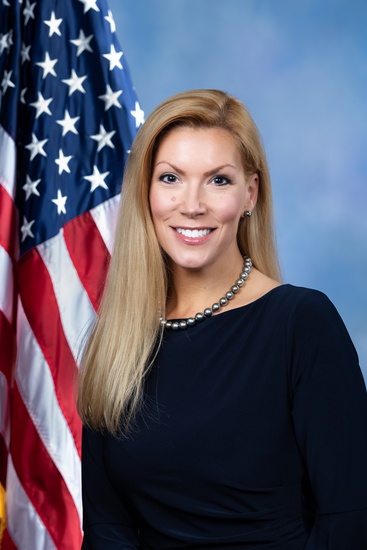
Rep. Beth Van Duyne
Sponsored bills
This bill eliminates federal pandemic unemployment compensation on May 31, 2021. Under current law, this supplementary compensation is available to claimants in participating states until September 6, 2021.
Metastatic Breast Cancer Access to Care Act This bill expedites payment of Social Security Disability Insurance (SSDI) benefits and eligibility for Medicare coverage for those with metastatic breast cancer (i.e., breast cancer that has spread to other sites in the body). Specifically, the bill eliminates the 5-month waiting period for SSDI benefits and the subsequent 24-month waiting period for Medicare coverage for individuals with metastatic breast cancer. Under current law, individuals generally must wait five months after the onset of disability to begin receiving SSDI benefits and an additional 24 months to become eligible for Medicare.
EIDL Oversight Act of 2021 This bill establishes oversight requirements for economic injury disaster loans and advances made on those loans. Such requirements include directing the Small Business Administration (SBA) to (1) ensure that loan and advance proceeds are deposited in a legitimate account of a borrower, (2) ensure that any modification of a request for a loan or an advance is reviewed by an SBA employee, and (3) verify the legitimacy of loan or advance applicants through tax returns or other documentation.
Stop CRT Act This bill grants Executive Order 13950 the force and effect of law. That order prohibits federal agencies and contractors from advancing specified policies or training related to race or sex.
Motor Carrier Safety Selection Standard Act This bill establishes a standard of care for the selection of brokers and other entities that contract with motor carriers for the shipment of goods or household goods. A broker is a person, other than a motor carrier or an employee or agent of a motor carrier, that as a principal or agent sells, offers for sale, negotiates for, or holds itself out by solicitation, advertisement, or otherwise as selling, providing, or arranging for, transportation by motor carrier for compensation. Specifically, the bill requires such entities to verify that a transporting motor carrier (1) is properly registered with the Department of Transportation (DOT); (2) has obtained the minimum required insurance coverage; and (3) is not determined unfit to safely operate commercial motor vehicles, or otherwise ordered to discontinue operations by the Federal Motor Carrier Safety Administration or a state. DOT must prescribe by regulation a process for revoking the registration of an owner or operator determined unfit to safely operate a commercial motor vehicle.
LEOSA Reform Act This bill broadens the authority for certain law enforcement officers to carry concealed firearms across state lines. Specifically, the bill allows qualified active and retired law enforcement officers to carry concealed firearms and ammunition (including magazines) in school zones; in national parks; on state, local, or private property that is open to the public; and in certain federal facilities that are open to the public. Further, the bill permits states to reduce the frequency with which retired law enforcement officers must meet certain qualification standards.
Life at Conception Act This bill declares that the right to life guaranteed by the Constitution is vested in each human being at all stages of life, including the moment of fertilization, cloning, or other moment at which an individual comes into being. Nothing in this bill shall be construed to authorize the prosecution of any woman for the death of her unborn child.
No Taxpayer Funding for Abortion and Abortion Insurance Full Disclosure Act of 2021 This bill modifies provisions relating to federal funding for, and health insurance coverage of, abortions. Specifically, the bill prohibits the use of federal funds for abortions or for health coverage that includes abortions. Such restrictions extend to the use of funds in the budget of the District of Columbia. Additionally, abortions may not be provided in a federal health care facility or by a federal employee. Historically, language has been included in annual appropriations bills for the Department of Health and Human Services (HHS) that prohibits the use of federal funds for abortions—such language is commonly referred to as the Hyde Amendment. Similar language is also frequently included in appropriations bills for other federal agencies and the District of Columbia. The bill makes these restrictions permanent and extends the restrictions to all federal funds (rather than specific agencies). The bill's restrictions regarding the use of federal funds do not apply in cases of rape, incest, or where a physical disorder, injury, or illness endangers a woman's life unless an abortion is performed. The Hyde Amendment provides the same exceptions. The bill also prohibits qualified health plans from including coverage for abortions. Currently, qualified health plans may cover abortion, but the portion of the premium attributable to abortion coverage is not eligible for subsidies.
Security First Act This bill provides statutory authorization for the Operation Stonegarden program from FY2022 through FY2025 and contains other provisions related to border security. (Operation Stonegarden provides grants to enhance the border security capabilities of state, local, and tribal governments.) From FY2022 through FY2025, the money from unreported monetary instruments seized from individuals crossing the U.S.-Mexico border and transferred into the Department of the Treasury general fund shall be made available without further appropriation to the Department of Homeland Security (DHS) to fund Operation Stonegarden. DHS shall report to Congress on (1) DHS hiring practices from 2017 to 2020, and (2) whether certain Mexican drug cartels meet the criteria to be designated as foreign terrorist organizations. DHS shall also periodically report to Congress about the technology needed to secure the U.S.-Mexico land border.