Maddy summarySRES 904 is a ceremonial Senate resolution commemorating the 75th anniversary of the Antiquarian Booksellers’ Association of America (ABAA), founded in 1949. The resolution recognizes the ABAA’s role in upholding ethical standards, supporting book collecting education, and fostering community among antiquarian booksellers. It formally requests the Senate transmit copies of the resolution to the ABAA’s leadership. This procedural resolution has no policy impact or direct effect on any individuals or entities beyond the symbolic acknowledgment.
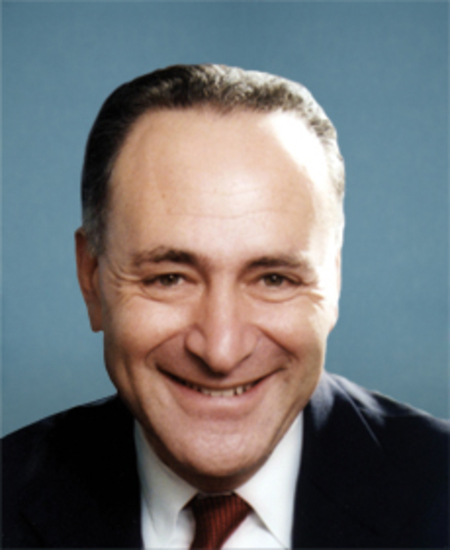
Sen. Charles E. Schumer
Sponsored bills
Maddy summaryThis resolution authorizes the Senate Legal Counsel to represent specific senators in a federal lawsuit. It covers Committee Chairman Bernie Sanders, Ranking Member Bill Cassidy, and 18 other members of the Senate Health, Education, Labor, and Pensions Committee, who are named as defendants in Dr. Ralph de la Torre v. Bernard Sanders, et al. (Civil Action No. 1:24-cv-02776-TNM). The resolution cites the Ethics in Government Act, allowing the Senate to direct its counsel to defend members in civil cases related to their official duties. This is a procedural measure, not a policy change, solely addressing legal representation for the named officials.
Maddy summaryThis is a ceremonial Senate resolution (SRES 902) honoring the late Senator Timothy Peter Johnson of South Dakota, who died after a long career in public service. The resolution expresses the Senate's "profound sorrow" over his death, directs the Secretary of the Senate to share the resolution with the House and send a copy to his family, and calls for the Senate to adjourn in his memory. It does not create new laws or affect any policies, as it is purely a formal expression of respect for a former senator. The resolution commemorates his decades of service, including his time as Chairman of the Banking Committee and his return to work after a serious health setback.
Maddy summaryThe Department of Energy Quantum Leadership Act of 2024 amends the National Quantum Initiative Act to strengthen federal quantum research and development. It establishes new programs for quantum research centers, instrumentation, network infrastructure, and user expansion, with $175 million annually allocated for research through 2029. The bill requires a 10-year strategic plan for quantum high-performance computing, creates a traineeship program for underrepresented students, and includes provisions to support small businesses in accessing quantum resources. It directly affects the Department of Energy, National Laboratories, universities, and the quantum technology industry. The law aims to accelerate U.S. leadership in quantum technology through coordinated research, workforce development, and commercialization efforts.
Maddy summaryS 3534, the Fire Island AIDS Memorial Establishment Act, authorizes the Pines Foundation to establish a memorial at Fire Island National Seashore to honor residents of Fire Island Pines and Cherry Grove, New York, who died from AIDS during the epidemic. The memorial, located along a specific walkway near Carrington House, must be funded entirely through non-Federal contributions, as federal funds cannot be used for its design, installation, or maintenance. The bill aims to preserve the memory of those affected and educate future generations about the AIDS epidemic's impact on these communities.
Maddy summarySRES 897 is a Senate resolution designating November 2024 as National Native American Heritage Month and recognizing the Friday after Thanksgiving as Native American Heritage Day, as established by the 2009 Native American Heritage Day Act. It formally acknowledges the contributions of Native Americans to U.S. history, culture, and society, including their roles in agriculture, environmental stewardship, military service, and the influence of Indigenous governance concepts on the U.S. Constitution. The resolution encourages the public to observe these designations through educational programs and activities. As a ceremonial resolution, it does not create new laws or directly affect any individuals or communities.
Maddy summaryThis resolution authorizes former Senate employee Daniel Schwager to provide testimony in the federal case *United States v. Baez* (criminal case No. 21-507 in the District of Columbia) and directs the Senate Legal Counsel to represent him regarding evidence production. It is based on Senate privileges under Rule XI and the Ethics in Government Act of 1978, which allow the Senate to protect its employees' official responsibilities. Testimony is permitted except for matters where Senate privileges (such as confidential communications) would apply. This is a procedural resolution addressing a specific legal request, not a policy change.
Maddy summaryThis resolution designates October 30, 2024, as a national day of remembrance for workers in the U.S. nuclear weapons program, including uranium miners, millers, plutonium processors, and participants in atmospheric nuclear tests. It directly recognizes the contributions and health sacrifices of these workers, who developed serious illnesses while supporting national defense. The key provision is the formal designation of the date, encouraging public commemoration through ceremonies and activities. This follows a series of similar Senate resolutions recognizing these workers since 2009. As a procedural resolution, it does not create new laws or funding but serves as a symbolic acknowledgment.
Maddy summarySRES 888 is a ceremonial Senate resolution honoring the late James Ralph Sasser, a former U.S. Senator from Tennessee (served 1976-1993). It formally expresses the Senate’s "profound sorrow" over his death and requests the Secretary of the Senate transmit the resolution to his family. The resolution has no policy impact or direct effect on any individuals or entities - it is solely a commemorative gesture. As a procedural resolution, it does not create new laws or alter existing policies.
Maddy summaryThis bill adjusts the premium tax credit program under the Affordable Care Act to make health insurance more affordable for lower-income households. It establishes a new sliding scale for the percentage of income people pay toward premiums based on household income relative to the federal poverty line (ranging from 150% to 400% of the poverty line). For example, households earning 150-200% of the poverty line would pay 0-2% of income, while those earning 300-400% would pay 6-8.5%. The changes apply to tax years beginning after December 31, 2025, and directly affect individuals purchasing health insurance through marketplace plans who qualify for these tax credits.