Accelerating Kids' Access to Care Act This bill requires state Medicaid programs to establish a process through which qualifying out-of-state providers may enroll as participating providers without undergoing additional screening requirements. Among other things, a qualifying provider must (1) serve minors, or adults whose condition began as a minor; and (2) have previously been screened for Medicare participation or for participation in the Medicaid program of the state in which the provider is located.
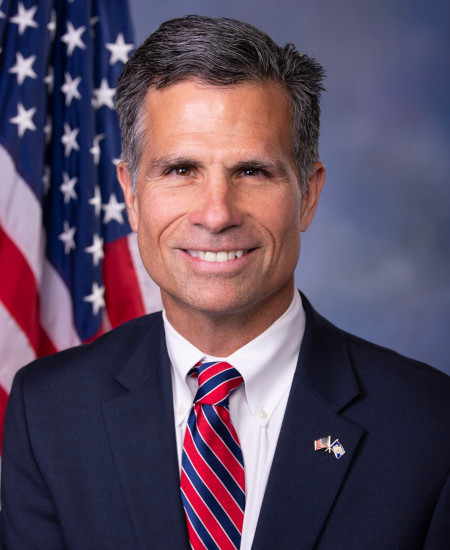
Rep. Daniel Meuser
Sponsored bills
This resolution calls for the International Olympic Committee to rebid the 2022 Winter Olympics if China fails to demonstrate significant progress in securing fundamental human rights. The resolution also expresses support for the well-being of Olympic athletes and the integrity of sport.
Motor Carrier Safety Selection Standard Act This bill establishes a standard of care for the selection of brokers and other entities that contract with motor carriers for the shipment of goods or household goods. A broker is a person, other than a motor carrier or an employee or agent of a motor carrier, that as a principal or agent sells, offers for sale, negotiates for, or holds itself out by solicitation, advertisement, or otherwise as selling, providing, or arranging for, transportation by motor carrier for compensation. Specifically, the bill requires such entities to verify that a transporting motor carrier (1) is properly registered with the Department of Transportation (DOT); (2) has obtained the minimum required insurance coverage; and (3) is not determined unfit to safely operate commercial motor vehicles, or otherwise ordered to discontinue operations by the Federal Motor Carrier Safety Administration or a state. DOT must prescribe by regulation a process for revoking the registration of an owner or operator determined unfit to safely operate a commercial motor vehicle.
Putting Our First Responders First Act of 2021 This bill modifies the requirements for calculating taxable income to allow first responders to exclude from gross income certain service-connected disability payments received as part of a pension or annuity after reaching the age of retirement. The bill applies to law enforcement officers, employees in fire protection activities, and individuals who provide out-of-hospital emergency medical care.
Investing in American Workers Act This bill allows a business-related tax credit for employers who increase worker training expenditures. The credit is equal to 20% of the excess of (1) the qualified training expenditures for the year, over (2) the average of the adjusted qualified training expenditures for the three previous years. If the employer had no qualified training expenditures in any one of the three previous years, the credit is equal to 10% of the adjusted qualified training expenditures for the year. The credit applies to expenditures for the training of non-highly compensated employees (annual compensation does not exceed $82,000). The training must result in the attainment of a recognized postsecondary credential and be provided through an apprenticeship program; a program of training services that is included on a list of eligible training providers that states are required to maintain under the Workforce Innovation and Opportunity Act; a program that is conducted by an area career and technical education school, a community college, or a labor organization; or a program that is sponsored and administered by an employer, industry trade association, industry or sector partnership, or labor organization. Certain small businesses and tax-exempt organizations may apply the credit against payroll taxes, subject to specified limits and requirements. Eligible small businesses may also apply the credit against the alternative minimum tax.
This concurrent resolution commemorates the 30th anniversary of Operation Provide Comfort (the humanitarian operation to defend and deliver aid to Kurdish refugees fleeing attacks by the Hussein regime), and it reaffirms the strong American-Kurdish partnership.
Putting Americans First Act This bill prohibits the termination of U.S. sanctions against Iran unless and until the President certifies that all U.S. citizens imprisoned in Iran have been released into U.S. custody.
Homecare for Seniors Act This bill allows tax-exempt distributions from health savings accounts (HSAs) to be used for qualified home care. Qualified home care means a contract to provide three or more of the following services in the residence of the service recipient assistance with eating, assistance with toileting, assistance with transferring, assistance with bathing, assistance with dressing, assistance with continence, and medication adherence. The Department of Health and Human Services must carry out a campaign to increase public awareness of the in-home service expenses that are eligible for tax-free distribution from HSAs.
Return Excessive Migrants and Asylees to International Neighbors in Mexico Act of 2021 or the REMAIN in Mexico Act of 2021 This bill requires the Department of Homeland Security (DHS) to implement the Migrant Protection Protocols as outlined in the January 25, 2019, memo titled Policy Guidance for Implementation of the Migrant Protection Protocols . (The protocols generally required aliens who are not clearly admissible, including those seeking asylum, arriving by land along the U.S.-Mexico border to be returned to Mexico while their immigration proceedings are pending, rather than remain in the United States. On January 21, 2021, DHS stopped applying the protocols to newly-arrived individuals.)
Pain-Capable Unborn Child Protection Act This bill establishes a new criminal offense for performing or attempting to perform an abortion if the probable post-fertilization age of the fetus is 20 weeks or more. A violator is subject to criminal penalties—a fine, a prison term of up to five years, or both. The bill provides exceptions for an abortion (1) that is necessary to save the life of the pregnant woman, or (2) when the pregnancy is the result of rape or incest. A physician who performs or attempts to perform an abortion under an exception must comply with specified requirements. A woman who undergoes a prohibited abortion may not be prosecuted for violating or conspiring to violate the provisions of this bill.