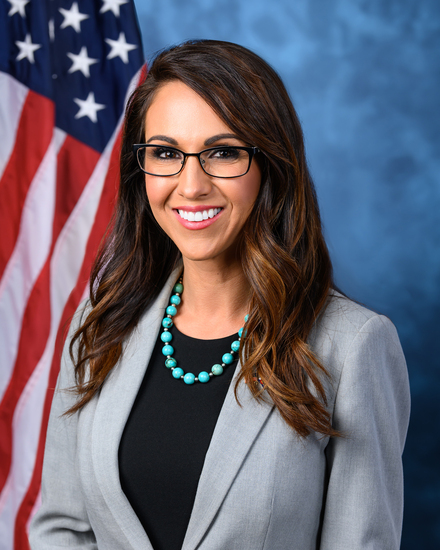
Photo of Lauren Boebert
R United States House · District 4 · Colorado On the 2026 ballot

Rep. Lauren Boebert

Compare
Total votes
2,837
all sessions
Attendance
96%
120 missed
Lower than 78% of chamber peers
With party
82%
of cast votes
Lower than 96% of chamber peers
Bipartisan score
9%
crosses aisle rarely
Higher than 94% of chamber peers
Sponsored
1,024
bills & resolutions
Near the chamber average
Committees
7
assignments
1,024 bills and resolutions

Sponsored bills

Total
1,024
Primary
88
Co-sponsor
936
This page
1,024
matching current filters
Co-sponsor HR 8730
In committee · Illinois House · Co-sponsor
Connected Vehicle Security Act of 2026

Maddy summaryThe Connected Vehicle Security Act of 2026 restricts the importation, sale, and manufacture of vehicles and related technology from specific countries, including China, Russia, Iran, and North Korea, to address national security concerns. The law defines prohibited items as connected vehicles, their software, and hardware components and sets different effective dates, with vehicle bans starting in 2027 and hardware restrictions beginning in 2030. A government official can grant exceptions for specific items after reviewing security risks and notifying Congress, while the agency must publish annual reports on enforcement actions and compliance.

In committee May 11, 2026 1 co-sponsor
Co-sponsor HR 8680
In committee · Illinois House · Co-sponsor
Armed Forces Carry Rights Protection Act of 2026

Maddy summaryThe Armed Forces Carry Rights Protection Act of 2026 modifies federal law to make it easier for military personnel to carry personal firearms on military bases when they are not on duty. Under this bill, commanders would face a legal presumption in favor of approving such requests, shifting the default stance toward allowing carry rather than restricting it. If a commander does deny a request, the law requires them to provide a written explanation that is specific to the individual and based on objective criteria. This change directly affects active-duty service members and the commanders who evaluate their requests for firearm authorization on installation.

In committee May 7, 2026 1 co-sponsor
Co-sponsor HR 8596
In committee · Illinois House · Co-sponsor
FAIR Labels Act of 2026

Maddy summaryThe FAIR Labels Act of 2026 establishes new labeling requirements for cell-cultivated protein products and plant-based alternatives designed to look like meat or poultry. It mandates that labels for these products prominently display the terms "cell-cultivated" or "plant-based alternative protein product" and include clear disclaimers stating the items are not derived from live animals or birds. Additionally, the bill updates regulatory oversight by requiring the USDA and FDA to revise their agreement, assigning the USDA primary responsibility for regulating cell-cultivated meat and poultry while the FDA oversees production safety and facility compliance. The legislation also directs these agencies to create common standards of identity for these products within 180 days of enactment.

In committee Apr 30, 2026 1 co-sponsor
Co-sponsor HR 8591
In committee · Illinois House · Co-sponsor
No Capital Gains Tax on Family Farms Act

Maddy summaryThis bill, titled the No Capital Gains Tax on Family Farms Act, would allow farmers to sell their land to immediate family members without paying capital gains tax on the profit. To qualify, the property must have been used as a farm for at least two years within the eight years prior to the sale, and the buyer must be a spouse, lineal descendant, or their spouse. If the new owner keeps the farm for ten years, the property's tax basis will be adjusted upward to reflect its fair market value at the time of the sale. The law applies to sales occurring after its enactment and requires the IRS to issue regulations to guide its implementation.

In committee Apr 30, 2026 1 co-sponsor
Co-sponsor HR 8587
In committee · Illinois House · Co-sponsor
Safeguarding Honest Speech Act of 2026

Maddy summaryThe Safeguarding Honest Speech Act of 2026 prohibits federal agencies from using taxpayer money to enforce rules that require employees or contractors to use a person's preferred pronouns if they conflict with that person's biological sex or to use names other than legal names. The bill defines sex strictly based on biological characteristics, such as the reproductive system used for fertilization, to determine these requirements. It also establishes a process where affected workers can file complaints, receive a formal response within 30 days, and sue their agency for violations if the response is unsatisfactory. If a worker wins a lawsuit, the court can order the agency to stop the practice, pay damages up to $100,000, and cover legal fees.

In committee Apr 29, 2026 1 co-sponsor
Primary HR 8537
In committee · Illinois House · Lead sponsor
TRUMP Ballroom Act

Maddy summaryThis bill, known as the TRUMP Ballroom Act, authorizes the President to design and build a new ballroom on White House grounds. It grants the President sole authority over the project's design and approval without requiring input from other officials. The legislation directly affects the White House by permitting the construction of this specific facility on its property.

In committee Apr 28, 2026 0 co-sponsors
Co-sponsor HR 161
In committee · Illinois House · Co-sponsor
New Source Review Permitting Improvement Act

New Source Review Permitting Improvement Act This bill modifies terminology for purposes of the New Source Review (NSR) permitting program of the Environmental Protection Agency (EPA). In order for a change to a stationary source to be a modification (a change to a stationary source that increases the air pollutant emissions or results in new pollutants) for purposes of the NSR permitting program, the maximum hourly emission rate achievable by such source must be higher than the maximum hourly rate achievable by such source during any hour in the 10-year period preceding the change. A change at a stationary source is not considered to be a modification under the bill if it is designed to (1) reduce the amount of any air pollutant emitted; or (2) restore, maintain, or improve the reliability of operations at, or safety of, the source. However, such changes are not excepted if the EPA determines the increase in the maximum achievable hourly emission rate from such change would cause an adverse effect on human health or the environment. Construction , in connection with a major emitting facility (a type of stationary source), does not include a change at such a facility that does not result in a significant emissions increase or a significant net emissions increase. In relation to major emitting facilities in nonattainment areas, the terms modifications and modified do not include changes at such facilities that do not result in a significant emissions increase or a significant net emissions increase.

In committee Apr 28, 2026 1 co-sponsor
Co-sponsor HR 8470
In committee · Illinois House · Co-sponsor
Surveillance Accountability Act

Maddy summaryThe Surveillance Accountability Act aims to strengthen Fourth Amendment protections against warrantless government searches, directly affecting federal employees involved in surveillance and individuals whose data or privacy is subject to government access. It generally mandates that government entities obtain a warrant based on probable cause for most searches, explicitly requiring one to access data held by third-party companies like internet providers or financial institutions. While outlining exceptions for situations like plain view or publicly available information, the bill specifically prohibits the warrantless collection or analysis of biometric data (e.g., facial recognition) or license plate reader data from public places without informed consent. Additionally, it creates a new legal avenue for individuals to sue federal employees who violate their Fourth Amendment rights, allowing for redress and attorney's fees.

In committee Apr 23, 2026 1 co-sponsor
Co-sponsor HR 8427
In committee · Illinois House · Co-sponsor
Congressional Pension Integrity Act of 2026

Maddy summaryThe Congressional Pension Integrity Act of 2026 prohibits Members of Congress from receiving annuity or retired pay based on their service if they are convicted of specific offenses committed while in office. The bill adds a new section to federal law that bars pension payments for individuals convicted of crimes including rape, sexual assault, sexual abuse of a minor, certain sex trafficking offenses, crimes of violence, and various federal crimes related to bribery, elections, theft, fraud, and obstruction of justice. Additionally, the legislation allows for denial of pension benefits if the House of Representatives determines that a Member engaged in sexual misconduct with an officer or employee under their supervision. These provisions apply to current and former Members and their survivors, with the ban taking effect for the Congress following the bill's enactment.

In committee Apr 21, 2026 1 co-sponsor
Co-sponsor HR 8374
In committee · Illinois House · Co-sponsor
Equal Treatment for Farmers Act

Maddy summaryThe Equal Treatment for Farmers Act removes references to 'socially disadvantaged farmers and ranchers' from multiple federal agricultural laws and programs. This bill amends various statutes including the Federal Crop Insurance Act, Consolidated Farm and Rural Development Act, and other agricultural legislation to eliminate special preferences or categories based on social disadvantage status. The legislation also prohibits the USDA from providing any preference, priority consideration, or enhanced benefits based on race or gender in its programs. These changes affect how federal agricultural assistance, loans, and benefits are categorized and distributed to farmers and ranchers.

In committee Apr 20, 2026 1 co-sponsor
Showing 51 to 60 of 1,024 bills
Previous 1 … 5 6 7 … 103 Next