Maddy summaryThis bill proposes a constitutional amendment to limit how long members of Congress can serve. It would restrict Representatives to six two-year terms (12 years total) and Senators to two six-year terms (12 years total), with any service exceeding one year in a term counting as a full term. The amendment would not apply to current members serving before the 118th Congress (2023-2025). If ratified, it would create a permanent term limit for future members of the House and Senate.
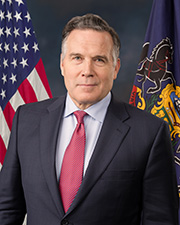
Sen. David McCormick
Sponsored bills
Maddy summaryThe Combating Organized Retail Crime Act amends federal law to strengthen legal tools for addressing organized retail crime, including theft from stores, online, and supply chains. It establishes a new Organized Retail and Supply Chain Crime Coordination Center within the Department of Homeland Security to coordinate Federal, State, local, and tribal law enforcement efforts. The Center will share information, assist with investigations, track crime trends, and provide training to combat these crimes. The bill expands legal definitions to include organized retail crime as a specific category and requires annual reports on the Center's activities. The Center will operate for 7 years before sunset.
Maddy summaryThis bill amends the U.S. Housing Act of 1937 to exclude certain veterans' disability benefits from income calculations for housing assistance. Specifically, it excludes disability benefits received under Chapter 11 or 15 of Title 38 (veterans' benefits) when determining eligibility for the Section 8 supported housing program and other housing assistance. It directly affects disabled veterans receiving these specific benefits by making them less likely to be disqualified from housing programs due to their disability income. The change applies to income eligibility determinations under HUD-administered housing assistance programs, not to the definition of adjusted income itself.
Maddy summaryThe FIGHT Act of 2025 amends the Animal Welfare Act to ban gambling on animal fighting events (including broadcasts), prohibit transporting roosters (defined as male chickens over 6 months old) for fighting, and make it illegal to sponsor, exhibit, or allow minors under 16 to attend such events. It allows citizens to file civil lawsuits to stop violations after 60 days' notice to authorities, with fines up to $5,000 per violation. The law also permits seizure of property used to facilitate violations, such as land or buildings. It does not override state or local laws on animal fighting unless there is a direct conflict.
Maddy summaryS 1485, the North American Energy Act, creates a new federal certification process for new cross-border energy infrastructure projects. It requires companies to obtain a "certificate of crossing" from the Federal Energy Regulatory Commission (for oil/gas pipelines) or the Department of Energy (for electric transmission) before building or operating new border-crossing facilities, with a 90-day deadline for approval unless the project is deemed not in the public interest. The bill eliminates the need for Presidential permits for these projects and exempts existing facilities, pending permits, and projects with prior approvals. This directly affects energy companies planning new border infrastructure, streamlining federal review while maintaining environmental and reliability standards.
Maddy summaryThis bill requires states that use federal Medicaid funds to pay abortion providers to submit detailed annual reports to the federal government. The reports must include specific payment amounts, purposes, comparisons to prior years, the number of abortions performed, gestational age, and abortion method for each provider. States must also publish these reports online, and the federal government must compile and publish a summary for Congress. The law directly affects states administering Medicaid who fund abortions, mandating transparency about these payments using plain language definitions of "abortion" and "abortion provider."
Maddy summaryThis bill amends federal rules governing physician self-referral to improve access for rural hospitals. It creates a new exemption for "covered rural hospitals" (defined as rural facilities meeting specific criteria) from certain referral restrictions, while clarifying they aren't required to meet additional criteria. It also removes a prohibition on expanding existing physician-owned hospitals, allowing such expansions to begin immediately upon enactment. The changes directly affect rural hospitals qualifying under the new definition and physician-owned hospitals seeking to expand. The bill modifies existing Social Security Act provisions without creating new programs or funding.
Maddy summaryThis bill, titled misleadingly as the "Secure Family Futures Act of 2025," actually modifies tax rules for specific insurance companies, not family-related policies. It directly affects "applicable insurance companies" (defined as most domestic insurers not using special tax elections or foreign entities) by: (1) excluding their debt holdings (like bonds) from being counted as capital assets for tax purposes, and (2) allowing capital losses incurred by these companies to be carried forward over 10 years instead of the standard period. These changes apply to debt acquired and losses arising after December 31, 2025. The bill contains no provisions related to families, child welfare, or social programs.
Maddy summaryThis resolution (SRES 159) is a ceremonial Senate measure honoring the late Senator John Bennett Johnston, Jr. (1932-2024), who represented Louisiana in the U.S. Senate from 1972 to 1997. It commemorates his career, including his work on energy policy, flood control, and Louisiana conservation efforts, and requests the Senate adjourn in his memory while sending condolences to his family. As a non-binding resolution, it has no policy impact or direct effect on any individuals or laws.
Maddy summaryThis bill (S 1308, VETS Opportunity Act of 2025) changes how the U.S. Department of Veterans Affairs (VA) counts independent study programs toward education benefits for veterans. It requires these programs to include regular, substantive interaction between students and instructors to qualify for VA funding. The bill also specifies that only institutions participating in federal student aid programs (Title IV of the Higher Education Act) can offer qualifying independent study courses. These changes apply to education terms starting August 1, 2025, directly affecting veterans pursuing VA-covered independent study courses.