

Safeguard American Voter Eligibility Act or the SAVE Act This bill requires individuals to provide documentary proof of U.S. citizenship when registering to vote in federal elections. Specifically, the bill prohibits states from accepting and processing an application to register to vote in a federal election unless the applicant presents documentary proof of U.S. citizenship. The bill specifies what documents are considered acceptable proof of U.S. citizenship, such as identification that complies with the REAL ID Act of 2005 that indicates U.S. citizenship. Further, the bill (1) prohibits states from registering an individual to vote in a federal election unless, at the time the individual applies to register to vote, the individual provides documentary proof of U.S. citizenship; and (2) requires states to establish an alternative process under which an applicant may submit other evidence to demonstrate U.S. citizenship. Each state must take affirmative steps on an ongoing basis to ensure that only U.S. citizens are registered to vote, which shall include establishing a program to identify individuals who are not U.S. citizens using information supplied by certain sources. Additionally, states must remove noncitizens from their official lists of eligible voters. The bill allows for a private right of action against an election official who registers an applicant to vote in a federal election who fails to present documentary proof of U.S. citizenship. The bill establishes criminal penalties for certain offenses, including registering an applicant to vote in a federal election who fails to present documentary proof of U.S. citizenship.
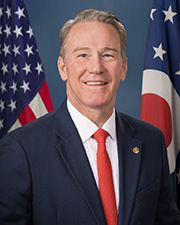
Sen. Jon Husted
Sponsored bills
Maddy summaryThis bill requires the President to designate Ansarallah (the Houthi movement in Yemen) as a foreign terrorist organization within 30 days, imposing sanctions on the group and its officials or affiliates. It mandates a 180-day strategy to restore Red Sea navigation and degrade Ansarallah's military capabilities, including targeting their command structure and support networks. The bill also requires a report on humanitarian aid obstacles in Yemen under Ansarallah's control, detailing bureaucratic barriers, interference with aid delivery, and threats to aid workers. The provisions directly affect Ansarallah, its leadership (including key figures like Abdul Malik al-Houthi), and U.S. efforts to support humanitarian access in Yemen.
Maddy summaryThis bill (S 100) repeals the Corporate Transparency Act, which required businesses to disclose beneficial ownership information to the government. It directly affects businesses (especially small entities) that previously had to report who ultimately owns or controls them. The bill removes specific reporting requirements from Title 31 of the U.S. Code and eliminates related provisions in the Anti-Money Laundering Act of 2020. Key mechanisms include striking references to reporting sections (like 5336) and repealing sections of the 2021 National Defense Authorization Act that established the rules. This would end the federal mandate for businesses to disclose ownership details to the Financial Crimes Enforcement Network (FinCEN).
Maddy summaryS 94, the "Miracle on Ice Congressional Gold Medal Act," authorizes three congressional gold medals for the 1980 U.S. Olympic Men's Ice Hockey Team members. The bill directs the Secretary of the Treasury to strike the medals, with one medal displayed at each of three locations: the Lake Placid Olympic Center, the U.S. Hockey Hall of Fame Museum in Minnesota, and the U.S. Olympic & Paralympic Museum in Colorado Springs. The legislation also permits the sale of bronze duplicates to cover costs, with proceeds going to the U.S. Mint. This is a commemorative measure recognizing the team's 1980 Olympic victory, not a policy change affecting current legislation or constituents.
Maddy summaryThis bill requires Congress to pass the annual budget resolution and all funding bills by October 1 each year. If Congress misses this deadline, members of Congress (excluding the Vice President) would not receive salary for the period of non-compliance, and this pay would not be retroactively issued. The Budget Chairs of each chamber would determine compliance and certify pay withholding. The law takes effect on September 29, 2027.
Maddy summaryThis bill would allow individuals with a valid concealed carry permit from their home state to carry concealed handguns in other states that either permit concealed carry for residents or don’t ban it entirely. It applies to permit holders who are federally eligible to possess firearms, require government-issued ID, and must follow the host state’s specific restrictions (like where carry is prohibited). The bill does not override state laws on issuing permits but ensures reciprocity for those who legally carry in their home state, excluding machineguns and destructive devices.