Agricultural Security Risk Review Act This bill expands the membership of the Committee on Foreign Investment in the United States to include the Secretary of Agriculture. (The committee reviews the national security implications of certain foreign investments in U.S. businesses or real estate, including critical infrastructure or technologies.)
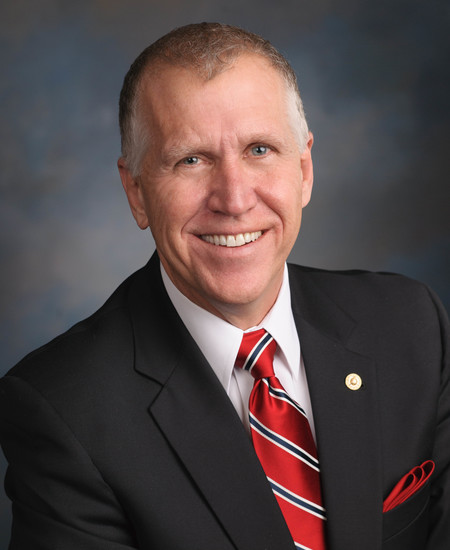
Sen. Thom Tillis
Sponsored bills
Reaching America's Rural Minority Businesses Act of 2021 This bill authorizes the Minority Business Development Agency to establish rural business centers at historically Black colleges and universities to assist rural minority businesses with issues such as broadband adoption, advanced manufacturing, and entrepreneurship.
No Stolen Trademarks Honored in America Act This bill modifies the bar against U.S. courts enforcing or validating trademarks that were confiscated by the Cuban government. The bill prohibits U.S. courts from enforcing or validating such confiscated trademarks if the mark had been used in connection with a confiscated business or asset. Currently, the prohibition applies only if the confiscated trademark is being asserted in the United States by a Cuban national. Under the bill, the prohibition shall not apply if the original trademark owner, or a successor, has expressly consented to the enforcement action. The prohibition shall apply only if the entity asserting the trademark rights knew or should have known, when it acquired the rights, that the mark was the same or substantially similar to one connected to a confiscated business or asset.
Protecting Our Well-being by Expanding Russian Sanctions Act or the POWERS Act This bill expands existing sanctions against foreign persons engaged in certain activities related to the Nord Stream 2 and TurkStream pipelines, two Russian pipelines that were constructed to supply natural gas to Europe. Currently, these sanctions apply to foreign persons that (1) provided pipe-laying vessels for the construction of either pipeline, (2) facilitated certain transactions for such vessels, (3) provided certain underwriting services or insurance for such vessels, or (4) provided certain services for such vessels or Nord Stream 2. Under this bill, these sanctions must also apply to any foreign person that engaged in any transaction with such sanctioned persons. The bill also reinstates any sanctions that were previously waived with respect to Nord Stream 2 AG (the company established to construct and operate the pipeline) or any of its corporate officers. Such reinstated sanctions may not be waived except by an act of Congress.
Don't Weaponize the IRS Act This bill codifies regulations promulgated by the Trump Administration exempting certain tax-exempt organizations from specified reporting requirements. Specifically the bill increases from $5,000 to $50,000 the gross receipts threshold used to determine the eligibility of tax-exempt organizations for the exemption from certain disclosure and reporting requirements; expands the definition of organization to include tax-exempt charitable organizations and organizations with no significant activities relating to lobbying, political activity, and the operation of a trade or business; exempts from disclosure the names and addresses of contributors to an organization in its annual informational return; and extends exemptions from reporting requirements to political action committees (i.e., 527 organizations).
This resolution affirms U.S. support for Israel's right to peace and security as well as its right to defend itself and its civilians against terror.
Taxpayer Receipt Act This bill requires the Department of the Treasury to provide taxpayers with a one-page document that contains information regarding the federal budget for the most recently completed fiscal year. The document must include total outlays during the year, total revenues collected during the year, the deficit or surplus for the year, and the total debt held by the public.
This bill requires each state that offers pandemic unemployment assistance (PUA) or pandemic emergency unemployment compensation (PEUC) to condition benefit eligibility for a long-term unemployed individual on an employer's confirmation that work is unavailable for the unemployed individual. Specifically, each state unemployment agency must request confirmation from the unemployed individual's most recent employer that the individual's position is not available at the time of the request. Unless the employer provides this confirmation, the state must terminate the individual's PUA or PEUC. The bill's provisions apply only to long-term unemployed individuals who have received PUA or PEUC for more than 30 weeks of unemployment.
Postal Service Reform Act of 2021 This bill addresses the finances and operations of the U.S. Postal Service (USPS). The bill requires the Office of Personnel Management to establish, within the Federal Employees Health Benefits Program, the Postal Service Health Benefits Program for USPS employees and retirees and provides for coordinated enrollment of retirees under this program and Medicare. The bill repeals the requirement that the USPS annually prepay future retirement health benefits. Additionally, the USPS may establish a program to enter into agreements with an agency of any state government, local government, or tribal government, and with other government agencies, to provide certain nonpostal products and services that reasonably contribute to the costs of the USPS and meet other specified criteria. The USPS must develop and maintain a publicly available dashboard to track service performance and must report regularly on its operations and financial condition. The bill requires mail delivery to occur at least six days a week. The Postal Regulatory Commission must annually submit to the USPS a budget of its expenses. It must also conduct a study to identify the causes and effects of postal inefficiencies relating to flats (e.g., large envelopes). The USPS Office of Inspector General shall perform oversight of the Postal Regulatory Commission.
This bill authorizes the President to issue a posthumous honorary commission promoting Lieutenant General Frank Maxwell Andrews, U.S. Army, to the grade of general.