

Equitable Data Collection and Disclosure on COVID-19 Act of 2021 This bill expands data collection and reporting on demographic information and disparities related to COVID-19 (i.e., coronavirus disease 2019). During the COVID-19 emergency, the Centers for Disease Control and Prevention (CDC) and the Centers for Medicare & Medicaid Services must publish data on COVID-19 testing, treatment, vaccinations, and outcomes on the CDC website. They must update the data daily and disaggregate it by race, ethnicity, and other demographic factors. In addition, the Indian Health Service must consult with tribal nations about COVID-19 data collection and reporting. The Department of Health and Human Services must make a summary of final statistics related to COVID-19 publicly available and report specified information to Congress within 60 days of the end of the COVID-19 emergency. The bill also establishes the Commission on Ensuring Data for Health Equity. The commission must determine approaches to using data to reduce disparities in health outcomes, including specifically with respect to COVID-19. In addition, it must provide recommendations to improve demographic data collection and use in future public health emergencies.
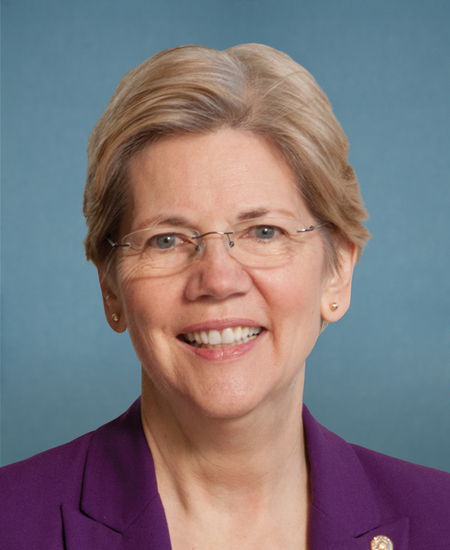
Sen. Elizabeth Warren
Sponsored bills
Ending Qualified Immunity Act This bill eliminates the defense of qualified immunity in civil actions for deprivation of rights. Qualified immunity is a judicially created doctrine that protects government employees or those acting with state authority from being held personally liable for constitutional violations. The bill provides that under the statute allowing a civil action alleging deprivation of rights under color of law, it shall not be a defense or immunity to any such action that (1) the defendant was acting in good faith or believed that his or her conduct was lawful at the time it was committed; (2) the rights, privileges, or immunities secured by the Constitution or federal laws were not clearly established at the time of their deprivation; or (3) the state of the law was such that the defendant could not reasonably have been expected to know whether his or her conduct was lawful.
Forced Arbitration Injustice Repeal Act This bill prohibits a predispute arbitration agreement from being valid or enforceable if it requires arbitration of an employment, consumer, antitrust, or civil rights dispute.
This concurrent resolution (1) affirms, on the 400th anniversary of the arrival of the first slave ship, that the nation owes a debt of remembrance not only to those who lived through the injustices of slavery but also to their descendants; and (2) urges the establishment of a U.S. Commission on Truth, Racial Healing, and Transformation to properly acknowledge, memorialize, and be a catalyst for progress, including toward permanently eliminating persistent racial inequities.
This resolution designates the week of February 22-February 26, 2021, as Public Schools Week.
Stop Tip-overs of Unstable, Risky Dressers on Youth Act or the STURDY Act This bill requires the Consumer Product Safety Commission to revise the safety standards for freestanding clothing storage units such as dressers, bureaus, or chests of drawers. Such standards must include specified testing related to tip overs and new warning requirements for all such products entering the U.S. market.
Coronavirus Medicaid Response Act This bill increases the Medicaid federal matching rate, also known as the Federal Medical Assistance Percentage (FMAP), for states and U.S. territories that experience economic downturns (i.e., high unemployment) beginning on or after January 1, 2020, in accordance with specified requirements and limitations. The bill's increase is in addition to previously enacted FMAP increases relating to COVID-19 (i.e., coronavirus disease 2019) but may not result in an FMAP greater than 95%.
Mainstreaming Addiction Treatment Act of 2021 This bill removes the requirement that a health care practitioner apply for a separate waiver through the Drug Enforcement Administration (DEA) to dispense certain narcotic drugs (e.g., buprenorphine) for maintenance or detoxification treatment (i.e., substance use disorder treatment). Further, a community health aide or community health practitioner may dispense certain narcotic drugs for maintenance or detoxification treatment without registering with the DEA if the drug is prescribed by a health care practitioner through telemedicine. It preempts state laws related to licensure for this activity. The bill also directs the Substance Abuse and Mental Health Services Administration to conduct a national campaign to educate health care practitioners and encourage them to integrate substance use disorder treatment into their practices.
Democracy Restoration Act of 2021 This bill addresses the voting rights of individuals convicted of a criminal offense and the restoration of their voting rights. First, the bill declares that the right of a U.S. citizen to vote in any election for federal office shall not be denied or abridged because that individual has been convicted of a criminal offense unless, at the time of the election, such individual is serving a felony sentence. Further, the bill provides for enforcement of, and remedies for violations of, the bill. In addition, it sets forth requirements for state and federal notification of individuals of the restoration of their voting rights. Finally, the bill prohibits federal funding of construction or improvement of a place of incarceration unless U.S. citizens incarcerated in that jurisdiction are notified, upon release, of their voting rights.
This resolution recognizes Black History Month as an opportunity to reflect on U.S. history and to commemorate the contributions of African Americans. It calls for the United States to (1) honor the contribution of pioneers who helped to ensure its legacy; and (2) move forward as a nation "indivisible, with liberty and justice for all."