Renewable Fuel Infrastructure Investment and Market Expansion Act of 2021 This bill establishes programs and requirements to expand access to renewable fuel. Specifically, the U.S. Department of Agriculture must establish a program to award grants for the deployment of renewable fuel infrastructure as specified by this bill. In addition, the Environmental Protection Agency (EPA) must finalize a 2021 proposed rule titled E 15 Fuel Dispenser Labeling and Compatibility With Underground Storage Tanks . When finalizing the rule, the EPA must eliminate the labeling requirements for fuel pumps that dispense E 15 fuel (i.e., gasoline that contains 15% ethanol).
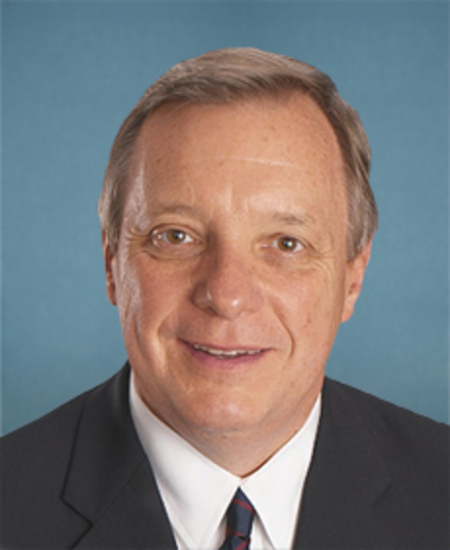
Sen. Richard J. Durbin
Sponsored bills
Family and Medical Insurance Leave Act or the FAMILY Act This bill entitles every employee to a family and medical leave insurance (FMLI) monthly benefit payment of two-thirds of the employee's regular pay, limited to a maximum of $4,000, for not more than 60 days of qualified caregiving. The bill establishes the Office of Paid Family and Medical Leave within the Social Security Administration to administer the FMLI program. An FMLI benefit payment must be coordinated with any periodic benefits received under a state or local temporary disability insurance or family leave program. The bill imposes a tax on employers, employees, and self-employed individuals to fund FMLI benefits. It also establishes the Federal Family and Medical Leave Insurance Trust Fund to hold tax revenues.
United States-Cuba Trade Act of 2021 This bill repeals the trade embargo on Cuba and other provisions restricting trade and travel to Cuba. Specifically, the bill (1) removes restrictions on certain transactions related to trademarks used in connection with a confiscated business or asset, (2) extends nondiscriminatory trade treatment to Cuban products, and (3) prohibits and rescinds limits on remittances to Cuba. The bill authorizes common carriers to provide telecommunications services between the United States and Cuba. In addition, travel by U.S. citizens and residents to Cuba may not be regulated or prohibited if such travel would be lawful in the United States. The President shall take all necessary steps to engage with Cuba to (1) negotiate settlements relating to claims that Cuba had taken the property of U.S. nationals, and (2) secure the protection of internationally recognized human rights. The President may, with respect to Cuba, impose new export controls and exercise powers related to declared national emergencies. The President must submit a specified determination about a foreign country to Congress prior to denying an income tax credit for taxes paid to the foreign country.
Dream Act of 2021 This bill directs the Department of Homeland Security (DHS) to cancel removal and grant lawful permanent resident status on a conditional basis to an alien who is inadmissible or deportable or is in temporary protected status who (1) has been continuously physically present in the United States for four years preceding this bill's enactment, (2) was younger than 18 years of age on the initial date of U.S. entry, (3) is not inadmissible on various grounds such as those related to crime or security, and (4) has fulfilled specified educational requirements. DHS shall cancel the removal of, and adjust to the status of an alien lawfully admitted for permanent residence on a conditional basis, an alien who was granted Deferred Action for Childhood Arrivals (DACA) status unless the alien has engaged in conduct that would make the alien ineligible for DACA. DHS shall remove the conditional basis of the permanent resident status granted under this bill if the alien meets various requirements, such as (1) maintaining residence in the United States, and (2) acquiring a degree from an institution of higher education or serving in the uniformed services. DHS may not disclose or use information provided in applications filed under this bill or in DACA requests for immigration enforcement purposes. The bill repeals a restriction barring states from providing higher education benefits to undocumented aliens unless those benefits are available to all U.S. citizens.
COVID-19 Whistleblower Protection Act This bill establishes whistleblower protections for government contractors and private sector workers who may witness waste, fraud, or abuse or be victims of misconduct with respect to a COVID-19 (i.e., coronavirus disease 2019) pandemic-related program, project, or activity. Specifically, employers may not discharge, demote, or otherwise discriminate against such protected individuals who disclose information concerning fraud, misuse, or other misconduct related to COVID-19 program funds. A protected individual may submit to the Department of Labor a complaint alleging a violation of these protections and Labor may adjudicate such complaints and award relief in accordance with the Internal Revenue Service whistleblower procedures.
Real Economic Support That Acknowledges Unique Restaurant Assistance Needed To Survive Act of 2021 or the RESTAURANTS Act of 2021 This bill temporarily establishes and provides funding for the Restaurant Revitalization Fund, from which the Department of the Treasury shall make grants to eligible food and beverage purveyors to cover specified costs such as payroll, operational expenses, and paid sick leave. For the grant program's initial period, Treasury must (1) prioritize awarding grants to marginalized and underrepresented communities, and (2) only award grants to eligible food and beverage purveyors with annual revenues of less than $1.5 million in 2019. For tax purposes, grant amounts are excluded from the recipient's gross income. An entity that received a loan under the Paycheck Protection Program established to support small businesses in response to COVID-19 (i.e., coronavirus disease 2019) may not apply for or use a restaurant revitalization grant for the same expenses for which the entity received the paycheck protection loan. Further, a grant applicant may request an additional amount to cover the cost of providing 10 days of paid sick leave to its employees. Treasury must report a list of grant recipients with the amount each recipient received, as well as demographics and other specified information.
Supporting State and Local Leaders Act This bill repeals the prohibition against granting state and local governments a tax credit for paid sick and paid family and medical leave.
This resolution expresses the sense of the Senate that the activities of Yevgeniy Prigozhin, his affiliated entities, and the Wagner Group pose a threat to U.S. national security. The resolution calls on the President to work with Congress to develop a strategy to counter these threats. (Prigozhin is a Russian businessman accused of interference in the 2016 U.S. presidential election and the 2018 U.S. midterm elections, and the Wagner Group is a private, Russian paramilitary organization.)
Paycheck Fairness Act This bill addresses wage discrimination on the basis of sex. Specifically, it (1) limits an employer's defense that a pay differential is based on a factor other than sex to only bona fide job-related factors in wage discrimination claims, (2) enhances nonretaliation prohibitions, (3) makes it unlawful to require an employee to sign a contract or waiver prohibiting the employee from disclosing information about the employee's wages, and (4) increases civil penalties for violations of equal pay provisions. Additionally, the Equal Employment Opportunity Commission (EEOC) and the Office of Federal Contract Compliance Programs must train EEOC employees and other affected parties on wage discrimination. The bill directs the Department of Labor to (1) establish and carry out a grant program for negotiation skills training for girls and women, (2) conduct studies to eliminate pay disparities between men and women, and (3) make available information on wage discrimination to assist the public in understanding and addressing such discrimination. The bill also establishes the Secretary of Labor's National Award for Pay Equity in the Workplace for an employer who has made a substantial effort to eliminate pay disparities between men and women. Finally, the bill requires the EEOC to issue regulations for collecting from employers compensation and other employment data according to the sex, race, and national origin of employees for use in enforcing laws prohibiting pay discrimination.
Adopt the Greenhouse gases, Regulated Emissions, and Energy use in Transportation model Act or the Adopt GREET Act This bill requires the Environmental Protection Agency (EPA) to update the methodology used in life-cycle analyses of greenhouse gas emissions that result from the production and use of corn-based ethanol and biodiesel fuel. The EPA must update its methodology within 90 days and every five years thereafter. In the first update, the EPA must adopt the most recent Greenhouse gases, Regulated Emissions, and Energy use in Transportation model (commonly referred to as the GREET model) developed by Argonne National Laboratory.