

Veteran Families Health Services Act of 2021 This bill addresses fertility treatments, counseling, and other health-related programs for veterans and members of the Armed Forces. Specifically, the bill requires the Department of Defense (DOD) and the Department of Veterans Affairs (VA) to provide fertility treatments and counseling to covered veterans and active duty service members or a spouse, partner, or gestational surrogate of such veteran or service member. A covered veteran or service member is a former or current member of the Armed Forces who has an infertility condition, unless it is demonstrable that the individual was completely infertile prior to serving in the Armed Forces. In the case of in vitro fertilization treatment, DOD and the VA may not furnish more than three completed cycles or six attempted cycles, whichever occurs first. DOD must establish procedures related to gamete retrieval and storage. Additionally, DOD must provide service members with the opportunity to cryopreserve and store their gametes prior to deployment to a combat zone or a hazardous duty assignment. DOD and the VA must share best practices and facilitate referrals for the furnishing of fertility treatment and counseling to eligible individuals. Fertility counseling and treatment are included within authorized VA medical services. The VA may pay the adoption expenses (for up to three adoptions) for a covered member who is enrolled in the VA health care system. The VA must facilitate specified reproduction and infertility research conducted collaboratively by DOD and the Department of Health and Human Services.
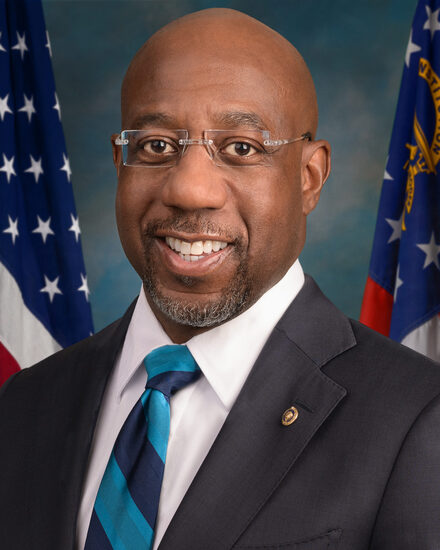
Sen. Raphael G. Warnock
Sponsored bills
Puppies Assisting Wounded Servicemembers for Veterans Therapy Act or the PAWS for Veterans Therapy Act This bill implements a program and a policy related to service dog therapy for veterans. Specifically, the bill requires the Department of Veterans Affairs (VA) to implement a five-year pilot program to assess the effectiveness of addressing post-deployment mental health and post-traumatic stress disorder through a method where veterans train service dogs for veterans with disabilities. The bill also authorizes the VA to provide service dogs to veterans with mental illnesses, regardless of whether they have a mobility impairment.
Recognizing and Ensuring Taxpayer Access to Infrastructure Necessary for GPS and Satellite Communications Act of 2021 or the RETAIN GPS and Satellite Communications Act of 2021 This bill places conditions on entities that deploy commercial terrestrial operations in the 1525-1559 megahertz (MHz) band or the 1626.5-1660.6 MHz band of the electromagnetic spectrum. These frequency bands are traditionally used for satellite operations, including the global positioning system (GPS). On April 19, 2020, the Federal Communications Commission approved an application for a low-power 5G wireless network in such bands despite concerns about the network interfering with GPS and other operations on adjacent bands. In its application, the entity committed to update, repair, or replace federal devices, platforms, or systems affected by its operations. This bill requires an entity (including the previously approved entity) that deploys terrestrial operations in the designated bands to reimburse a federal agency or a person for certain costs if the entity's operations interfere with or otherwise affect the operations of the agency or person. These costs may include necessary upgrades, repairs, or replacements to satellite communication devices and related equipment, as well as expenses for engineering studies and labor. Reimbursable costs owed by the entity transfer to any assignee, successor, or purchaser of its license to deploy terrestrial operations in the designated bands. The bill also expressly authorizes federal agencies to directly accept from the entity reimbursements for incurred costs.
Restored, Equitable, Coronavirus Adjusted Lodging Act of 2021 or the RECAL Act of 2021 This bill prohibits the General Services Administration (GSA), when determining the FY2022 and FY2023 per diem reimbursement rates for locations within the Continental United States (CONUS), from setting lodging allowances below the FY2020 levels. CONUS per diem reimbursement rates are the maximum allowances that federal employees are reimbursed for official travel expenses. The rates consist of lodging, meals, and incidental expense allowances; the GSA sets rates annually based on data from the prior 12-month period.
Washington, D.C. Admission Act This bill provides for admission into the United States of the state of Washington, Douglass Commonwealth, composed of most of the territory of the District of Columbia. The commonwealth shall be admitted to the Union on an equal footing with the other states. The Mayor of the District of Columbia shall issue a proclamation for the first elections to Congress of two Senators and one Representative of the commonwealth. The bill applies current District laws to the commonwealth and continues pending judicial proceedings. The commonwealth (1) shall consist of all District territory, with specified exclusions for federal buildings and monuments, including the principal federal monuments, the White House, the Capitol Building, the U.S. Supreme Court Building, and the federal executive, legislative, and judicial office buildings located adjacent to the Mall and the Capitol Building; and (2) may not impose taxes on federal property except as Congress permits. District territory excluded from the commonwealth shall be known as the Capital and shall be the seat of the federal government. The bill maintains the federal government's authority over military lands and specified other property. The bill provides for expedited consideration of a joint resolution repealing the Twenty-third Amendment to the Constitution, which provides for the appointment of electors of the President and Vice President. The bill continues certain federal authorities and responsibilities, including regarding employee benefits, agencies, courts, and college tuition assistance, until the commonwealth certifies that it is prepared to take over the authorities and responsibilities. The bill establishes the Statehood Transition Commission to advise the President, Congress, and District and commonwealth leaders on the transition.
Preventing Election Subversion Act of 2021 This bill establishes certain federal criminal offenses related to voting and sets forth additional requirements for federal elections. The bill makes it a crime to (1) intimidate, threaten, coerce, or harass an election worker (i.e., an election official, a poll worker, or an election volunteer) with the intent to interfere with the official duties of, or retaliate against, the worker; or (2) publicly disclose restricted personal information about an election worker or an immediate family member with the intent to threaten or cause harm to the worker or the family member. In addition, the bill restricts the ability of a statewide election administrator to remove a local election administrator. A statewide election administrator may suspend, remove, or relieve the duties of a local election administrator only for inefficiency, neglect of duty, or malfeasance while in office. Further, the bill establishes certain requirements for challenging an individual's eligibility to register to vote or vote in federal elections. The bill also sets a minimum distance for poll observers.
Solar Energy Manufacturing for America Act This bill allows a new tax credit for the production of solar property in the taxpayer's trade or business. The credit is allowed for certain solar components, including photovoltaic cells and wafers, solar grade polysilicon, and a non-integrated solar module able to generate electricity when exposed to sunlight.
Juneteenth National Independence Day Act This bill establishes Juneteenth National Independence Day, June 19, as a legal public holiday.
Pell Grant Preservation and Expansion Act of 2021 This bill makes various changes to the Federal Pell Grant program, including by expanding student eligibility for Pell Grants. The bill also revises student eligibility for federal student-aid programs. Specifically, the bill provides funding to increase the maximum Pell Grant award for each eligible student. Further, the bill requires the award amount to be adjusted for inflation. Next, the bill allows students who receive means-tested federal benefits (e.g., Medicaid) to automatically qualify for the maximum Pell Grant award plus an additional award amount. In addition, the bill moves the Iraq and Afghanistan Service Grant program into the Pell Grant program. Next, the bill raises from 12 to 18 the total number of semesters during which a student may receive a Pell Grant. The bill makes Dreamer students (i.e., students who have been granted Deferred Action for Childhood Arrivals status) who entered the United States before the age of 18 and who meet certain educational criteria eligible for federal financial aid. The bill also revises satisfactory academic progress requirements for federal student-aid programs, including by allowing a student who has not been enrolled in an institution of higher education for two years to regain eligibility for federal student aid.
Unsubscribe Act of 20 21 This bill requires that certain consumer protections are included in negative option agreements (an agreement under which a consumer's failure to take an affirmative action is considered approval to be charged for goods or services). These agreements are prohibited unless the agreement discloses all material terms; a consumer provides express informed consent before the consumer is charged for a product or the agreement is automatically renewed; and the agreement provides the consumer with a way to cancel the agreement, in the same manner by which the agreement was entered, before incurring further or increased charges. Further, under free-to-pay conversion contracts (a type of negative option agreement where a consumer is charged a nominal introductory rate and an increased rate after the introductory period ends), before charging a consumer the provider of the good or service must obtain the consumer's informed consent, provide the terms of the contract, and provide information about how to cancel the contract. The bill also requires that certain notifications are provided to consumers in the context of other forms of negative option agreements online, such as notice between two and seven days before an automatic renewal. The bill provides for enforcement of these requirements by the Federal Trade Commission and state attorneys general.