

Duty To Report Act This bill requires political committees, candidates for federal office, and other individuals to report to the Federal Election Commission (FEC) and the Federal Bureau of Investigation (FBI) any offers of prohibited contributions, including offers of nonpublic information regarding other candidates, by foreign nationals. Specifically, political committees and candidates must report to the FEC within 24 hours any (1) offers of prohibited contributions from foreign nationals, and (2) meetings with foreign governments or their agents. In addition, the bill requires political committees, candidates, immediate family members of candidates, and individuals affiliated with a campaign (e.g., employees and independent contractors) to report to the FBI within 24 hours any offers of prohibited contributions from foreign nationals. Further, the bill establishes a new criminal offense for knowingly and willfully failing to comply with this reporting requirement. A violator is subject to criminal penalties—a fine, a prison term of up to two years, or both. Such reported information may not be used to enforce certain immigration provisions related to the removal of undocumented aliens.
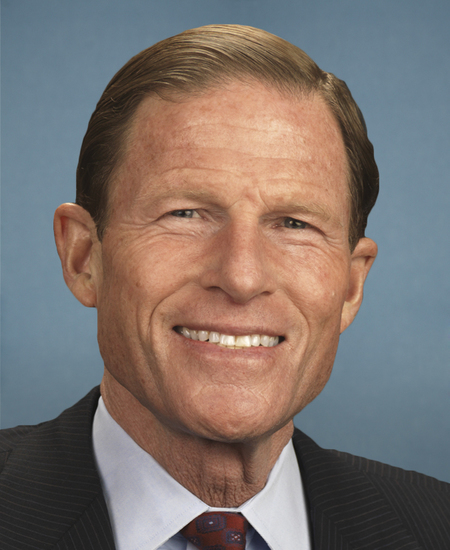
Sen. Richard Blumenthal
Sponsored bills
Protecting Our Students and Taxpayers Act of 2021 or the POST Act of 2021 This bill requires a for-profit institution of higher education (IHE), in order to participate in federal student-aid programs, to derive at least 15% of its revenue from sources other than federal funds. Current law requires a for-profit IHE to derive at least 10% of its revenue from sources other than federal funds. The bill also expands the definition of federal funds to include GI education benefits, with an exception for the monthly housing stipend provided under the Post-9/11 Educational Assistance Program.
Safe Recall Information Distributed Equitably Act of 2021 or the Safe RIDE Act of 2021 This bill directs the Government Accountability Office to study motor vehicle recalls and the reasons why vehicle owners do not have repairs performed for vehicles subject to such recalls. It also directs the National Highway Traffic Safety Administration to study how vehicle recall notices can (1) more effectively reach vehicle owners, (2) be made easier for consumers to understand, and (3) incentivize vehicle owners to complete the repairs described in such notices.
Protection of Kids in Immigrant Detention Act or PROKID Act This bill establishes the Office of the Ombudsperson for Immigrant Children in Government Custody within the Department of Health and Human Services (HHS). The office shall ensure that if government detention of an immigrant child is necessary, that child is held in the least restrictive setting. The office shall also advocate for (1) the quick and safe release of such a detained child, and (2) a child who was detained with family to be released concurrently with a parent or legal guardian. The office's duties shall include (1) monitoring facilities with immigrant children held in government custody to ensure compliance with applicable laws and standards, (2) investigating claims of mistreatment and complaints against foster care providers, (3) reviewing contested decisions about the placement of an immigrant child, and (4) reviewing data from HHS and the Department of Homeland Security (DHS) relating to such children. The office may also offer individual case assistance to such a detained child who requires expedited processing or elevated attention. The office may also issue subpoenas with HHS approval. DHS and HHS must ensure that the office has the ability to conduct investigative and monitoring activities, including by providing unobstructed access to any detention facility with immigrant children. The office and DHS shall enter into a memorandum of understanding to coordinate oversight between DHS and HHS. The bill also establishes an expert advisory committee to assist the office and an interagency working group to identify and discuss concerns related to detained immigrant children.
Equality Act This bill prohibits discrimination based on sex, sexual orientation, and gender identity in areas including public accommodations and facilities, education, federal funding, employment, housing, credit, and the jury system. Specifically, the bill defines and includes sex, sexual orientation, and gender identity among the prohibited categories of discrimination or segregation. The bill expands the definition of public accommodations to include places or establishments that provide (1) exhibitions, recreation, exercise, amusement, gatherings, or displays; (2) goods, services, or programs; and (3) transportation services. The bill allows the Department of Justice to intervene in equal protection actions in federal court on account of sexual orientation or gender identity. The bill prohibits an individual from being denied access to a shared facility, including a restroom, a locker room, and a dressing room, that is in accordance with the individual's gender identity.
COVID-19 Nursing Home Protection Act of 2021 This bill provides funds and establishes requirements for Medicare skilled nursing facilities (SNFs) and Medicaid nursing facilities (NFs) to address COVID-19 (i.e., coronavirus disease 2019). Specifically, the bill provides FY2021 funding for COVID-19 strike teams that can be deployed to these facilities to help with vaccinations, clinical care, infection control, or staffing. The amounts provided by the bill are designated as an emergency requirement pursuant to the Statutory Pay-As-You-Go Act of 2010 (PAYGO) and the Senate PAYGO rule. (This excludes the budget effects from being counted for the purposes of enforcing the PAYGO rules.) In addition, the bill requires the Centers for Medicare & Medicaid Services (CMS) to ensure that, during the public health emergency relating to COVID-19, at least one of its contracts with Medicare quality improvement organizations requires that the organization assist SNFs with COVID-19 infection control (e.g., training materials). Finally, the bill provides statutory authority for the requirement that SNFs and NFs report data regarding COVID-19 preparedness, testing, infections, and deaths. Additionally, the CMS must publish on the Nursing Home Compare website certain demographic information, aggregated by state, with respect to COVID-19 infections and deaths in such facilities.
ABLE Age Adjustment Act This bill increases from 26 to 46 the age threshold for tax-favored ABLE (Achieving a Better Life Experience) accounts. (ABLE accounts are designed to enable individuals with disabilities to save for and pay for disability-related expenses. To establish an account, an individual must have a qualifying impairment that began before the individual attained the age threshold.)
Black Maternal Health Momnibus Act of 2021 This bill directs multi-agency efforts to improve maternal health, particularly among racial and ethnic minority groups, veterans, and other vulnerable populations. It also addresses maternal health issues related to COVID-19 (i.e., coronavirus disease 2019). The Department of Health and Human Services (HHS) and other specified departments must address the social determinants of maternal health, which include child care, housing, food security, transportation, and environmental conditions. The bill also extends to 24 months postpartum eligibility for the Special Supplemental Nutrition Program for Woman, Infants, and Children. Additionally, HHS and other agencies must take actions to grow and diversify the maternal health workforce. To increase access to maternity care, HHS and other agencies must (1) award specified grants; (2) test an alternative payment model for perinatal care under Medicaid and the Children's Health Insurance Program (CHIP); and (3) support training, technology, and telehealth initiatives. The bill also increases research and data collection on maternal morbidity and mortality, particularly among tribal populations and minority groups. The Bureau of Prisons and the Department of Justice must establish programs to improve maternity care for incarcerated populations. The Medicaid and CHIP Payment and Access Commission must also report on the impact of Medicaid ineligibility for pregnant and postpartum prisoners. Additionally, as a condition for certain grants, states and territories must have laws limiting the use of restraints on pregnant individuals in prisons. The bill also directs activities to mitigate adverse maternal health outcomes associated with climate change and to improve maternal vaccination rates.
Data to Save Moms Act This bill expands data collection and research on maternal morbidity and mortality among minority populations. Specifically, the bill adds requirements to a program within the Centers for Disease Control and Prevention (CDC) that supports maternal mortality review committees. To the extent practicable, the committees must use the most up-to-date indicators of severe maternal morbidity; review deaths caused by suicide, overdose, or other behavioral health conditions attributed to or aggravated by pregnancy or childbirth; and consult with representatives of communities about nonclinical factors that may contribute to adverse maternal outcomes. The CDC may also award grants to committees to increase their engagement with local communities, such as by bringing on community representatives as committee members. Additionally, the Centers for Medicare & Medicaid Services and the Agency for Healthcare Research and Quality must consult with diverse stakeholders to review maternal health data collection processes and quality measures and make recommendations to improve them. The Indian Health Service and the Department of Health and Human Services must also arrange for studies on adverse maternal health outcomes among tribal and minority populations, respectively.
COVID-19 Medical Debt Collection Relief Act of 2021 This bill temporarily limits certain activities to collect medical debts by health care providers that apply for, or accept, COVID-19 (i.e., coronavirus 2019) financial relief. Specifically, such health care providers must suspend extraordinary collection actions, such as selling a debt to a third-party collector or placing a lien on an individual's property, until the later of the end of the COVID-19 public health emergency or 18 months after the enactment of this bill. Further, such health care providers must notify individuals who have entered into medical debt repayment plans that they may request the suspension of payments during such period. Providers must provide reasonable repayment options for individuals once repayments resume, such as extending repayment periods. The bill also applies specified consumer protections to medical debt incurred for COVID-19-related testing and treatment between February 1, 2020, and 60 days after the COVID-19 public health emergency ends.