Taiwan Democracy Defense Lend-Lease Act of 2022 This bill authorizes the President to lend or lease defense articles to Taiwan for protection against potential Chinese military aggression and requires the President to establish expedited procedures for delivering loaned or leased defense articles to Taiwan.
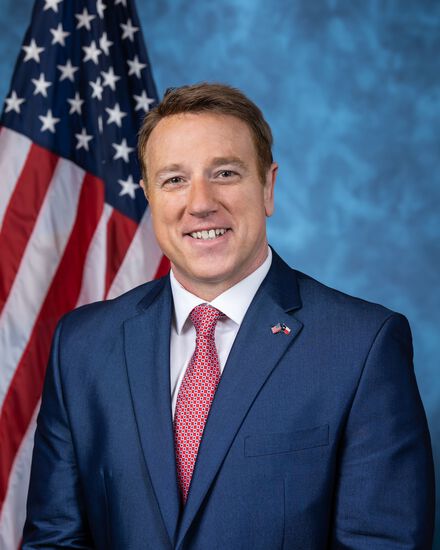
Rep. Pat Fallon
Sponsored bills
Rural Hospital Extensions for Low-volume Programs Act of 2022 or the Rural HELP Act of 2022 This bill makes certain payment adjustments for Medicare-dependent hospitals and low-volume hospitals permanent (the adjustments currently expire at the end of FY2022).
Securing and Enabling Commerce Using Remote and Electronic Notarization Act of 2022 or the SECURE Notarization Act of 2022 This bill allows a notary public commissioned under state law to remotely notarize electronic records and perform notarizations for remotely located individuals. The bill provides technical requirements for such notarizations, including the creation and retention of video and audio recordings and the use of communication technologies (i.e., video chat). Additionally, the bill requires U.S. courts and states to recognize notarizations—including remote notarizations of electronic records and notarizations of remotely-located individuals—that occur in or affect interstate commerce and are performed by a notary public commissioned under the laws of other states. The bill also allows a notary public to remotely notarize electronic records involving an individual located outside of the United States, subject to certain requirements.
Fairness for Responsible Borrowers Act This bill generally prohibits the Departments of Education, Justice, or the Treasury from taking any action to cancel or forgive the outstanding balances, or portion of balances, of covered loans. Covered loans refer to Federal Family Education Loans, Federal Direct Loans, Federal Perkins Loans, and loans under the Health Education Assistance Loan Program. The prohibition does not apply to targeted federal student loan forgiveness, cancellation, or repayment programs carried out under the Higher Education Act of 1965.
Investing in American Defense Technologies Act of 2022 This bill requires the Department of Defense (DOD) to implement a five-year pilot program to accelerate the development of advanced technology for national security by creating incentives for trusted private capital to invest in domestic small businesses or nontraditional businesses that are developing technology that DOD considers necessary to support the modernization of DOD and national security priorities. DOD must brief Congress on the implementation and outcomes of the pilot program.
RETURN (Repealing Excise Tax on Unalienable Rights Now) our Constitutional Rights Act of 2022 or the RETURN our Constitutional Rights Act of 2022 This bill repeals the excise taxes on firearms and ammunition and on bows and arrows. It also repeals the excise tax on transferring and making firearms under the National Firearm Act.
This bill expands eligibility for Department of Veterans Affairs (VA) reimbursement of emergency treatment for veterans who are treated in a non-VA facility. Specifically, the bill waives the requirement that a veteran must have received VA care within the 24-month period preceding the furnishing of emergency treatment if the veteran receives such emergency treatment within the 60-day period following their enrollment in the VA health care system.
Border Bonds for America Act of 2022 This bill directs the Department of the Treasury to issue up to $5 billion in bonds in a fiscal year, with proceeds going into a trust fund for the construction of reinforced fencing, physical barriers, and related infrastructure for the southwest border with Mexico. Treasury may issue such bonds for 30 years from the bill's enactment date. The bill also authorizes Treasury to accept gifts of money for the same purpose.
Standing with Moms Act This bill requires the Department of Health and Human Services (HHS) to disseminate information about pregnancy-related resources. Specifically, HHS must maintain a public website (life.gov) that lists such resources that are available through federal, state, and local governments and private entities. Additionally, HHS must maintain on its website a portal that provides a user, based on the user's responses to a series of questions, tailored information about pregnancy resources available in the user's zip code and risks related to abortion. HHS must develop a plan to conduct follow-up outreach to users of the portal (if the user consents to the outreach). States must recommend resources that meet criteria set by HHS for including through the portal. HHS may award grants to states to establish or support a system that aggregates resources to include on the portal. Further, the Health Resources and Services Administration must share information about life.gov and the portal through the Maternal Mental Health Hotline. HHS must also ensure that the life.gov website and hotline are available to families who speak languages other than English. The bill excludes from life.gov, the portal, and the hotline resources provided by entities that (1) perform, induce, refer for, or counsel in favor of abortions; or (2) financially support such entities. The bill also requires HHS to report on traffic to life.gov and the portal, gaps in services available to pregnant and postpartum individuals, and related matters.
Container Missile Notification Act This bill requires the Office of the Director of National Intelligence (ODNI) to notify Congress if the intelligence community receives intelligence that Russia, China, Iran, or North Korea is deploying (or about to deploy) a missile launcher disguised as or concealed in a shipping container. Currently, ODNI is only required to notify Congress about intelligence that Russia is deploying the Club-K container missile system.