

Washington, D.C. Admission Act This bill provides for admission into the United States of the state of Washington, Douglass Commonwealth, composed of most of the territory of the District of Columbia. The commonwealth shall be admitted to the Union on an equal footing with the other states. The Mayor of the District of Columbia shall issue a proclamation for the first elections to Congress of two Senators and one Representative of the commonwealth. The bill applies current District laws to the commonwealth and continues pending judicial proceedings. The commonwealth (1) shall consist of all District territory, with specified exclusions for federal buildings and monuments, including the principal federal monuments, the White House, the Capitol Building, the U.S. Supreme Court Building, and the federal executive, legislative, and judicial office buildings located adjacent to the Mall and the Capitol Building; and (2) may not impose taxes on federal property except as Congress permits. District territory excluded from the commonwealth shall be known as the Capital and shall be the seat of the federal government. The bill maintains the federal government's authority over military lands and specified other property. The bill provides for expedited consideration of a joint resolution repealing the Twenty-third Amendment to the Constitution, which provides for the appointment of electors of the President and Vice President. The bill continues certain federal authorities and responsibilities, including regarding employee benefits, agencies, courts, and college tuition assistance, until the commonwealth certifies that it is prepared to take over the authorities and responsibilities. The bill establishes the Statehood Transition Commission to advise the President, Congress, and District and commonwealth leaders on the transition.
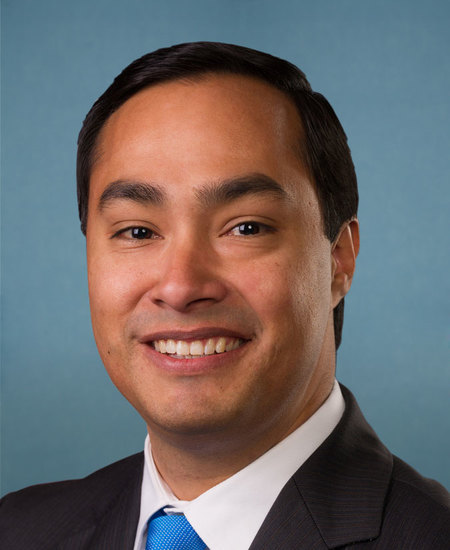
Rep. Joaquin Castro
Sponsored bills
Global Electoral Exchange Act of 2021 This bill authorizes the Department of State to establish a Global Electoral Exchange Program to promote sound election-administration practices around the world. The State Department may award grants to qualified, tax-exempt, U.S.-based organizations that have expertise and experience in relevant topics, such as election-system integrity. Grants may be used to design programs to bring relevant individuals, such as election administrators and poll workers, together to study and discuss election procedures. The State Department shall periodically report to Congress on the program's activities.
This resolution states that the August 9, 2020, election in Belarus was neither free nor fair and, as such, the House of Representatives does not recognize Alyaksandr Lukashenka as the country's legitimate president. The resolution also states that the people of Belarus have the right to determine the country's future without unwelcome intervention from outside actors and condemns the human rights violations committed by Belarusian authorities.
Secure and Fair Enforcement Banking Act of 2021 or the SAFE Banking Act of 2021 This bill generally prohibits a federal banking regulator from penalizing a depository institution for providing banking services to a legitimate cannabis-related business. Prohibited penalties include terminating or limiting the deposit insurance or share insurance of a depository institution solely because the institution provides financial services to a legitimate cannabis-related business and prohibiting or otherwise discouraging a depository institution from offering financial services to such a business. Additionally, proceeds from a transaction involving activities of a legitimate cannabis-related business are not considered proceeds from unlawful activity. Proceeds from unlawful activity are subject to anti-money laundering laws. Furthermore, a depository institution is not, under federal law, liable or subject to asset forfeiture for providing a loan or other financial services to a legitimate cannabis-related business. The bill also provides that a federal banking agency may not request or order a depository institution to terminate a customer account unless (1) the agency has a valid reason for doing so, and (2) that reason is not based solely on reputation risk. Valid reasons for terminating an account include threats to national security and involvement in terrorist financing, including state sponsorship of terrorism. Finally, the bill decreases the cap on the surplus funds of the Federal Reserve banks. (Amounts exceeding this cap are deposited in the general fund of the Treasury.)
Southeast Asia Strategy Act This bill directs the Department of State to submit to Congress a strategy for engagement with Southeast Asia and the Association of Southeast Asian Nations (ASEAN). The strategy shall include various elements including (1) an identification of enduring U.S. interests in the region and efforts to bolster ASEAN's effectiveness; (2) a list of ongoing and planned initiatives to strengthen U.S. relationships in the region, including efforts to promote inclusive economic growth and energy innovation; and (3) a summary of ongoing efforts to promote human rights and democracy and strengthen the rule of law.
This resolution condemns the actions taken by the governments of China and Hong Kong to put in place national security legislation that violates the freedoms and rights guaranteed to the people of Hong Kong. (Hong Kong is a part of China but, by agreement, has operated a legal and economic system largely separate from China's.)
Workplace Violence Prevention for Health Care and Social Service Workers Act This bill requires the Department of Labor to address workplace violence in health care, social service, and other sectors. Specifically, Labor must issue an interim occupational safety and health standard that requires certain employers to take actions to protect workers and other personnel from workplace violence. The standard applies to employers in the health care sector, in the social service sector, and in sectors that conduct activities similar to those in the health care and social service sectors. In addition, Labor must promulgate a final standard within a specified time line.
Fire Fighters and EMS Employer-Employee Cooperation Act This bill requires the Federal Labor Relations Authority to determine whether a state substantially provides fire and emergency medical services (EMS) personnel the right to form and join a labor organization; recognition by fire and EMS employers of the employees' labor organization, agreement to bargain with the organization, and reduction of any agreements to writing in a contract or memorandum of understanding; the right to bargain over hours, wages, and terms and conditions of employment; and arbitration or other mechanisms to resolve an impasse in collective bargaining negotiations. The bill makes the authority responsible for (1) determining the appropriateness of units for labor representation; (2) supervising elections; (3) conducting hearings and resolving complaints of unfair labor practices; and (4) protecting the right of employees to form, join, or assist any labor organization, or to refrain from doing so. An employer, fire and EMS personnel, or labor organization may not engage in a lockout, sickout, work slowdown, strike, or any other organized job action that will measurably disrupt the delivery of emergency services and is designed to compel an employer, fire and EMS personnel, or labor organization to agree to the terms of a proposed contract.
Tax Fairness for Workers Act This bill allows an above-the-line tax deduction for union dues and expenses. (An above-the-line deduction is subtracted from gross income and is available whether or not a taxpayer itemizes other deductions.) The bill also reinstates the miscellaneous itemized tax deduction for unreimbursed expenses attributable to the performance of services as an employee (Under current law, all miscellaneous itemized deductions are suspended through 2025).
Stopping Activities Underpinning Development In Weapons of Mass Destruction Act or the SAUDI WMD Act This bill establishes measures to inhibit the development of nuclear weapons by Saudi Arabia. Specifically, the bill restricts the sale of specified munitions items to Saudi Arabia if, in the last three fiscal years, Saudi Arabia has taken certain steps towards developing nuclear weapons. Further, the bill requires the President to submit to Congress a written determination detailing (1) whether any foreign person knowingly engaged in the trade of specified weapons subject to the Missile Technology Control Regime (MTCR) with Saudia Arabia in the last three fiscal years, and (2) the sanctions the President has imposed or intends to impose against those persons. (The MTCR is an informal political understanding among states that seek to limit the proliferation of missiles and missile technology.) The bill also requires the Department of State and the Department of Energy to submit a report on MTCR compliance and a strategy to prevent the spread of nuclear weapons and missiles in the Middle East.