Maddy summaryThis bill amends the tax code to allow first-time homebuyers to use funds from 529 college savings plans for home purchases without tax penalties, under specific conditions. It permits tax-free withdrawals of the original contributions (plus earnings) if the account was maintained for 15 years, the funds are used within 60 days for a first home purchase, and the total lifetime withdrawals do not exceed $35,000. If the home is sold within 5 years, a recapture tax may apply based on the time held. It directly affects first-time homebuyers who have maintained 529 plans for 15 years and use the funds for qualifying home purchases.
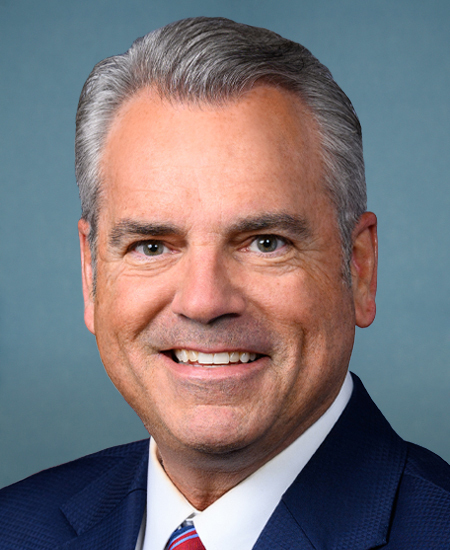
Rep. Mark Alford
Sponsored bills
Maddy summaryThis bill prevents state or local governments from banning or restricting energy connections (like installation, modification, or access) based on the type or source of energy, such as electricity, natural gas, or renewable fuels. It directly affects consumers choosing energy providers and energy companies seeking to offer services. The key provision prohibits local laws, regulations, or policies that limit energy services sold in interstate commerce, covering all energy types listed in the bill’s definitions. It does not create new programs but limits regulatory authority at the state or local level. The law aims to ensure open access to diverse energy sources without source-based restrictions.
Maddy summaryThe Make Elections Great Again Act (HR 7300) would require voters to present photo identification to cast ballots in person or by mail for federal elections, with limited exceptions for religious objections or military voters. It would establish new requirements for proving U.S. citizenship during voter registration, including documentary proof of citizenship and proof of state residency. The bill would change mail-in ballot procedures by requiring voters to request mail-in ballots (rather than universal mail-in voting), implementing barcode tracking for mail-in ballots, and setting strict deadlines for ballot receipt. These provisions would apply to all states for federal elections held in 2027 or later, affecting how voters register, vote in person, and submit mail-in ballots for federal office elections.
Safeguard American Voter Eligibility Act or the SAVE America Act This bill requires individuals to provide documentary proof of U.S. citizenship when registering to vote, and requires photo identification to vote, in federal elections. Specifically, the bill prohibits states from accepting and processing an application to register to vote in a federal election unless the applicant presents documentary proof of U.S. citizenship. The bill specifies what documents are considered acceptable proof of U.S. citizenship, such as identification that complies with the REAL ID Act of 2005 that indicates U.S. citizenship. Further, the bill (1) prohibits states from registering an individual to vote in a federal election unless, at the time the individual applies to register to vote, the individual provides documentary proof of U.S. citizenship; and (2) requires states to establish an alternative process to demonstrate U.S. citizenship. Each state must take affirmative steps on an ongoing basis to ensure that only U.S. citizens are registered to vote, which shall include establishing a program to identify individuals who are not U.S. citizens using information supplied by certain sources. Additionally, states must remove noncitizens from their official lists of eligible voters. The bill (1) provides for a private right of action for certain violations, and (2) establishes criminal penalties for certain offenses. Individuals voting in federal elections must present an eligible photo identification document. An individual who votes by absentee ballot must submit a copy of their identification document with both the request for, and the submission of, the absentee ballot.
Maddy summaryThis is a ceremonial resolution (HRES 1020), not a legislative bill. It contains factual inaccuracies: Greenland is an autonomous territory within Denmark, not a U.S. territory, and no such agreement securing U.S. sovereignty over Greenland military installations has ever been negotiated or implemented under any administration. The resolution falsely claims President Trump "secured a historic strategic agreement" for permanent U.S. control, which contradicts actual U.S.-Denmark relations and international law. As a purely commemorative resolution with no policy or legal effect, it does not establish new rights, obligations, or mechanisms. A factual summary cannot be provided due to the resolution's misleading claims about the agreement.
Maddy summaryHR 5764, the "AI for Main Street Act," amends the Small Business Act to require the Small Business Administration (SBA) to provide guidance and training to small business concerns on using artificial intelligence. It directly affects small businesses by adding new SBA responsibilities to help them evaluate AI for operations, including best practices, cybersecurity, data protection, regulatory compliance, and customer trust. Key provisions mandate the SBA to offer information, training, and outreach on incorporating AI into business processes, such as planning for unexpected circumstances. The bill does not authorize new funding for these activities. It defines "artificial intelligence" using the existing term from the National AI Initiative Act.
Maddy summaryThis bill creates a tax credit for businesses selling products made with U.S.-grown cotton. The credit equals 24% of the cotton's market value if processed only in the U.S. or in countries with U.S. trade deals, or 18% for other processing locations. To qualify, cotton must be digitally traced from U.S. farms to finished products and certified by the USDA as meeting origin requirements. It directly affects clothing and textile manufacturers selling qualifying products in the U.S. market.
Maddy summaryThis bill eliminates the $250,000 tax exclusion limit for single homeowners and $500,000 limit for married couples when selling their primary residence. It removes the current dollar cap on capital gains tax exclusion, meaning all profit from such home sales would be tax-free. The change applies to sales occurring after the bill's enactment. This directly affects homeowners who currently owe taxes on gains exceeding the removed limits.
Maddy summaryHR 7156, the SCAM Act, would expand grounds for revoking U.S. citizenship (denaturalization) for naturalized citizens who commit specific offenses within 10 years of becoming citizens. It targets individuals convicted of defrauding federal, state, or local governments (e.g., $10,000+ in public benefit fraud), affiliating with foreign terrorist organizations, or committing aggravated felonies or espionage. If convicted in these categories, the government could automatically revoke citizenship retroactively (as if it never existed) based on evidence that the person lacked good moral character or loyalty to the U.S. at the time of naturalization. This bill directly affects naturalized citizens who commit these offenses within a decade of gaining citizenship, with revocation triggering immediate deportability.
Maddy summaryThis resolution (HRES 998) is a symbolic House of Representatives commendation honoring President Trump, U.S. military/intelligence agencies, and Justice Department personnel for the alleged success of "Operation Absolute Resolve" in apprehending Venezuelan leader Nicolás Maduro. It cites Maduro's charges (including narcoterrorism conspiracy) and the Maduro regime's alleged dismantling of Venezuelan democracy, state-sponsored drug trafficking, and human rights abuses. The resolution expresses support for Venezuela's democratic transition but contains no new policy, funding, or legal changes. As a procedural resolution, it does not directly affect any individuals or alter laws.