Educational Equity Challenge Grant Act of 2021 This bill establishes a program through which the Department of Education must award grants to eligible entities (e.g., state and local educational agencies) to address students' academic, social, emotional, mental, behavioral, and physical health needs related to the COVID-19 (i.e., coronavirus disease 2019) pandemic.
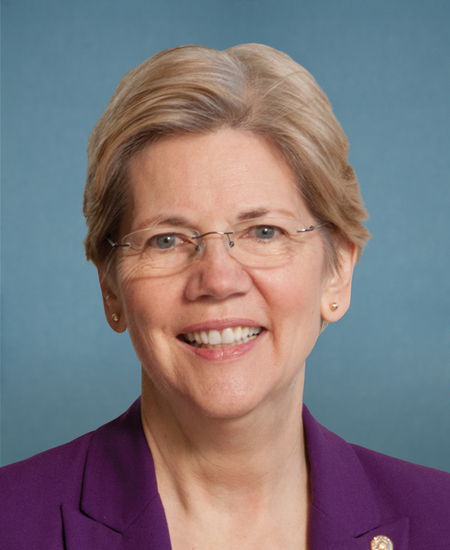
Sen. Elizabeth Warren
Sponsored bills
This resolution recognizes the centennial of the Tulsa Race Massacre of 1921. The resolution acknowledges the historical significance of this event as one of the largest single instances of state-sanctioned violence against Black people in American history; honors the lives and legacies of the estimated 300 Black individuals who were killed during the massacre and the nearly 9,000 who were left homeless and penniless; condemns efforts to cover up the truth and shield the white community, especially government officials, from accountability; condemns the continued legacy of racism and white supremacy against Black people in the United States, particularly in the form of police brutality; encourages education about the massacre, the history of white supremacy that fueled the massacre, and subsequent attempts to deny or cover up the massacre, in all elementary and secondary education settings and in institutions of higher education; and recognizes the commitment of Congress to acknowledge and learn from the history of racism and racial violence to reverse the legacy of white supremacy and fight for racial justice.
Hello Girls Congressional Gold Medal Act of 2021 This bill provides for the award of a single Congressional Gold Medal in honor of the female telephone operators of the Army Signal Corps, commonly known as the Hello Girls , in recognition of their military service, devotion to duty, and 60-year struggle for veterans' benefits and recognition as soldiers.
Enhancing North Korea Humanitarian Assistance Act This bill addresses humanitarian concerns related to sanctions on North Korea. The Office of Foreign Assets Control shall take one or more specified actions relating to U.S. sanctions on North Korea, such as (1) expanding the current humanitarian exception to such sanctions to include items that meet basic human needs and are not subject to the Export Administration Regulations, or (2) exempting certain nonsensitive items for humanitarian operations from specific licensing requirements. For the purposes of such sanctions, personal computers for authorized humanitarian activities by nongovernmental organizations shall not be considered luxury goods. The Department of State shall direct the U.S. representative to the United Nations (UN) to urge the UN to (1) make it less burdensome for nongovernmental organizations to apply for humanitarian exemptions to UN sanctions on North Korea, and (2) speed up approval for such applications. The State Department shall devise a strategy to expedite and simplify the process for U.S. passport holders to obtain permission to travel to North Korea to provide humanitarian assistance.
Tar Sands Tax Loophole Elimination Act This bill expands the definition of crude oil for purposes of the excise tax on petroleum and petroleum products to include any bitumen or bituminous mixture, any oil derived from a bitumen or bituminous mixture (tar sands), and any oil derived from kerogen-bearing sources (oil shale). The bill also authorizes the Department of the Treasury to classify as crude oil or as a petroleum product subject to such tax any fuel feedstock or finished fuel product transported by pipeline, vessel, railcar, or tanker truck if (1) such classification is consistent with the definition of oil under the Oil Pollution Act of 1990, and (2) such fuel feedstock or finished fuel product is produced in sufficient commercial quantities as to pose a significant risk of hazard in the event of a discharge.
COVID-19 in Immigration Detention Data Transparency Act This bill requires U.S. Immigration and Customs Enforcement (ICE), U.S. Customs and Border Protection (CBP), and the Office of Refugee Resettlement (ORR) to collect and report various information about detained individuals, including data on COVID-19 (i.e., coronavirus disease 2019) testing. During the COVID-19-related declared public health emergency and for one year after, ICE, CBP, and ORR shall publicly post on a website certain data about its detention facilities, including COVID-19 testing numbers for detained individuals and detention facility staff, COVID-19 case outcomes, vaccinations, and COVID-19-related information about detained individuals who were released or removed from the United States. The Centers for Disease Control and Prevention (CDC) shall issue guidance as to the COVID-19-related data that ICE, CBP, and ORR must collect and report weekly to the CDC. The CDC shall periodically report to Congress a summary of this data and an analysis of the trends and pattern of the spread of the disease. ICE, CPB, and ORR shall ensure that each detained individual receives all medical records related to any COVID-19 test administered to the individual. ICE, CPB, and ORR shall also report to Congress on (1) the COVID-19 safety protocols in its facilities, and (2) information relating to their efforts to ensure that each detained individual has access to legal counsel. This bill's data collection and reporting requirements that apply to ICE, CPB, and ORR shall also apply to any contract facilities that they use to hold detained individuals.
Public Health Infrastructure Saves Lives Act This bill provides annual funding for the Centers for Disease Control and Prevention (CDC) to strengthen core public health infrastructure. Core public health infrastructure includes the elements and workforce capabilities that enable health departments to perform critical functions such as disease surveillance and emergency response. Specifically, the CDC must award grants to health departments for their core infrastructure needs. In addition, the CDC must support the development of accreditation standards for health departments that emphasize core public health infrastructure. Health departments must meet those (or similar) standards as a condition of receiving grants beginning in FY2025. The CDC must also take steps to expand and improve its own public health infrastructure.
Biliteracy Education Seal and Teaching Act or the BEST Act This bill directs the Department of Education to award renewable two-year grants to states to establish or improve, and carry out, Seal of Biliteracy programs to recognize student proficiency in speaking, reading, and writing in both English and a second language. Further, these programs must allow speakers of any official Native American language to use equivalent proficiency in speaking, reading, and writing in such language in lieu of proficiency in English.
American Dream Employment Act of 2021 This bill permits the compensation of congressional employees who hold a current employment authorization document that was issued pursuant to a grant of (1) deferred action, including under the Deferred Action for Childhood Arrivals Program; (2) deferred enforced departure; or (3) temporary protected status. (Generally, these programs and statuses allow eligible aliens to remain and work in the United States.)
Stabilize Medicaid and CHIP Coverage Act of 2021 This bill requires the Children's Health Insurance Program (CHIP) and state Medicaid programs to provide 12-month continuous enrollment for eligible individuals. The bill also establishes bonus payments for states that implement certain Medicaid enrollment and retention policies for specified categories of individuals (e.g., children), such as aligning income eligibility standards with those of other insurance affordability programs.