Safeguarding Human Rights in Arms Exports Act of 2021 or the SAFEGUARD Act of 2021 This bill establishes specified measures to prevent the sale, export, or transfer of defense articles or defense services to foreign countries for use in violation of international humanitarian law or internationally recognized human rights. These measures include (1) prohibiting arms sales to countries committing genocide or war crimes, (2) requiring a consideration of human rights practices and democratization in any foreign country to which an arms sale is contemplated, and (3) providing for congressional oversight of arms exports to foreign countries wherein certain human rights violations have occurred.
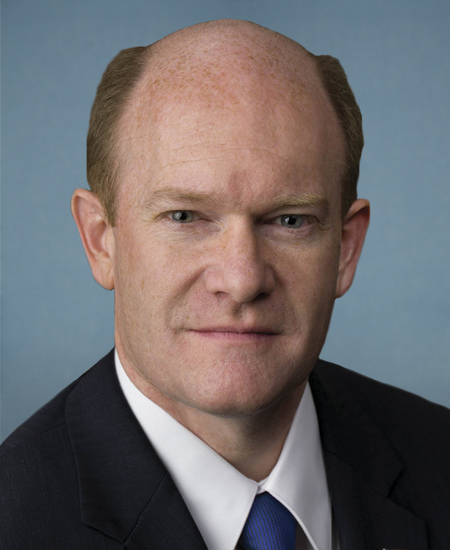
Sen. Christopher A. Coons
Sponsored bills
Military Hunger Prevention Act This bill requires the Department of Defense (DOD) to pay a basic needs allowance to certain low-income members of the Armed Forces. Specifically, those eligible for the basic needs allowance are members who (1) have completed initial entry training, (2) have a gross household income that did not exceed an amount equal to 130% of the federal poverty guidelines of the Department of Health and Human Services (HHS), and (3) do not elect to decline the allowance. In situations where a household contains two or more eligible members, the bill specifies that only one allowance may be paid per year to one member they jointly elect. The amount of the allowance must be the aggregate amount equal to 130% of the HHS federal poverty guidelines minus the gross household income of the covered member during the preceding year divided by 12. The Defense Finance and Accounting Service (DFAS) of DOD must notify, in writing, individuals determined to be eligible for the allowance. The notice must include information regarding financial management and assistance programs administered by DOD for which the individuals are also eligible. Individuals who seek to receive the allowance must submit specified information to DFAS.
Inventor Diversity for Economic Advancement Act of 2021 or the IDEA Act This bill requires the U.S. Patent and Trademark Office (USPTO) to request demographic information from the inventor on each patent application submitted to the USPTO. Inventors shall not be required to provide the requested information, which shall include gender, race, and military or veteran status. The USPTO shall (1) publish an annual public report about the collected data, including the collected data broken down by the types of technology covered by the patent applications; and (2) make the underlying data publicly available.
Coronavirus Housing Counseling Improvement Act This bill authorizes additional housing counseling services provided through the Neighborhood Reinvestment Corporation. Funding priority is given to counseling organizations that target low-income and minority homeowners, renters, individuals experiencing homelessness, and individuals at risk of homelessness.
This resolution condemns Iran's state-sponsored persecution of its Baha'i minority and its continued violation of the international covenants on human rights. Further, it calls on Iran to immediately release all imprisoned or detained Baha'is, and it urges the President and the Department of State to impose sanctions on Iranian officials and others who are responsible for serious human rights abuses, including abuses against Iran's Baha'i community.
This bill provides for the award of Congressional Gold Medals posthumously to Glen Doherty, Tyrone Woods, J. Christopher Stevens, and Sean Smith (four Americans who were killed in the September 11, 2012, attack on the U.S. consulate in Benghazi, Libya) in recognition of their contributions to the nation.
This bill establishes the Veterans Economic Opportunity and Transition Administration to administer economic opportunity assistance programs for veterans and their dependents and survivors. Specifically, the Veterans Economic Opportunity and Transition Administration must administer the following Department of Veterans Affairs (VA) programs: vocational rehabilitation and employment programs, educational assistance programs, veterans' housing loan and related programs, the Transition Assistance Program, and the database of small business concerns owned and controlled by veterans. Prior to the transfer of administrative responsibilities, the bill requires the VA to certify that (1) the transition of the provision of services will not negatively affect the provision of such services to veterans, and (2) such services are ready to be transferred.
Caring for Survivors Act of 2021 This bill increases the monthly rate of dependency and indemnity compensation payable to surviving spouses through the Department of Veterans Affairs. The bill also adjusts the amount payable to surviving spouses and children of veterans who were rated as totally disabled for a period of less than 10 years before their death.
Fair Care for Vietnam Veterans Act of 2021 This bill provides a presumption of service-connection for hypertension and monoclonal gammopathy of undetermined significance (MGUS) for veterans who served in Vietnam between January 9, 1962, and May 7, 1975. Under a presumption of service-connection, specific conditions diagnosed in certain veterans are presumed to have been caused by the circumstances of their military service. Health care benefits and disability compensation may then be awarded.
This bill requires the Department of Veterans Affairs to ensure that, if it creates a presumption of service-connection between the occurrence of a disease and exposure to an herbicide agent while serving in the Armed Forces between January 9, 1962, and June 30, 1976, at a military base in Thailand, such presumption must also apply to exposure at any military base in Thailand, regardless of where on the base the veteran was located or what military job specialty the veteran performed.