This resolution designates the week of September 19-September 25, 2021, as National Estuaries Week.
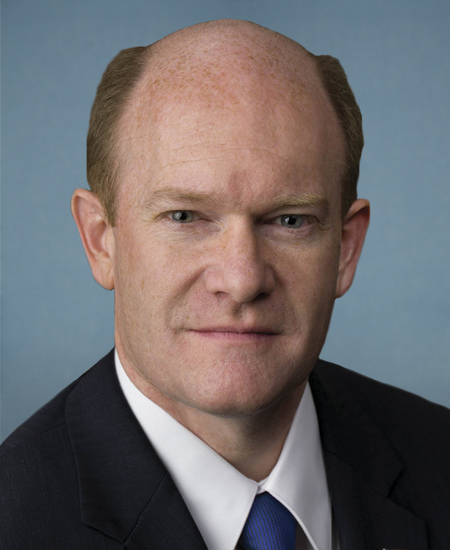
Sen. Christopher A. Coons
Sponsored bills
This joint resolution proposes a constitutional amendment authorizing Congress and the states to set reasonable limits on the raising and spending of money by candidates and others to influence elections. The amendment grants Congress and the states the power to implement and enforce this amendment by legislation. They are allowed to distinguish between natural persons and corporations or other artificial entities created by law, including by prohibiting such entities from spending money to influence elections.
Driftnet Modernization and Bycatch Reduction Act This bill addresses certain driftnet fishing. Driftnet fishing is a method of fishing in which a gillnet composed of a panel or panels of webbing, or a series of such gillnets, is placed in the water and allowed to drift with the currents and winds for the purpose of entangling fish in the webbing. Currently, the use of large-scale drift gillnets with a total length of 2.5 kilometers or more is prohibited in the United States.The bill expands the definition of large-scale driftnet fishing to prohibit the use of gillnets with a mesh size of 14 inches or greater. This expanded prohibition does not apply within the U.S. exclusive economic zone for five years. The Department of Commerce must conduct a transition program to facilitate the phase out of large-scale driftnet fishing and to promote the adoption of alternative fishing practices that minimize the incidental catch of living marine resources. Commerce must award grants to program participants. The North Pacific Fishery Management Council may recommend and Commerce may approve regulations that require charter operators to pay fees on vessels that harvest Pacific halibut in specific International Pacific Halibut Commission regulatory areas.
America's Children Act or the Protecting Children of Long-term Visa Holders Act of 2021 This bill provides lawful permanent resident status to certain college graduates who entered the United States as children and addresses other immigration-related issues. Specifically, this bill allows an alien to apply for lawful permanent resident status if the alien (1) was lawfully admitted into the United States as a dependent child of an alien on a temporary worker visa, (2) was in the United States with such status for at least four years, (3) has graduated from an institution of higher education in the United States, and (4) is not deportable or otherwise inadmissible. In addition, the alien must have been lawfully present in the United States for at least 10 years at the time of the application. The bill also modifies various provisions related to the calculation of an alien's age for immigration purposes and the priority date of certain immigration-related applications.
Do No Harm Act This bill prohibits the application of the Religious Freedom Restoration Act of 1993 (RFRA) to specified federal laws or the implementation of such laws. Currently, RFRA prohibits the government from substantially burdening a person's exercise of religion even if the burden results from a rule of general applicability, except in furtherance of a compelling governmental interest when using the least restrictive means. Under the bill, RFRA is inapplicable to laws or the implementation of laws that protect against discrimination or the promotion of equal opportunity (e.g., the Civil Rights Act of 1964); require employers to provide wages, other compensation, or benefits, including leave; protect collective activity in the workplace; protect against child labor, abuse, or exploitation; or provide for access to, information about, referrals for, provision of, or coverage for, any health care item or service. The bill prevents RFRA from being used to deny (1) goods or services the government has contracted, granted, or made an agreement to provide to a beneficiary of or participant in a program or activity funded by such government contract, grant, agreement, or other award; or (2) a person's full and equal enjoyment of a government-provided good, service, benefit, facility, privilege, advantage, or accommodation. In order for a person to assert a RFRA claim or defense in a judicial proceeding, the government must be a party to the proceeding.
This resolution supports the designation of a Muslim-American Heritage Month. The resolution also honors the contributions and integral role of Muslim Americans in the economy, culture, and identity of the United States.
This resolution recognizes the courage and resolve shown by the Ukrainian people in their pursuit of sovereignty and democracy. It also condemns the illegal military invasion and occupation of Crimea by Russia and the violence fomented by proxies of Russia in eastern Ukraine.
Constitution education Is Valuable In Community Schools Act of 2021 or the CIVICS Act of 2021 This bill requires national activities supported by American History and Civics Education grants to include programs that educate students about the history and principles of the Constitution, including the Bill of Rights.
Comprehensive Mental Health in Schools Pilot Program Act of 2021 This bill requires the Department of Education to establish a pilot program to award grants to local educational agencies for establishing comprehensive mental and behavioral health services programs in elementary and secondary schools.
For the People Act of 2021 This bill addresses voter access, election integrity and security, campaign finance, and ethics for the three branches of government. Specifically, the bill expands voter registration (e.g., automatic and same-day registration) and voting access (e.g., vote-by-mail and early voting). It also limits removing voters from voter rolls. The bill requires states to establish independent redistricting commissions to carry out congressional redistricting. Additionally, the bill sets forth provisions related to election security, including sharing intelligence information with state election officials, supporting states in securing their election systems, developing a national strategy to protect U.S. democratic institutions, establishing in the legislative branch the National Commission to Protect United States Democratic Institutions, and other provisions to improve the cybersecurity of election systems. Further, the bill addresses campaign finance, including by expanding the prohibition on campaign spending by foreign nationals, requiring additional disclosure of campaign-related fundraising and spending, requiring additional disclaimers regarding certain political advertising, and establishing an alternative campaign funding system for certain federal offices. The bill addresses ethics in all three branches of government, including by requiring a code of conduct for Supreme Court Justices, prohibiting Members of the House from serving on the board of a for-profit entity, and establishing additional conflict-of-interest and ethics provisions for federal employees and the White House. The bill requires the President, the Vice President, and certain candidates for those offices to disclose 10 years of tax returns.