Maddy summarySRES 449 designates November 2021 as "National College Application Month" through a Senate resolution. It encourages U.S. citizens to evaluate college options, submit financial aid applications (like the FAFSA), and support students in navigating college applications. The resolution specifically urges communities to host activities promoting college access, with emphasis on assisting low-income, first-generation, and minority students. It does not create new laws or funding but symbolically highlights efforts to address enrollment declines and barriers in higher education, particularly following pandemic-related disruptions. This is a procedural designation with no binding policy changes.
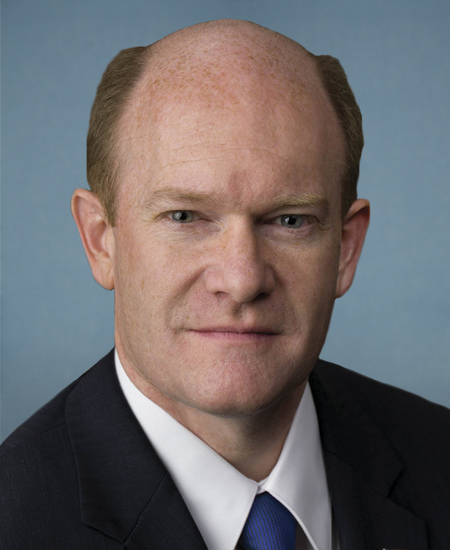
Sen. Christopher A. Coons
Sponsored bills
This resolution establishes the McCain-Mansfield Fellowship Program for wounded or disabled veterans. Under the program, qualifying individuals may serve a 24-month fellowship in the office of a Senator. The Senate Committee on Rules and Administration must issue regulations for program administration, including eligibility criteria.
This resolution supports the designation of Public Radio Music Day. It also expresses deep appreciation for the role of public radio music stations, particularly during the COVID-19 pandemic, in serving listeners, musicians, and hundreds of communities in the United States.
John R. Lewis Voting Rights Advancement Act of 2021 This bill establishes new criteria for determining which states and political subdivisions must obtain preclearance before changes to voting practices may take effect. Preclearance is the process of receiving preapproval from the Department of Justice (DOJ) or the U.S. District Court for the District of Columbia before making legal changes that would affect voting rights. The bill also includes provisions related to federally protected activities at polling places and voting access on tribal lands. A state and all of its political subdivisions shall be subject to preclearance of voting practice changes for a 10-year period if 15 or more voting rights violations occurred in the state during the previous 25 years; or 10 or more violations occurred during the previous 25 years, at least 1 of which was committed by the state itself. A political subdivision as a separate unit shall also be subject to preclearance for a 10-year period if three or more voting rights violations occurred there during the previous 25 years. States and political subdivisions that meet certain thresholds regarding minority groups must preclear covered practices before implementation, such as changes to methods of election and redistricting. Further, states and political subdivisions must notify the public of changes to voting practices. Next, the bill authorizes DOJ to require states or political subdivisions to provide certain documents or answers to questions for enforcing voting rights. The bill also outlines factors courts must consider when hearing challenges to voting practices, such as the history of official voting discrimination in the state or political subdivision. In addition, the bill (1) includes certain protections for election workers, polling places, and election infrastructure; and (2) expands voting access on tribal lands.
Research Advancing to Market Production for Innovators Act This bill provides commercialization services for federally funded small business research and development under the Small Business Innovation Research (SBIR) and Small Business Technology Transfer (STTR) programs. Specifically, the bill (1) expedites the application and award process for SBIR proposals and STTR solicitations, (2) requires determinations of commercialization potential for projects undertaken through SBIR and STTR awards, (3) provides continued flexibility of technical and business assistance for SBIR and STTR awardees, (4) instructs participating federal agencies to designate a technology commercialization official to help awardees commercialize, and (5) requires the Small Business Administration and the U.S. Patent Office to reach an interagency agreement to help SBIR and STTR awardees with intellectual property protection.
Hydrogen for Ports Act of 2021 This bill supports infrastructure for hydrogen-derived fuels, including ammonia, at ports and in the shipping industry. For example, the bill directs the Department of Energy to establish a program that awards grants to states, local governments, Indian tribes, and other eligible entities for infrastructure that supports hydrogen-derived fuels, including ammonia, at ports and in the shipping industry.
Hydrogen Infrastructure Finance and Innovation Act This bill requires the Department of Energy (DOE) to establish a hydrogen infrastructure finance and innovation pilot program. Under the program, DOE must provide grants and low-interest loans to certain entities for hydrogen infrastructure, including projects for hydrogen transportation, storage, or delivery.
Electronic Service for Effectiveness, Reduction of Violence, and Improved Court Efficiency Act of 2021 or the E-SERVICE Act This bill requires the Department of Justice to award demonstration grants to certain state or tribal courts to implement a program for properly and legally serving protection orders electronically. Courts that receive these grants must be part of a multidisciplinary partnership of government entities and various domestic violence stakeholders.
Fair Day in Court for Kids Act of 2021 This bill provides legal protections for a noncitizen (i.e., an individual referred to as an alien in federal law) who is detained or subject to immigration-related proceedings. The Department of Justice (DOJ), or the Department of Health and Human Services (HHS) in a case involving an unaccompanied child, may appoint or provide counsel at the government's expense to noncitizens in removal proceedings and related appeals. An unaccompanied child must be represented by counsel paid for and appointed by the government at every stage of such proceedings unless the child has obtained counsel at their own expense. If HHS fails to provide counsel to an unaccompanied child, the deadline for filing a motion to reopen a proceeding shall not apply, and the filing of such a motion shall stay the child's removal from the United States. The Department of Homeland Security (DHS) must provide a complete copy of a noncitizen's immigration file to the noncitizen (or the noncitizen's counsel) within seven days of a notice to appear for an immigration proceeding, and failure to provide the file shall result in a delay in the proceeding. DHS must provide access to counsel for all detained noncitizens. The bill authorizes HHS to enter into contacts or award grants for providing immigration-related legal services to children. The Office of Refugee Resettlement must develop model guidelines for representing noncitizen children in immigration proceedings.
Department of State, Foreign Operations, and Related Programs Appropriations Act, 2022 This bill provides FY2022 appropriations for the Department of State, foreign operations, and related programs. The bill provides appropriations to the State Department for Administration of Foreign Affairs, International Organizations, and International Commissions. The bill provides appropriations for related agencies and programs, including the U.S. Agency for Global Media, the Asia Foundation, the U.S. Institute of Peace, the Center for Middle Eastern-Western Dialogue Trust Fund, the Eisenhower Exchange Fellowship Program, the Israeli Arab Scholarship Program, the East-West Center, and the National Endowment for Democracy. The bill provides appropriations for other commissions, including the Commission for the Preservation of America's Heritage Abroad, the U.S. Commission on International Religious Freedom, the Commission on Security and Cooperation in Europe, the Congressional-Executive Commission on the People's Republic of China, and the U.S.-China Economic and Security Review Commission. The bill provides appropriations to the U.S. Agency for International Development (USAID), the State Department and the President for International Security Assistance, and the President and International Financial Institutions for Multilateral Assistance. The bill provides appropriations for bilateral economic assistance to the President; the State Department; Independent Agencies, including the Peace Corps, the Millennium Challenge Corporation, the Inter-American Foundation, and the U.S. African Development Foundation; and the Department of the Treasury. The bill provides appropriations for export and investment assistance to the Export-Import Bank of the United States, the U.S. International Development Finance Corporation, and the U.S. Trade and Development Agency. The bill sets forth requirements and restrictions for using funds provided by this and other appropriations acts.