

Veterans' Prostate Cancer Treatment and Research Act This bill requires the Department of Veterans Affairs (VA) to establish in its National Surgery Office an interdisciplinary clinical pathway for all stages of prostate cancer. Clinical pathways are health care management tools designed around research and evidence-based practices that provide direction for the care and treatment of a specific condition. The clinical pathway must include specified elements, such as a diagnosis pathway and a treatment pathway. The VA must consult with and incorporate feedback from (1) veterans who have received prostate cancer care at its medical facilities, and (2) experts in multidisciplinary cancer care and clinical research. Additionally, the VA must publish the clinical pathway on a public VA website and annually update the pathway as needed based on medical literature and evidence-based guidelines. The bill also requires the VA to submit a plan to establish a prostate cancer program using the comprehensive prostate cancer clinical pathway.
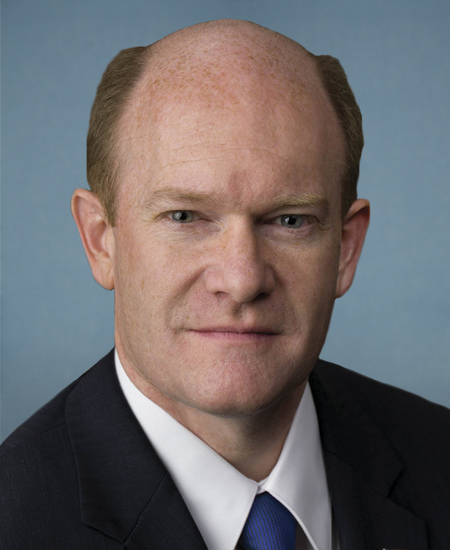
Sen. Christopher A. Coons
Sponsored bills
Department of Veterans Affairs Post-Traumatic Stress Disorder Processing Claims Improvement Act of 2021 This bill requires the Veterans Benefits Administration (VBA) within the Department of Veterans Affairs (VA) to update an ongoing national training program for claims processors who review compensation claims for service-connected post-traumatic stress disorder (PTSD). Such claims processors will be required to participate in the training at least once a year starting in their second year of being a VA claims processor. The training program must be standardized at regional offices of the VBA and include instruction on stressor development and verification. The VBA must establish a formal process to annually analyze training needs based on identified processing error trends. Additionally, the VBA must establish a formal process to conduct annual studies to help guide the national training program for claims processors. Finally, the VBA must evaluate the guidance relating to PTSD to determine if updates are warranted to provide claims processors with better resources regarding best practices for claims processing, including specific guidance regarding development of claims involving compensation for service-connected PTSD.
Student Veterans Transparency and Protection Act of 2021 This bill addresses the maintenance of the GI Bill Comparison Tool and administration of Department of Veterans Affairs (VA) educational assistance. The VA must maintain the tool and ensure its historical data remains easily and prominently accessible on the VA's benefits website for at least seven years from the initial publication. The VA must retain, maintain, and publish feedback from students and state approving agencies regarding the quality of instruction, recruiting practices, and post-graduation employment placement of approved institutions of higher learning for the duration that the institution is approved for VA benefit purposes. The bill provides institutions of higher learning with up to 30 days to review and respond to any feedback and address issues before the feedback is published. The bill requires that the GI Bill Comparison Tool include updated information, including descriptions of each federal student aid program and the amount of educational assistance an individual may be eligible to receive under the program. The VA must train personnel that provide education benefits counseling, vocational or transition assistance, or similar functions to properly use the comparison tool and provide appropriate education counseling services. The VA must restore entitlement to educational assistance in situations where there is a civil enforcement action or VA action against an educational institution, and an individual was unable to complete the course or program of education due to such action. Individuals may be charged against their entitlement at their request.
Reconnecting Communities Act This bill establishes a grant program to remove, retrofit, or otherwise address infrastructural barriers (e.g., highways, railways, or viaducts) that impede mobility and connectivity, with a particular focus on communities of color and low-income communities. Under this program, the Department of Transportation (DOT) must award three types of grants: community engagement, education, and capacity-building grants to educate and involve community members in transportation and economic development planning; planning and feasibility study grants to develop designs, conduct environmental reviews, and carry out other preliminary activities required to remove, retrofit, or mitigate an infrastructural barrier; and capital construction grants to remove, retrofit, or mitigate an infrastructure barrier. DOT must award the community engagement, education, and capacity-building grants and the planning and feasibility study grants to state, tribal, and local governments; metropolitan planning organizations; and nonprofits. An eligible entity may apply for and receive funding from more than one type of grant. DOT must award the capital construction grants to the owner of an infrastructure barrier. The owner may, if applicable, partner with other eligible entities.
This resolution expresses support for the goals and ideals of American Diabetes Month and decreasing the prevalence of diabetes in the United States through increased research, treatment, and prevention.
This resolution expresses support for the goals and ideals of Sickle Cell Disease Awareness Month. Sickle cell disease is an inherited blood disorder than can lead to pain, anemia, infections, and stroke.
Kenneth P. Thompson Begin Again Act This bill expands eligibility for the expungement of records related to a first-time drug possession offense. Current law permits expungement for offenders who commit the offense before age 21. This bill permits expungement for offenders who commit the offense at any age.
Protecting Medicare and American Farmers from Sequester Cuts Act This bill makes several budgetary, technical, and procedural changes, particularly in relation to Medicare and increasing the debt limit. Specifically, the bill continues to exempt Medicare from sequestration until March 31, 2022. (Sequestration is a process of automatic, usually across-the-board spending reductions under which budgetary resources are permanently cancelled to enforce specific budget policy goals.) The bill also establishes expedited Senate procedures for considering legislation to increase the debt limit. The procedures limit debate, waive points of order, and prohibit amendments. The procedures may only be used once and expire after January 16, 2022. Additionally, the bill (1) temporarily extends other provisions under Medicare, including a payment increase under the physician fee schedule; and (2) requires any debits recorded for FY2022 on the statutory pay-as-you-go (PAYGO) scorecards to be deducted from the scorecards for 2022 and added to the scorecards for 2023.
This resolution expresses support for the people of South Sudan in their efforts to establish an independent, stable, democratic, and prosperous country.
Elementary and Secondary School Counseling Act This bill directs the Department of Education to award formula grants to state educational agencies and, through them, subgrants to local educational agencies to increase access to school-based, mental-health-services providers at high-need public elementary and secondary schools.