

Ethiopia Peace and Stabilization Act of 2022 This bill addresses U.S. efforts to support a peaceful, democratic Ethiopia and bring an end to the country's civil conflict. The President may provide support for efforts (1) by the African Union or other credible entities to bring about a peaceful resolution to the conflict across Ethiopia; (2) to engage in peace building, mediation, and community reconciliation; and (3) to pursue accountability for war crimes and crimes against humanity in Ethiopia. The Department of State must develop and implement strategies to support democracy, rule of law, and human rights in Ethiopia. The State Department must also ensure the implementation of a strategy, to be developed by the U.S. Agency for International Development, to support conflict mitigation and management, reconciliation, and trauma healing for Ethiopians affected by the conflict. The President must impose property- and visa-blocking sanctions on foreign individuals and entities that have engaged in certain actions related to the conflict in Ethiopia, such as taking significant actions to undermine efforts to end the conflict or deriving significant benefit from efforts to impede the transition to democracy. The bill also (1) prohibits the U.S. International Development Finance Corporation from providing support for economic development projects in Ethiopia, (2) suspends any U.S. security assistance to the government of Ethiopia, and (3) requires U.S. representatives at international financial institutions to oppose any loan or extension of assistance to the governments of Ethiopia and Eritrea. These restrictions shall continue until there is a resolution of the civil conflict.
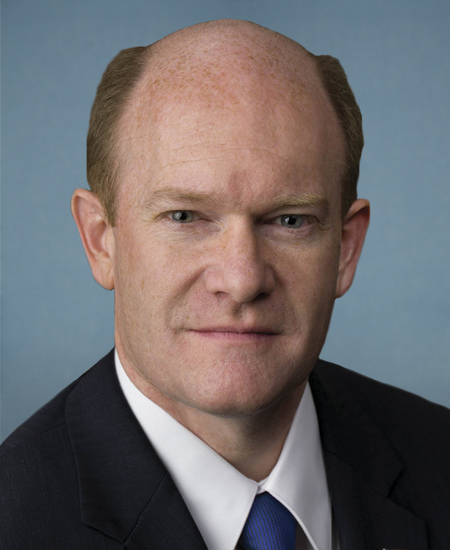
Sen. Christopher A. Coons
Sponsored bills
United States-Ecuador Partnership Act of 2022 This bill requires and authorizes actions to strengthen the U.S.-Ecuador relationship. The President may transfer two excess Coast Guard vessels to Ecuador if there is sufficient capacity to maintain the vessels. The Department of State must develop and implement a strategy to strengthen commercial and economic ties between the United States and Ecuador, including by (1) promoting cooperation and information sharing to increase trade and investment opportunities, and (2) supporting efforts by Ecuador's government to promote a more open and competitive business environment. The State Department must also develop and implement a strategy to increase the capacity of Ecuador's justice system and law enforcement to combat crime, corruption, and the harmful influence of malign foreign and domestic actors. The U.S. Agency for International Development (USAID) must develop and implement a strategy to support inclusive economic development across Ecuador's national territory, including by facilitating increased access to financing and investment for small- and medium-sized businesses. USAID must also, by working through appropriate nonprofit organizations, develop and implement programs to provide training and technical assistance to strengthen the National Assembly of Ecuador. USAID must also develop and implement programs to improve ecosystem conservation and enhance the effective stewardship of Ecuador's natural resources. The State Department and USAID must periodically report to Congress on the implementation of these strategies and programs.
Maddy summarySRES 565 is a ceremonial Senate resolution honoring the late Representative Don Young (R-AK), who served 49 years in the U.S. House of Representatives - the longest tenure of any Alaska representative and the 45th Dean of the House. The resolution commemorates his life, service, and legacy, including his work on landmark legislation like the Trans-Alaska Pipeline authorization and the Alaska Native Claims Settlement Act. It contains no policy changes or new laws; instead, it directs the Senate to mourn his passing, honor his bipartisan service, and transmit a copy to his family. This is a purely symbolic resolution with no direct impact on constituents or legislation.
Victims of Child Abuse Act Reauthorization Act of 2022 This bill reauthorizes for FY2022-FY2028 and otherwise revises grants for local and regional children's advocacy centers (CACs). CACs coordinate a multidisciplinary response to child abuse.
Support Kids Not Red Tape Act of 2022 This bill extends and modifies the authority of the Department of Agriculture (USDA) to waive certain requirements related to the National School Lunch Program, the School Breakfast Program, the Child and Adult Care Food Program, and the Summer Food Service Program. Current law authorizes USDA to waive certain requirements, such as those related to nutritional content and congregate feeding, for the purpose of dealing with the COVID-19 pandemic. Under this bill, USDA shall have authority through FY2023 to grant such a waiver, with no waiver having effect past FY2023. Currently, USDA's authority to grant a waiver expires on June 30, 2022, with no waiver having effect past the 2021-2022 school year. If a state elects to receive a waiver that modifies the operation of a school breakfast or lunch program for the 2022-2023 school year, the state must provide a transition plan to USDA. USDA must provide technical assistance to help school food authorities and states meet nutritional standards and resume regular meal program operations for the 2023-2024 school year. While a waiver is in effect during the 2022-2023 school year, the state subject to the waiver must provide technical assistance in lieu of fiscal action for meal pattern violations due to supply chain disruptions. The bill also appropriates funds as necessary to carry out this bill's activities.
This resolution congratulates the people of Greece as they celebrate the 201st anniversary of Greece's independence. The resolution also expresses support for the principles of democratic governance to which the people of the United States and Greece are committed.
Continuing Emergency Support for Restaurants Act This bill provides an additional $48 billion in FY2021 for the Restaurant Revitalization Fund and designates specified amounts for fund administrative expenses and audits of grants made from the fund. The fund was established in response to COVID-19 to make grants to eligible food and beverage purveyors for covering specified costs such as payroll, operational expenses, and paid sick leave. The bill designates the funding as emergency spending, which is exempt from discretionary spending limits.
Baltic Defense and Deterrence Act This bill requires the Department of State to establish and implement an initiative to increase security and economic ties with the Baltic countries (i.e., Estonia, Latvia, and Lithuania). The bill also requires the Department of Defense to establish and implement an initiative to deepen security cooperation with the Baltic countries.
READ Act Reathorization [ sic ] Act of 2022 This bill reauthorizes a law that requires the implementation of a strategy to promote quality basic education in partner countries by (1) expanding access to basic education for all children, particularly marginalized children and vulnerable groups; and (2) improving the quality of basic education and learning outcomes.
Military Spouse Hiring Act This bill expands the Work Opportunity Tax Credit (WOTC) to include the hiring of a qualified military spouse. (The WOTC permits employers who hire individuals who are members of a targeted group such as qualified veterans, ex-felons, or long-term unemployment recipients to claim a tax credit equal to a portion of the wages paid to those individuals.) A qualified military spouse is any individual who is certified by the designated local agency as being (as of the hiring date) a spouse of a member of the Armed Forces.