Enhanced Election Security and Protection Act This bill makes various changes related to federal elections. Among other elements, the bill (1) reauthorizes through FY2027 the Election Assistance Commission, (2) increases penalties related to crimes against federally protected voting activities, and (3) requires the U.S. Postal Service to take certain actions related to federal election mail.
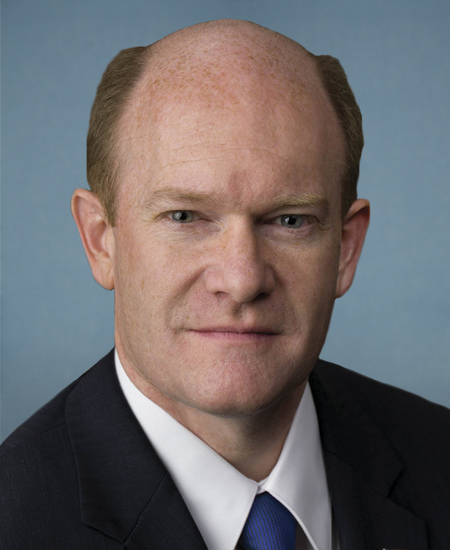
Sen. Christopher A. Coons
Sponsored bills
ISA Student Protection Act of 2022 This bill sets forth consumer protections and other requirements for educational income share agreements (ISAs). In an educational ISA, a provider credits or advances funding for a recipient's postsecondary education or other training; in turn, the recipient agrees to pay the provider a percentage of the recipient's future earnings over a set period of time. (The Department of Education currently considers educational ISAs as private education loans for the purposes of preferred lender arrangement disclosures.) Under the bill, the recipient is only obligated to pay back the provider if the recipient earns over a certain amount. The recipient's obligation to pay ends at the specified time even if the recipient does not pay back the full amount of the funding. Further, payments are limited to 20% of the recipient's income. Recipients earning under a certain threshold are exempt from payments. If a recipient files for bankruptcy, ISAs are not subject to the same undue hardship standard typical of student loan discharges, therefore making these agreements easier to discharge. The bill also applies current consumer loan protections to these agreements. A provider must make certain disclosures to the recipient before entering into an ISA, including how payments are calculated, the length of the agreement, and how these agreements compare to student loan options. The bill establishes the tax treatment of ISAs, including by exempting from taxable income the amounts received under an ISA.
Homicide Victims' Families' Rights Act of 2022 This bill establishes a framework for immediate family members of a victim of murder under federal law to request a review of the victim's case file if the murder was committed more than three years prior, the murder was investigated by a federal law enforcement entity, all probative investigative leads have been exhausted, and no likely perpetrator has been identified.
Respect for Marriage Act This bill provides statutory authority for same-sex and interracial marriages. Specifically, the bill repeals and replaces provisions that define, for purposes of federal law, marriage as between a man and a woman and spouse as a person of the opposite sex with provisions that recognize any marriage that is valid under state law. (The Supreme Court held that the current provisions were unconstitutional in United States v. Windsor in 2013.) The bill also repeals and replaces provisions that do not require states to recognize same-sex marriages from other states with provisions that prohibit the denial of full faith and credit or any right or claim relating to out-of-state marriages on the basis of sex, gender, race, ethnicity, or national origin. (The Supreme Court held that state laws barring same-sex marriages were unconstitutional in Obergefell v. Hodges in 2015; the Court held that state laws barring interracial marriages were unconstitutional in Loving v. Virginia in 1967.) The bill allows the Department of Justice to bring a civil action and establishes a private right of action for violations.
Democracy Is Strengthened by Casting Light On Spending in Elections Act of 2021 or the DISCLOSE Act of 2021 This bill addresses campaign finance, including by expanding the prohibition on campaign spending by foreign nationals, requiring additional disclosures of campaign expenditures, and requiring additional disclosures regarding certain political advertisements. First, the bill prohibits foreign nationals from participating in the decision-making process regarding an election expenditure. Additionally, the bill expands existing foreign money prohibitions to include disbursements for paid web-based or digital communications and federal judicial nomination communications. It also prohibits foreign nationals from contributing to campaigns related to ballot initiatives and referenda. The Federal Election Commission (FEC) must conduct an audit after each federal election cycle to determine the incidence of illicit foreign money. Next, the bill makes it unlawful to establish or use a corporation, company, or other entity with the intent to conceal an election contribution or donation by a foreign national. A violator is subject to criminal penalties—a fine, a prison term of up to five years, or both. Covered organizations (e.g., corporations, labor organizations, and political organizations) must, within 24 hours, file reports with the FEC to disclose campaign expenditures of more than $10,000 during an election cycle. Finally, the bill requires organizations to provide additional disclosures regarding political advertisements, including the donors who contributed the most money to that organization in the last year.
Building Civic Bridges Act This bill establishes the Office of Civic Bridgebuilding within the Corporation for National and Community Service to administer a grant program that addresses local issues and fosters social cohesion across diverse communities.
This resolution expresses that the Senate continues to refuse to recognize Alyaksandr Lukashenka as the legitimately elected leader of Belarus; condemns the ongoing harassment and persecution of opposition leaders, civil society activists, human rights defenders, and independent media carried out by the Lukashenka regime; urges the immediate release, without preconditions, of all political prisoners in Belarus; calls for new presidential and parliamentary elections to be held in Belarus and conducted in a manner that meets international standards and includes independent election monitoring; and encourages President Biden to swiftly appoint a new Special Envoy for Belarus to support the pro-democracy movement in Belarus.
This resolution recognizes the critical role the Equal Employment Opportunity Commission plays in addressing long-standing issues including the wage gap, combating workplace harassment, and ensuring all workers are treated with dignity and respect in the workplace.
Countering Economic Coercion Act of 2022 This bill authorizes the President to take certain actions to assist foreign trading partners affected by economic coercion. Economic coercion refers to actions or threats undertaken by a foreign adversary to restrain, obstruct, or manipulate trade, foreign aid, investment, or commerce with the intent to cause economic harm or influence sovereign political actions. Specifically, the bill authorizes the President (upon a determination that a foreign trading partner is subject to economic coercion) to exercise specified authorities to support or assist the foreign trading partner. These authorities include, among others, decreasing duties or modifying tariff-rate quotas on imports from the foreign trading partner, requesting appropriations for foreign aid, and expediting export licensing decisions and regulatory processes. The President must consult with Congress prior to exercising any authority. Additionally, the President must publish notice in the Federal Register related to the exercise of such authority. Any determination of economic coercion must be revoked at the earliest of (1) two years from the date of determination, (2) upon a joint resolution of Congress, or (3) when the President revokes the determination. The bill also directs the President to endeavor to coordinate with other foreign trading partners to broaden economic support for the foreign trading partner.
Freedom to Travel for Health Care Act of 2022 This bill prohibits anyone from interfering with a person's ability to access out-of-state reproductive health care. (Reproductive health care is defined as medical, surgical, counseling, or referral services related to pregnancy, the termination of a pregnancy, contraception services, and other reproductive care.) Specifically, the bill prohibits anyone from restricting, discriminating against, or otherwise disadvantaging anyone who receives, provides, or assists with out-of-state reproductive health care that is legal in the state in which it is provided. The bill allows the Department of Justice to bring a civil action and establishes a private right of action for violations. The bill specifically waives any applicable governmental immunity and preempts any contravening state laws.