Maddy summarySenate Joint Resolution 45 seeks to block an Environmental Protection Agency (EPA) rule that would have allowed California to enforce its Advanced Clean Cars II vehicle emission standards. The resolution uses the congressional disapproval process under federal law to declare the EPA rule invalid, preventing California from implementing its stricter pollution controls for cars and trucks. If passed, this resolution would stop the rule from taking effect, meaning California could not override federal vehicle emission standards with its own requirements. The bill directly affects California's ability to set state-level environmental regulations for motor vehicles and the EPA's regulatory authority.
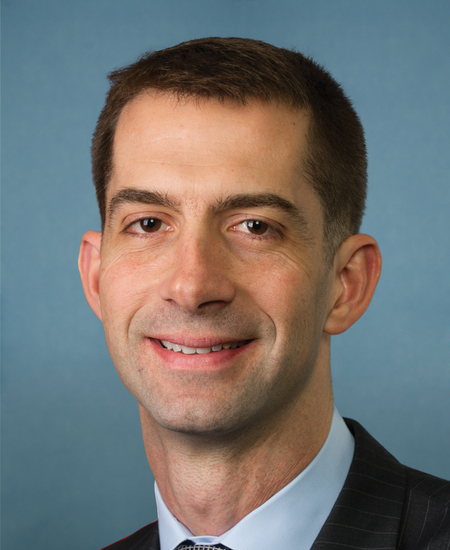
Sen. Tom Cotton
Sponsored bills
Maddy summarySJRES 46 is a joint resolution seeking congressional disapproval of an Environmental Protection Agency (EPA) rule concerning California's vehicle emission standards. The rule, submitted in 2023, relates to California's pollution control requirements for motor vehicles, including advanced clean trucks, zero-emission airport shuttles, and heavy-duty engine emissions. This resolution would block the rule from taking effect using a specific federal disapproval process under Title 5 of the U.S. Code. If passed, the rule would have no legal force, meaning California's current standards would remain without the EPA's formal approval for these specific provisions.
Maddy summaryThis bill amends federal law to clarify that certain less-than-lethal projectile devices are exempt from firearm restrictions under Title 18. It defines these devices as those not firing standard ammunition, operating below 500 ft/s velocity, unlikely to cause serious injury, and incompatible with common firearm magazines. The law directly affects manufacturers and users of such devices by establishing a clear legal standard for their classification. It also requires the Attorney General to review device requests within 90 days to confirm compliance with the new definition.
Defending Education Transparency and Ending Rogue Regimes Engaging in Nefarious Transactions Act or the DETERRENT Act This bill expands oversight and disclosure requirements related to foreign sources and institutions of higher education (IHEs). Specifically, the bill requires an IHE to annually disclose to the Department of Education (ED) any year in which the IHE receives a gift from a foreign country of concern (e.g., China or Russia) or foreign entity of concern of any dollar amount; receives a gift or contract from a foreign source (other than a foreign country of concern or foreign entity of concern) that is valued at $50,000 or more, considered alone or in combination with all other gifts or contracts within a calendar year (current disclosure threshold is $250,000 or more), or which has an undetermined monetary value; enters into a contract with a foreign country of concern or foreign entity of concern after receiving a waiver for such contract; or is substantially controlled by a foreign source. Additionally, the bill prohibits IHEs from entering into contracts with a foreign country of concern or with a foreign entity of concern without obtaining a waiver, and requires certain IHEs to disclose gifts or contracts between covered individuals (e.g., researchers) and foreign sources. The bill requires ED to investigate possible violations of this bill and outlines the various penalties for each violation. Penalties may include losing eligibility for federal student financial aid.
Maddy summaryThis bill requires all new passenger vehicles sold in the U.S. (including domestically manufactured, imported, or shipped vehicles) to include AM radio as standard equipment, meaning it must be built into the vehicle at no extra cost to buyers. It mandates that manufacturers install AM radio receivers that can access both traditional and digital AM broadcast stations, with compliance deadlines set 2-4 years after the rule is issued. During a transition period before the rule takes effect, manufacturers must clearly label vehicles without AM radio but cannot charge extra for AM access. The bill also prohibits states from creating their own requirements about AM radio access in vehicles, aiming to ensure consistent emergency alert capabilities through AM radio in cars.
Maddy summaryThis bill expands an existing federal rule allowing aquaculture facilities to manage double-crested cormorants that damage fish stocks. It requires the Secretary of the Interior to reissue the 2016 depredation order within one year, applying it to aquaculture facilities in 12 additional states (California, Colorado, Connecticut, Illinois, Indiana, Iowa, Michigan, Missouri, New Jersey, Ohio, Pennsylvania, Wisconsin) and to licensed lake and pond managers. The key change adds these new states and facility types to the existing rule without altering the original management procedures. This directly affects private aquaculture operations and water managers in those states who currently face cormorant-related fish losses.
Maddy summaryThe Stephen Hacala Poppy Seed Safety Act requires the Secretary of Health and Human Services to establish, within two years of enactment, specific contamination limits for morphine, codeine, and other opiates in poppy seeds. Poppy seeds exceeding these limits would be banned from interstate commerce as adulterated food under federal law. The bill also clarifies that contaminated poppy seeds above these thresholds remain subject to the Controlled Substances Act. This directly affects poppy seed producers, food manufacturers, and retailers by setting new safety standards for poppy seed products.
Maddy summaryThe CONNECT for Health Act of 2025 expands Medicare coverage for telehealth services by removing geographic restrictions that previously limited where patients could receive telehealth care. It allows more healthcare providers to offer telehealth services, including expanding eligibility for practitioners and removing the six-month in-person visit requirement for telemental health. The bill also includes specific provisions for Federally Qualified Health Centers, rural health clinics, and Native American health facilities to better integrate telehealth into their services. Additionally, it establishes program integrity measures to address billing patterns and requires the posting of telehealth service data to improve transparency and quality measurement. These changes aim to make telehealth more accessible for Medicare beneficiaries, particularly in rural areas and for underserved populations.
Maddy summaryS 1224, the RIFLE Act, eliminates the federal tax on firearm transfers by repealing Section 5811 of the Internal Revenue Code. This directly affects firearm sellers and buyers, removing a tax they previously paid on transactions. The bill includes technical adjustments to other tax code sections to reflect the repeal and clarifies that firearms regulated under the National Firearms Act remain outside the jurisdiction of the Consumer Product Safety Commission. The changes take effect after the bill is enacted.
Maddy summaryThe Sanctioning Russia Act of 2025 establishes a framework for imposing comprehensive sanctions on Russia if the President determines Russia is engaging in actions that undermine peace with Ukraine, such as refusing to negotiate a peace agreement, violating peace agreements, or planning another military invasion. If such a determination is made, the bill mandates blocking property of Russian officials and entities, prohibiting transactions with Russian financial institutions, increasing tariffs on Russian goods to at least 500% ad valorem, banning energy exports to Russia, and prohibiting purchases of Russian sovereign debt. It also imposes sanctions on countries that purchase Russian oil, uranium, or petroleum products, with duties of at least 500% on such goods. The bill requires the President to make determinations every 90 days and allows for termination of sanctions if Russia ceases harmful actions and enters a peace agreement with Ukraine, with immediate reimposition if Russia resumes those actions.