

Continuing Robust and Uninhibited Drilling and Exporting Act or the CRUDE Act This bill limits the President's authority to restrict the export of crude oil from the United States. Currently, the President may restrict the export of oil for up to a year if the President declares a national emergency; the restrictions apply to countries, persons, or organizations for reasons of national security; or the Department of Commerce finds and reports to the President that the export of crude oil has caused sustained material oil supply shortages or sustained oil prices significantly above world market levels and those shortages or price increases have caused or are likely to cause sustained material adverse employment effects. However, this bill only allows the President to make such restrictions if the restrictions apply to countries, persons, or organizations for reasons of national security; or the Department of Defense, the Department of Energy, and Commerce jointly make those findings and report them to the President and Congress.
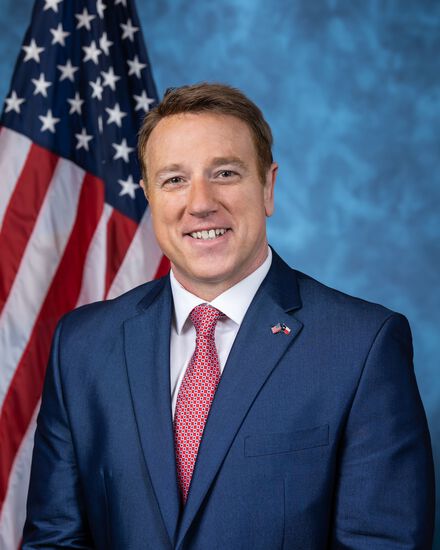
Rep. Pat Fallon
Sponsored bills
Securing American Families from Exploitation at the Border Act or the SAFE Border Act This bill directs the Federal Emergency Management Agency (FEMA) to establish a temporary grant program to reimburse landowners for loss or damage to property caused by an individual illegally crossing the southern border or to improve the security of such property. Specifically, FEMA may provide grants to landowners who have experienced (or are at risk of experiencing) property theft or damage in areas within 10 miles of the U.S.-Mexico border.
This bill requires the Food and Drug Administration (FDA) to make publicly available all records of information submitted to the FDA in conjunction with the emergency use authorization or licensing of a COVID-19 vaccine.
Crucial Communism Teaching Act This bill directs the Victims of Communism Memorial Foundation to develop a civic education curriculum and oral history resources for high school students to promote understanding of certain political ideologies (e.g., communism and totalitarianism) that conflict with principles of U.S. democracy.
Conscience Protection Act of 2021 This bill provides statutory authority for certain protections for health care providers that refuse to participate in abortions based on religious beliefs or other convictions. Health care providers include individual professionals, medical facilities, health insurance organizations, and social services providers that refer clients to health care services. The federal government and entities that receive federal funding for health-related activities, including state and local governments, may not discriminate against a health care provider that refuses to be involved in, or provide coverage for, abortions. Currently, similar requirements apply to various related activities, including certain employment or personnel decisions (the Church Amendments), abortion services training (the Coats-Snowe Amendment), qualified health plans offered through health insurance exchanges, and annual appropriations bills for the Department of Health and Human Services (HHS) and other federal agencies (the Weldon Amendment). The HHS Office for Civil Rights must investigate complaints of this kind of discrimination. Furthermore, HHS may terminate or reduce HHS funding for health-related activities if a person or entity fails to comply with nondiscrimination requirements. Additionally, the Department of Justice or any entity adversely affected by such discrimination may bring a civil action to obtain appropriate relief. A plaintiff does not need to seek or exhaust administrative remedies before bringing the action. A plaintiff may also bring an action, including one for money damages, against a governmental entity. In many cases, principles of sovereign immunity shield states and some localities from these kinds of actions.
Parents Bill of Rights Act This bill outlines various rights of parents and guardians regarding the elementary or secondary school education of their children. Among other requirements, the bill (1) directs local educational agencies to publicly post the curriculum for each elementary and secondary school grade level; and (2) requires schools to notify parents and guardians of their rights, including the right to review the school's curriculum and budget.
Parental Rights Protection Act This bill restricts government entities from requiring that individuals age 18 or younger receive certain COVID-19 vaccines that were authorized through emergency use and related procedures. Specifically, a federal, state, tribal, territorial, or local government entity (including a local educational agency) that receives funding from either the Department of Education or the Department of Health and Human Services may not require such COVID-19 vaccinations for individuals age 18 or younger. In particular, a local educational agency that mandates COVID-19 vaccinations for students loses its eligibility for federal education funding. The bill also requires the prior, informed, written consent of a parent or guardian before administration of such COVID-19 vaccines to an individual age 18 or younger.
This resolution modifies requirements for written statements required of nongovernmental witnesses who appear before standing committees of the House of Representatives. Specifically, the resolution eliminates a requirement that a witness disclose whether they are a fiduciary of an organization or entity that has an interest in the subject matter of the hearing, in favor of a requirement that they disclose whether they are a fiduciary of an entity that has received payments from a specified foreign entity. The resolution also requires nongovernmental witnesses to disclose in their written statement certain contracts with specified foreign persons or entities. If the committee determines that a witness knowingly and willfully failed to truthfully comply with such disclosure requirements, the witness is prohibited from testifying before the committee for three years.
Circumspectly Reducing Unintended Consequences Impairing Alliances and Leadership Act of 2021 or the CRUCIAL Act of 2021 This bill establishes requirements relating to the President's ability to impose sanctions on individuals or entities that engage in a significant transaction with the defense or intelligence sectors of Russia's government if the transaction involves a member of the Quadrilateral Security Dialogue. (The dialogue is a coalition comprised of the governments of the United States, Japan, India, and Australia.) Specifically, before imposing such sanctions for a transaction involving a member of the dialogue, the President must certify to Congress that the government in question is not participating in the dialogue on security matters that are critical to U.S. strategic interests.
Fairness for Federal Contractors Act of 2021 This bill prohibits executive agencies from requiring contractors to receive a COVID-19 vaccination. The bill also requires the Government Accountability Office to study the degree to which Executive Order 14042 (Ensuring Adequate COVID Safety Protocols for Federal Contractors) caused disruptions to federal contracts, supply chains, and transportation systems.