

Fairness for Farm Workers Act This bill extends overtime pay protections to agricultural workers. The bill requires employers, beginning in 2022, to compensate agricultural workers for hours worked in excess of their regular hours (i.e., 55 hours in 2022, 50 hours in 2023, 45 hours in 2024, and 40 hours in 2025) at not less than one and one-half times the employee's regular rate. For employers with 25 or fewer employees, the overtime pay requirements begin in 2025. These overtime pay requirements do not apply, as under current law, to employees who are the parent, spouse, child, or other member of the employer's immediate family. The bill also repeals the exemption from overtime pay requirements for employers in various agriculture-related industries, including certain small farms, irrigation projects, sugar processing, and cotton ginning and compressing.
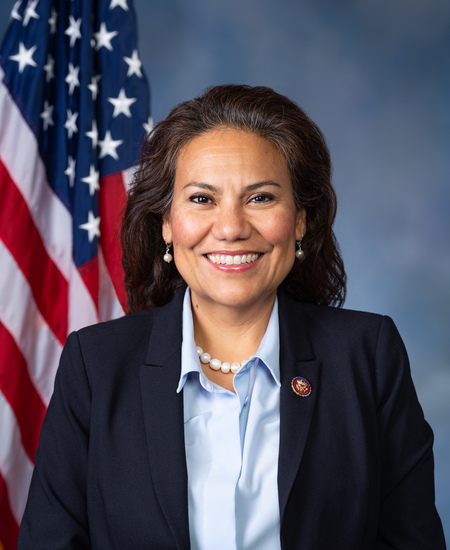
Rep. Veronica Escobar
Sponsored bills
I am Vanessa Guillén Act of 2021 This bill addresses the policies and procedures of the Department of Defense (DOD) for cases or allegations of sex-related offenses.
Health Equity and Access under the Law for Immigrant Women and Families Act of 2021 or the HEAL Immigrant Women and Families Act of 20 21 This bill extends Medicaid and Children's Health Insurance Program coverage to individuals lawfully present in the United States who otherwise meet eligibility requirements. Individuals granted federally authorized presence also are required to maintain minimum essential health insurance coverage and are eligible for health insurance exchanges, reduced cost sharing, premium subsidies, and premium tax credits.
Nurse Staffing Standards for Patient Safety and Quality Care Act of 2021 This bill requires hospitals to implement and submit to the Department of Health and Human Services (HHS) a staffing plan that complies with specified minimum nurse-to-patient ratios by unit. Hospitals must post a notice regarding nurse-to-patient ratios in each unit and maintain records of actual ratios for each shift in each unit. The bill also requires hospitals to follow certain procedures regarding how ratios are determined and other staff are prohibited from performing nurse functions unless specifically authorized within a state's scope of practice rules, among other requirements. HHS must adjust Medicare payments to hospitals to cover additional costs attributable to compliance with these ratios. Nurses may object to, or refuse to participate in, an assignment if it would violate minimum ratios or if they are not prepared by education or experience to fulfill the assignment without compromising the safety of a patient or jeopardizing their nurse's license. Hospitals may not (1) take adverse actions against a nurse based on the nurse's reasonable refusal to accept an assignment; or (2) discriminate against individuals for good faith complaints relating to the care, services, or conditions of the hospital or related facilities. HHS may impose civil monetary penalties on hospitals violating the ratio requirements and must publish the names of such hospitals. The bill provides stipends to the nurse workforce loan repayment and scholarship program and expands the nurse retention grant program to include nurse preceptorship and mentorship projects.
Ysleta del Sur Pueblo and Alabama-Coushatta Tribes of Texas Equal and Fair Opportunity Act This bill allows the Ysleta del Sur Pueblo and Alabama-Coushatta tribes to conduct gaming activities on their land in Texas if certain conditions are met. Currently, the Ysleta del Sur Pueblo and Alabama-Coushatta Indian Tribes of Texas Restoration Act prohibits the tribes from conducting gaming activities on their land if those activities are prohibited by Texas law. The bill instead prohibits the act from being construed to preclude or limit the applicability of the Indian Gaming Regulatory Act (IGRA). Therefore, the bill effectively makes IGRA the controlling federal statute governing gaming activities on the tribes' land.
Equity in Neuroscience and Alzheimer's Clinical Trials Act of 2021 or the ENACT Act of 2021 This bill sets out activities and requirements to increase the participation of underrepresented populations in research and clinical trials for Alzheimer's disease and related dementias. Specifically, the National Institute on Aging (NIA) must establish and provide technical assistance to Alzheimer's research centers located in areas with higher concentrations of minority groups. These centers must establish diagnostic and treatment clinics designed to serve minority, rural, and other underserved populations; operate clinical trials; and carry out public outreach to encourage members of minority populations to participate in clinical trials and research. Additionally, the NIA must disseminate information to members of minority populations about participating in clinical trials and take other actions to enhance diversity with respect to the Alzheimer's research that it conducts or supports. The bill also directs the NIA to increase diversity among Alzheimer's researchers by encouraging the participation of individuals who are from groups that are underrepresented in clinical, behavioral, and social sciences.
Green Transportation Act This bill incorporates greenhouse gas emission reduction in various transportation-related planning activities and programs. Specifically, states and metropolitan planning organizations must address greenhouse gas emission reductions and certain other issues (e.g., public health and climate change) in long-range and other planning related to highways and public transportation. The bill also makes reducing carbon dioxide and other greenhouse gas emissions from the transportation system a national goal of the Federal-aid Highway Program. The Department of Transportation (DOT) must establish applicable performance measures and standards related to that goal. Additionally, states and metropolitan planning organizations may use certain funding available through the National Highway Trust Fund to develop standardized models and methodologies to measure and monitor transportation-related greenhouse gas emissions. DOT must collect and organize such models and methodologies in a publicly available clearinghouse and report about them to Congress. Further, DOT must establish a program to fund projects that support the reduction of greenhouse gas emissions from the surface transportation system. As part of this program, DOT must annually evaluate carbon dioxide emissions on public roads and evaluate states' progress in reducing emissions.
Maximizing Outcomes for Moms through Medicaid Improvement and Enhancement of Services Act or the MOMMIES Act This bill establishes a series of programs and requirements under Medicaid and the Children's Health Insurance Program (CHIP) relating to maternal health. For example, the bill expands eligibility for coverage under Medicaid and CHIP from 60 days to one year after the last day of pregnancy and requires such coverage to include oral health services. The bill also establishes a demonstration program in which states receive grants to implement or expand models for maternity care homes that provide services to Medicaid or CHIP beneficiaries. The Government Accountability Office must report on (1) gaps in coverage under Medicaid and CHIP for pregnant and postpartum women, and (2) the use of telehealth by state Medicaid programs to increase access to maternity care.
This bill modifies the definition of water heater , otherwise revises energy conservation standards, and sets forth labeling requirements for water heaters.
This resolution supports the designation of Mental Health Awareness Month and declares mental health a national priority.