

American Food for American Schools Act of 20 21 This bill requires school food authorities (SFAs) to request a waiver from the Department of Agriculture (USDA) to purchase foreign commodities or products for the National School Lunch Program (NSLP). SFAs may purchase foreign commodities or products without a waiver if the commodities or products are not produced or available domestically. Under current law, Buy American provisions require SFAs to purchase, to the maximum extent practicable, domestic commodities or products for the NSLP. There are limited exceptions which permit the purchase of foreign products in circumstances when using domestic products is truly not practicable. If an SFA uses an exception, there is no requirement to request a waiver to purchase a foreign product or commodity, but the SFA must keep documentation justifying the exception. USDA may not provide a waiver for an SFA to purchase foreign commodities or products unless (1) the commodities or products are not produced domestically in sufficient amounts or of satisfactory quality, (2) the domestic commodities or products would be significantly higher in price than foreign commodities or products, and (3) the SFA agrees to make the waiver publicly available on its website and email a notification of the waiver to parents or guardians of students who will be served the foreign commodity or product purchased pursuant to the waiver.
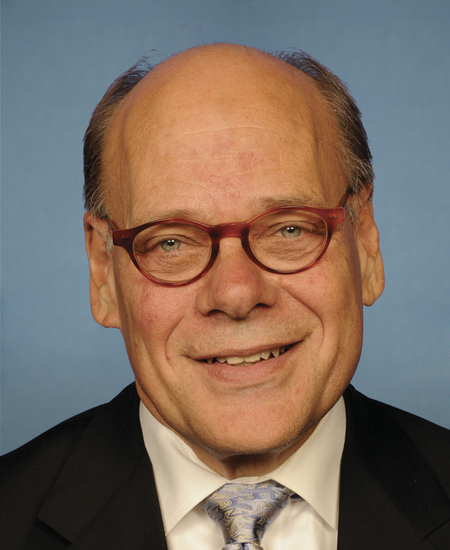
Rep. Steve Cohen
Sponsored bills
This resolution expresses support for sustained dialogue between the United States, Russia, and China to reduce the threats posed by nuclear weapons. The resolution calls on the President to extend the New START Treaty for five years and urges the current administration to consider continued participation in the Treaty on Open Skies.
Inaugural Fund Integrity Act This bill limits donations to inaugural committees and requires these committees to disclose donations and disbursements. Specifically, inaugural committees may not solicit, accept, or receive donations from corporations or foreign nationals. An individual may not make a donation in the name of another individual or authorize his or her name to be used to make such a donation. In addition, foreign nationals may not make donations or make promises to make donations to inaugural committees. Further, the bill caps the amount an individual may donate to an inaugural committee. Donations to inaugural committees may not be converted to personal use. Finally, inaugural committees must report certain information on donations and disbursements to the Federal Election Commission.
Access Technology Affordability Act of 2021 This bill allows a refundable tax credit equal to the amounts paid for qualified access technology for use by a blind individual who is the taxpayer, the taxpayer's spouse, or a dependent of the taxpayer. Qualified access technology is hardware, software, or other information technology with the primary function of converting or adapting information that is visually represented into forms or formats useable by blind individuals. The credit is limited to (1) costs that are not compensated by insurance or otherwise, and (2) an aggregate amount of $2,000 per blind individual in any period of three consecutive taxable years. The credit must be adjusted for inflation after 2021 and terminates after 2026.
Bicycle Commuter Act of 2021 This bill modifies provisions relating to the tax exclusion for employer-provided fringe benefits for bicycle commuting. Specifically, the bill (1) repeals the suspension (for the period between 2018 and the end of 2025) of the exclusion, (2) includes bikeshare (a bicycle rental operation providing for pick up and drop off) and low-speed electric bicycle within the definition of bicycle for purposes of the exclusion, and (3) modifies the limitation on the exclusion to provide for a specified monthly limitation amount (i.e., 30% of the parking fringe benefit amount).
COVID-19 Student Loan Relief Extension Act This bill extends certain temporary relief related to federal student loans and expands eligibility for such relief to additional types of loans. Specifically, the bill extends the current suspension of payments due on federal student loans to 30 days after the end of the COVID-19 (i.e., coronavirus disease 2019) public health emergency. It also extends the suspension of interest due on these loans until the economy shows specified initial signs of recovery. Further, the bill expands eligibility for temporary relief on federal student loans to include Federal Family Education Loans (FFELs) and Federal Perkins Loans that are not held by the Department of Education (ED) and certain health profession and nursing loans. (Currently, these temporary relief provisions are only applicable to certain Federal Direct Loans and FFELs that are held by ED.) Additionally, the bill makes this eligibility retroactive to March 13, 2020. Finally, ED and the Department of Health and Human Services must carry out a program, beginning on August 1, 2021, to provide at least six notices to borrowers that normal payment obligations will resume.
This resolution expresses the sense of the House of Representatives that the U.S. Postal Service should issue a commemorative stamp series honoring women veterans.
Presidential Tax Transparency Act This bill requires the President, the Vice President, and certain candidates for President and Vice President to disclose federal income tax returns for the ten most recent taxable years. The returns must be disclosed to the Federal Election Commission (FEC), which must make the returns publicly available after redacting information that is necessary for protecting against identity theft, such as Social Security numbers. If the tax returns are not disclosed to the FEC as required by this bill, the Internal Revenue Service must provide the returns to the FEC upon receiving a written request from the FEC.
Incentivizing Medicaid Expansion Act of 2021 This bill provides an enhanced federal matching rate to every state that expands Medicaid coverage for individuals who are newly eligible under the Patient Protection and Affordable Care Act, regardless of when such expansion takes place. Under current law, the enhanced Federal Medical Assistance Percentage (FMAP) is equivalent to 100% in 2014 through 2016, 95% in 2017, 94% in 2018, 93% in 2019, and 90% thereafter. The bill retains this enhanced FMAP, but bases it on a term of years rather than on specific dates. The bill applies retroactively.
This joint resolution prohibits the issuance of a manufacturing license, technical assistance license, or export license with respect to certain proposed agreements or transfers of specified defense articles or services to Saudi Arabia, the United Kingdom, Spain, or Italy.